


Cover Crops: Soil Health
EB0238
New 2022
By Clain Jones, Extension Soil Fertility Specialist and Professor1; Kathrin Olson-Rutz,Research Associate1; Perry Miller, Cropping System Professor1
Cathy Zabinski, Belowground Ecology Professor1, Susan Tallman, State Agronomist and Certified Crop Advisor2
1 Department of Land Resources and Environmental Sciences, Montana State University
2 USDA-NRCS
Overview
Cover crops are one tool to improve soil health and long-term agricultural sustainability,
especially when grown in place of fallow. Plant residue and living roots are critical
for healthy living soils. Microbial activity is largely dependent on the amount of
plant residue returned to the soil. In Montana studies, mixed-species cover crops
did not create more total biomass (over cover-wheat rotation), thus microbial activity,
than single-species pea cover. Cover residue high in N promotes bacterial activity
and over time reduces reliance on chemical N fertilizer, thus reducing the risk of
soil acidification and nitrate leaching. Specific cover species may provide specific
microbial benefits, promote arbuscular mycorrhizal fungi (AM-fungi) or promote disease-suppressing
bacteria. However, such
specialized benefits are hard to measure.
In semi-arid dryland cropping systems, covers can increase phosphorus (P) and N cycling,
improve water infiltration, soil aggregation, and decrease surface soil temperatures.
Cover crops tend to reduce subsequent small grain yields in Montana’s semi-arid environment
and possibly total organic matter input across rotations. Therefore, covers may not
be better than continuous cropping with a diversity of cash crop species to provide
plant residue which is a foundation of soil health (1). Terms used in this paper are
defined at the end of this document.
Soil Health
A healthy soil is a living system that supports plant growth which in turn supports
animals and people. It is teeming with bacteria, fungi and other microbes that provide
nutrients and physical support for plant growth and absorbs and holds water. Biologically
active soil looks, feels, and smells different from an unhealthy soil (Soil Health Shovel Test), but changes in soil health can be challenging to document.
The abundance of bacteria, fungi, enzymes (a by-product of organic material decomposition
by microbial life in the soil), and potentially mineralizable N (PMN; soil organic
N that can become plant available by microbial breakdown) are some biological properties
used to evaluate soil health. No single property can measure the impact of a change
in land management on soil health, but these biological properties may respond before
physical and chemical properties (such as available P and pH; 2,3, both SK).
Some soil properties (e.g., pH, SOM) are routinely provided on soil test results.
Biological indicators, such as enzyme activity, are harder to measure, their response
may be short-lived (4), and we may not know what a change means to soil health. Increased enzyme activity
could mean more microbial activity. It could also mean a certain nutrient is deficient
and microbes are excreting more enzyme to extract that nutrient from the SOM.
Individually each soil characteristic may not measurably improve with a change in
agronomic practices, yet in combination they indicate improved soil health. Soil health
tests, such as Haney and Cornell Comprehensive Assessment of Soil Health are available.
Their ‘scores’ relate to potential crop yields when looked at over several years on
a given field, but there can be little correlation between scores and yield when looked
at in a single year (5, 6).
The shovel test uses subjective rather than measurable indicators of soil health.
It is cheap and easy (Soil Health Shovel Test text box, or the USDA DRCS Montana Cropland Soil Health Assessment). Measuring the rate of cotton fabric decomposition is another rapid and easy farm
field test of microbial activity (7). See Evaluating Soil Quality and Health and USDA Soil Quality Indicator Sheets for more information on soil health tests.
|
Healthy Soil
|
|
|---|---|
|
Less-healthy soil
|
|
Cover Crops
Cover crops, also called covers or green manure, are crops grown between cash crops generally for soil conservation purposes. They are usually not intended for harvest, though sometimes annual covers provide feed. Covers are part of a regenerative approach to improve soil health. They increase plant diversity, keep the soil covered, and increase the time that living roots are in the soil. They can provide a variety of benefits to agronomic systems (see Potential Benefits of Cover Crops). Benefits achieved are dependent on many things including soil type, soil moisture, species planted, and when and how the cover is terminated. Whether or not a cover is successful depends on the goal; the goal will determine cover species selection and management. For example, decreasing N needs might result in a different selection than increasing infiltration or soil organic matter. It is unreasonable to expect a cover to provide all the potential benefits.
|
There are several options of when to seed and when and how to terminate covers. This
bulletin focuses on covers used as partial- or full-summer fallow replacement in cereal-fallow
systems. Some Montana farmers inter- or under-seed covers with the cash crop. Shoulder
season covers (after summer harvest to before spring planting) are challenging to
establish in much of Montana due to limited soil moisture after cash crop harvest
and harsh winter conditions.
Covers for forage (hay or grazed) increase the planting and termination timing options
because the forage may offset potential cash crop yield losses. Growing covers full
season or seeding them on winter feed grounds once the livestock move off could be
feasible. Integrating livestock grazing with covers changes soil water and nutrient
dynamics, the goals of covers, and their management and economics. They will be discussed
in a future bulletin.
Soil Microbes
An active soil microbial population is the key to healthy soils. It takes plant residue
to feed the soil microbes. See Cover Crops: Management for Organic Matter and Nitrogen for residue production. Soils high in soil bacteria have rapid decomposition of plant
residue and other organic matter. Soil fungi tend to increase SOM stability and soil
aggregation (8, PA). Arbuscular mycorrhizal fungi are a subgroup of fungi that help plants take
up water and nutrients through a symbiotic relationship with plant roots. In conjunction
with living plant roots, these fungi produce sugars and proteins that coat soil particles
to form soil aggregates (9). There are frequent new discoveries on other ways by which the soil microbial community
helps soil health and plant production.
Covers often increase both fungi and bacteria abundance. However, based on work with
potatoes, certain microbes may only be associated with certain covers (10, CO). Some plants promote AM-fungi (e.g., oat, cereal rye, clover) and others are
associated with non AM-fungi (e.g., hairy vetch; 8, PA).
Most of the indices used to measure soil biological activity were significantly improved
over fallow after three rotations (six years) of continuous wheat, and even more with
legume covers in place of fallow (2, SK). During the wheat phase, the number of bacteria and fungi (Figure 1), microbial biomass C, and microbial biomass N were 1.7 to 3.9 times higher in legume
cover crop than fallow-wheat. These microbiological attributes were far more responsive
to crop rotation than the rate of N and C mineralization, total soil organic N and
C, or soil aggregate stability (11).
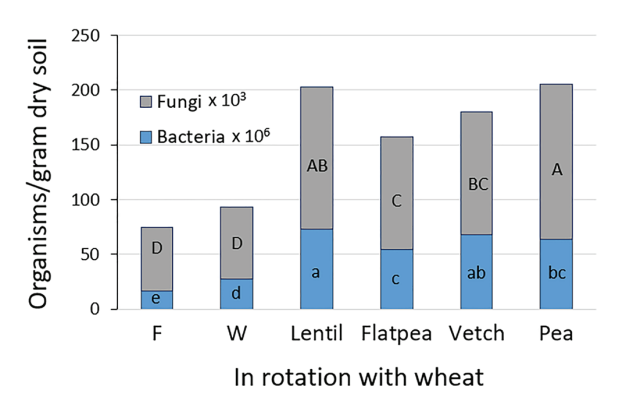
Figure 1. Fungi and bacteria counts in top 4-inch of soil following six years of crop rotations.
F – fallow, W – spring wheat. Sampled in October, two months after wheat harvest,
15 months after cover crop termination. Bars with at least one same letter within
microbe group are equal with 95% confidence (2, SK).
Microbial activity increases with plant residue input and N concentration of the residue.
In an 18-year Montana study, three of the four enzymes used to measure microbial activity
were correlated with above ground biomass (12). In an 8-year Montana study of partial fallow covers planted in May and terminated
at early bloom, microbial biomass and activity was greater in some years after covers
than fallow at spring seeding the following year. Microbial populations did not increase
with increasing number of cover rotations (13, MT). Since early terminated covers may not produce as much biomass as cash crop
stubble in semi-arid conditions, they are likely not as good as re-crop at feeding
microbial populations. Terminating covers before plant maturity (lower C:N, Figure 2), and including legumes in the cover are ways to increase residue N and microbial
activity (15, MT).
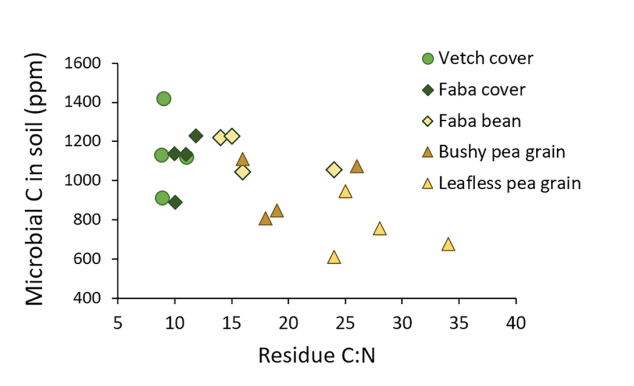
Figure 2. Relationship between the initial C:N of crop residue and soil microbial biomass
C in summer of third subsequent crop (14, AB).
Many of the benefits of covers can be attributed to increased plant diversity, which
is important to fully functioning ecosystems and soil health. A few studies have been
able to document greater bacterial diversity with mixed covers rather than single
species covers (16, SD; 17, ID). Microbial activity appears to be more dependent on
residue biomass (18, MT; 16, SD) than diversity (17, ID).
With growing interest in regenerative agriculture, there is more focus and question
about AM-fungi (19). In a South Dakota study with oat, canola and vetch, only oat cover or mixes containing
oat had enough AM-fungi in late fall to increase AM-fungi root colonization and growth
of the following crop (20). Brassicas may actually reduce AM-fungi, but promote disease-suppressing bacteria (21). After 8-years (four cover-wheat rotations), wheat following brassica cover
had less AM-fungi than following a cover of grasses, but overall fields with covers
did not consistently have more AM-fungi than fallow (13, MT).
A more direct way to sustain AM-fungi across rotations is to interplant AM-fungi-supporting
covers with the nonsupporting cash crop (e.g., canola). For example, when red clover
was sown between cabbage rows (non AM-fungi hosting) the following winter wheat yields
increased (22, Japan).
Arbuscular mycorrhizal fungi require some soil N. Since 45 lb N/acre added as ammonium
nitrate increased AM-fungi, (23), AM-fungi should benefit directly from soil N provided by legumes. The AM-fungi can
also benefit indirectly from legumes if less ammonium-based N fertilizer is applied
because of legume supplied N. Fungi are sensitive to soil acidity. With more than
45 lb N/acre as ammonium nitrate, AM-fungi decreased due to local soil acidification
by the fertilizer. Arbuscular mycorrhizal fungi biomass decreased by about 40% as
pH dropped from 7.3 to 6.1 (23). Such drops in soil pH are being seen in Montana’s traditionally high pH croplands
as a result of decades of ammonium-based N fertilization (MSU Extension: Cropland Soil Acidification).
In semi-arid systems with low biomass production, soil biological response from covers
is hard to measure with just a ‘few’ rotations, especially in plot studies where field
sampling activity can easily carry microbes from one treatment to the next. Soil biology
is highly year dependent and it may be cumulative. Also, cover effect may be easily
overridden by another factor such as drought, pesticide, fertilizer, or soil pH (24).
Chemical
Soil organic carbon (~60% of SOM), organic N, nitrate-N, P, and pH are some of the
chemical indicators of soil’s capacity to store and provide nutrients. Soil organic
matter and N are discussed in Cover Crops: Management for Organic Matter and Nitrogen.
Phosphorus acquired by crops is recycled annually through above and below ground plant
residue decomposition. An Alberta study compared decomposition of residue from red
clover and pea covers, and mature field pea, canola and wheat in fields in their seventh
and eighth year of tillage or no till (25). The clover and pea cover residue provided equal or more P and provided it earlier
in the next growing season than the mature pea, canola and wheat crop residues. Only
the covers released significant amounts of available P for the next crop (10 to 11
lb P2 O5/acre). In contrast, mature canola, pea and wheat stubble residue released less than
2 lb P2 O5/acree. Most of the P was released within the first 10 weeks after termination or
harvest, whether the field was tilled or not.
Cover crop composition (1, 2, 6 and 8-species) did not affect Olsen P after two cycles
in Montana (26). However, grasses are well suited to catch P (and N) runoff or deep
seepage in acidic or sandy soils, which do not bind P (27, Australia; 28). In contrast, brassicas released more P than other species after freeze-thaw cycles,
making the P vulnerable to runoff loss in the spring (29).
Soil acidification in the top few inches is an emerging soil health issue in Montana
croplands, leading to reduced yield and crop failure. Without plant cover, the soil
is vulnerable to erosion. A major contributing factor is use of ammonia based N fertilizer
(MSU Extension: Cropland Soil Acidification). Legume covers should help prevent soil acidification by reducing reliance on commercial
N fertilizer and N leaching. In Montana studies with covers, soil pH changed more
based on the amount of fertilizer N applied than the type of covers in rotation (30). Pea cover, pea grain and fallow followed by wheat all received less N and had less
soil acidification than continuous wheat over nine rotations (18 years, Figure 3).
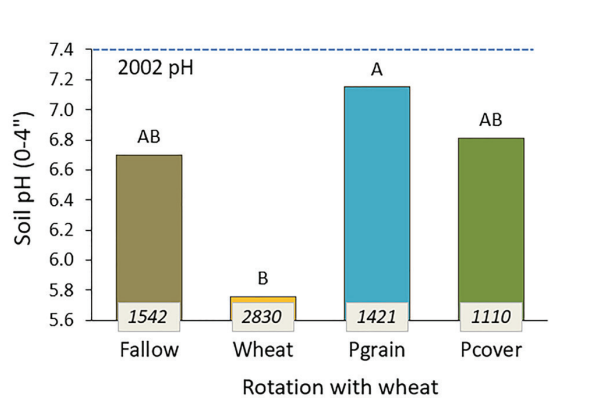
Figure 3. Soil pH after 18 years of fallow, wheat, pea grain, pea cover in no-till rotation
with wheat, and total N fertilizer (lb N/acre) applied to each system. Bars with the
same letters are equal with 90% confidence (30).
Physical
Soil aggregation increases the soil’s ability to absorb and hold water and resist
wind and water erosion. It is a result of complex interactions between the soil microbial
community (e.g., fungi, bacteria), soil micro fauna (e.g., worms, nematodes), plant
roots, and cementing/binding agents, all of which benefit from covers (31). Wet aggregate stability (also called water stable aggregates) increased with residue
input (15, MT). In a Saskatchewan study, wind erodibility after six years decreased due to
larger soil aggregates. Legume cover-wheat had the largest soil aggregates, fallow-wheat
the smallest, and continuous wheat was intermediate (11). In contrast, aggregate stability did not increase after two rotations of cover,
rather than fallow-wheat, at four Montana sites (32). Bulk density and penetration resistance were not affected by cropping system in
either the Saskatchewan or Montana study.
Water infiltration is highly variable across a field; therefore, it is hard to document
changes with management at least in shorter-term studies. After seven years there
was no difference in infiltration between cover and fallow-wheat (26, MT). In a different study, after 18 years, fallow had the lowest infiltration;
the other rotations, including cover and re-crop, had higher infiltration rates with
some indication that infiltration increases with SOM (Figure 4).
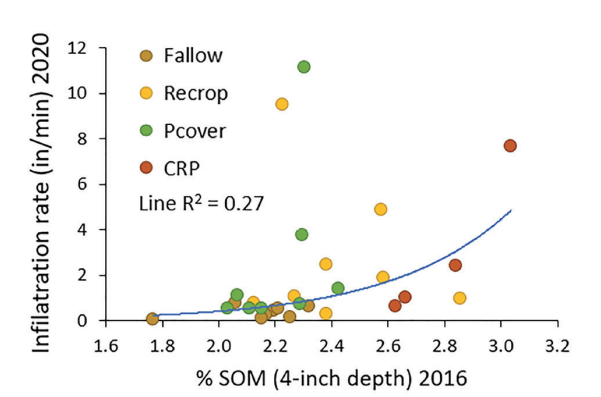
Figure 4. Water infiltration rate by % SOM after 18 years of fallow, wheat or pea grain (re-crop),
pea cover (chemical terminated generally at plump pod, sooner if weeds were a problem,
or hayed then sprayed) in rotation with wheat, and CRP (10 years Conservation Reserve
Program: mostly alfalfa with some grass) followed by pea grain-wheat (eight years;
33, 30, MT).
Soil temperature at a 2-inch depth was lower by 5 to 15°F with covers than fallow
from late June through late August (the last temperature measurement) even well after
cover termination (Figure 5). Lowered summer afternoon temperatures should decrease evaporation and likely benefit
biological activity.
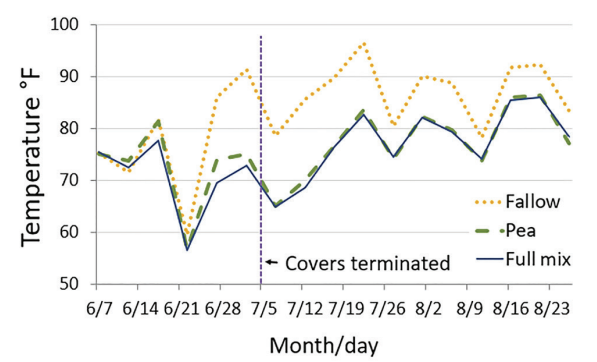
Figure 5. Summer soil temperature at 2-inch depth at 4 p.m. in fallow, pea cover, and 8-species (Full) cover chemically terminated at early bloom (32, MT).
Conclusion
Above and below ground plant residue is critical for healthy living soils, and for
that reason fallow is counterproductive to soil health. Plant residue is required
to keep the soil microbial community alive, to improve water infiltration and soil
aggregation, and to increase N, P, and carbon cycling. Producers need to be clear
on the intended goal of planting a cover. In semi-arid dryland systems, a good place
to start regenerating soil health is to reduce fallow and increase
the frequency of live plant cover and residue on a given field. Including legumes
in covers increases plant residue N, which increases microbial activity and the soil’s
N supply.
Acknowledgements
We thank the Western Sustainable Agriculture Research and Education (WSARE) program and the Montana Fertilizer Advisory Committee for funding MSU studies. We appreciate the time and expertise of the following for review and production of this bulletin: Kari Lewis (MSU Extension agent), Luke Ahlman (Certified Crop Adviser), Carl Vander Molen (Producer), and MSU Communications.
References
- Engel, R.E., P.R. Miller, B.C. McConkey, R. Wallander, and J.A. Holmes. 2017. Soil organic C changes to ten years of increasing cropping system intensity and no-till in a semiarid climate. Soil Sci. Soc. Am. J. 81:404-413. https://doi.org/10.2136/sssaj2016.06.0194
- Biederbeck V.O., R.P. Zentner, and C.A. Campbell. 2005. Soil microbial populations and activities as influenced by legume green fallow in a semiarid climate. Soil Biol. Biochem. 37:1775-1784. https://doi.org/10.1016/j.soilbio.2005.02.011
- Liebig, M., L. Carpenter-Boggs, J.M.F. Johnson, S. Wright, and N. Barbour. 2006. Cropping system effects on soil biological characteristics in the Great Plains. Renewable Agric. Food Syst.21:36-48. https://doi.org/10.1079/RAF2005124
- Kim, N., M. Zabaloy, K. Guan, and M. Villamil. 2020. Do cover crops benefit soil microbes? A meta-analysis of current research. Soil Biology and Biochemistry. 142. https://doi.org/10.1016/j.soilbio.2019.107701
- Crookston, B., M. Yost, M. Bowman, K. Veum, and G. Cardon.2021. How Often do Soil Health Assessment Scores Relate to Crop Yield? Soil Health Innovations Conference. March 2021. NCAT-ATTRA
- Jones, C., and D. Boss. 2014. Unpublished data
- Sanyal, D., J. Wolthuizen, and A. Bly. 2020. Cotton Strip Soil Test: Rapid Assessment of Soil Microbial Activity and Diversity in the Field. South Dakota State University Extension https://extension.sdstate.edu/cotton-strip-soil-test-rapidassessment-soil-microbial-activity-and-diversity-field
- Finney, D.M., J.S. Buyer, and J.P. Kaye. 2017. Living cover crops have immediate impacts on soil microbial community structure and function. J. Soil Water Conserv. 72:361-373. https://doi.org/10.2489/jswc.72.4.361
- Hoorman, J., J.C. de Moraes Sá, and R. Reeder. 2009. The Biology of Soil Compaction. Ohio State University Extension SAG-10-09 AEX-543-09. https://ohioline.osu.edu/factsheet/SAG-10
- Barnett, B.A., J.A. Delgado, and D.K. Manter. 2012. Effects of cover crops on the microbial community and its ability to suppress disease and acquire nutrients. Potato Association of America Proceedings. p. 10.
- Biederbeck, V.O., C.A. Campbell, V. Rasiah, R.P. Zentner, and G. Wen. 1998. Soil quality attributes as influenced by annual legumes used as green manure. Soil Biol. Biochem. 30:1177-1185. https://www.sciencedirect.com/science/article/pii/S0038071797001508
- Fouts, W. Impacts of crop rotations and nitrogen fertilizer on soil biological factors in semi-arid Montana. Montana State University Professional Paper. https://scholarworks.montana.edu/xmlui/handle/1/16425
- Housman, M., S. Tallman, C. Jones, P. Miller, and C. Zabinski. 2021. Soil biological response to multi-species cover crops in the Northern Great Plains. Agric. Ecosyst. Environ. 313:107373. https://doi.org/10.1016/j.agee.2021.107373
- Lupwayi, N.Z. and Y.K. Soon. 2016. Soil microbial properties during decomposition of pulse crop and legume green manure residues in three consecutive subsequent crops. Can. J. Soil Sci. 96:413-426. https://doi.org/10.1139/cjss-2016-0039
- O’Dea, J.K., C.A. Jones, C. Zabinski, P.R. Miller, and I.L. Keren. 2015. Legume, cropping intensity, and N-fertilization effects on soil attributes and processes from an eight-year-old semiarid wheat system. Nutr. Cycle. Agroecosys. 102:179-194. https://doi.org/10.1007/s10705-015-9687-4
- Sanyal, D., J. Wolthuizen, A. Bly, A. Rahhal, and H. Bielenberg. 2021. Cover Crops towards Soil Health Improvements. Soil Health Innovations Conference. March 2021. NCAT-ATTRA
- Sone, B., J. Lucas, and M. Strickland. 2021. Cover Crop Diversity Affects Microbial Community Diversity and Soil Carbon. Soil Health Innovations Conference. March 2021. NCAT-ATTRA
- D’Agati, K. 2020. Soil Response to Long Term Multispecies Cover Crop Mixes and Above Ground Biomass in the Semiarid Northern Great Plains. MS Thesis. Montana State University. 112 p. https://scholarworks.montana.edu/xmlui/handle/1/16036
- Karas, S. 2020. How the Fungus Might Save Us. California State University, Chico. Center for Regenerative Agriculture and Resilient Systems. https://www.csuchico.edu/regenerativeagriculture/blog/how-fungusmight-save-us.shtml
- Lehman, R., W.I. Taheri, S.L. Osborne, J.S. Buyer, and D.D. Douds, Jr. 2012. Fall cover cropping can increase arbuscular mycorrhizae in soils supporting intensive agricultural production. Appl. Soil Ecol. 61:300-304. https://doi.org/10.1016/j.apsoil.2011.11.008
- Vukicevich, E., T. Lowery, P. Bowen, J.R. Úrbez-Torres, and M.Hart. 2016. Cover crops to increase soil microbial diversity and mitigate decline in perennial agriculture. A review. Agron. Sustain. Dev. 38:48. https://doi.org/10.1007/s13593-016-0385-7
- Karasawa, T., and M. Takebe. 2012. Temporal or spatial arrangements of cover crops to promote arbuscular mycorrhizal colonization and P uptake of upland crops grown after nonmycorrhizal crops. Plant and Soil. 353:355-366. https://doi.org/10.1007/s11104-011-1036-z
- Pan, S., Y. Wang, Y. Qiu, D. Chen, L. Zhang, C. Ye, H. Guo, W. Zhu, A. Chen, G. Xu, Y. Zhang, Y. Bai, and S. Hu. 2020. Nitrogen-induced acidification, not N-nutrient, dominates suppressive N effects on arbuscular mycorrhizal fungi. GlobalChange Biology. https://doi.org/10.1111/gcb.15311
- Tosi, M., E. Mitter, J. Gaiero, and K. Dunfield. 2020. It takes three to tango: the importance of microbes, hostplant, and soil management to elucidate manipulation strategies for the plant microbiome. Can. J. Microbiol. 66:413-433. https://cdnsciencepub.com/doi/full/10.1139/cjm-2020-0085
- Lupwayi, N.Z., G.W. Clayton, J.T. O’Donovan, K.N. Harker, T.K. Turkington, and Y.K. Soon. 2007. Phosphorus release during decomposition of crop residues under conventional and zero tillage. Soil Tillage Res. 95:231–239. https://doi.org/10.1016/j.still.2007.01.007
- Jones, C. Unpublished data
- Alamgir, M., and P. Marschner. 2016. Changes in P pools over three months in two soils amended with legume residues. J. Soil Science and Plant Nutrition. 16:76-87. https://doi.org/10.4067/S0718-95162016005000006
- Hallama, M., C. Pekrun, H. Lambers, and E. Kandeler. 2019. Hidden miners - the roles of cover crops and soil microorganisms in phosphorus cycling through agroecosystems. Plant and Soil. 434:7-45. https://doi.org/10.1007/s11104-018-3810-7
- Liu, J., M. Macrae, J. Elliott, H. Baulch, H. Wilson, and P. Kleinman. 2019. Impacts of cover crops and crop residues on phosphorus losses in cold climates: a review. J. Environ. Qual. 48:850-868. https://doi.org/10.2134/jeq2019.03.0119
- Jones, C., and P. Miller. Unpublished data
- Lal, R. 2015. Soil carbon sequestration and aggregation by cover cropping. J. Soil Water Conserv. 70:329-339 https://www.tandfonline.com/doi/abs/10.2489/jswc.70.6.329
- Miller, P., C. Jones, C. Zabinski, J. Norton, S. Tallman, and M. Housman. 2016. Using cover crop mixtures to improve soil health in low rainfall areas of the northern plains. USDA WSARE Final Report. 40 pp. https://projects.sare.org/sare_project/sw11-099/
- Ewing, S., P. Miller, C. Jones. Unpublished data.
Resources
Montana Specific
- Montana State University Extension publications are available online at https://extension-store.montana.edu or call 406-994-3273.
- The Soil Scoop https://landresources.montana.edu/soilfertility/soilscoop/
- Eastern Ag Research Center Dryland Cool and Warm Season Cover Crop Performance Evaluations. 2016 Agricultural Research Update http://agresearch.montana.edu/earc/annualreports.html
- USDA-NRCS Bridger Plant Materials Center Technical Notes https://www.nrcs.usda.gov/wps/portal/nrcs/main/plantmaterials/pmc/west/mtpmc/
- MT-96. Peas: An Introduced Legume for Conservation Use in Montana and Wyoming. 2014. Hybner, R. 6p. (ID# 12101)
- MT-106. Radish: An Introduced Cover Crop for Use in Montana and Wyoming. 2015. Hybner, R. 6p. (ID# 12456)
- MT-120. Small-seeded Fava Bean as a Cash Crop and within Cover Crop Mixture. 2017. Tallman, S. 2p. (ID# 13262)
Online Tools
- Cover Crop Chart. USDA-ARS Northern Great Plains Research Lab. An online or pdf version decision aid tool with information on 58 crop species https://www.ars.usda.gov/plains-area/mandan-nd/ngprl/docs/cover-crop-chart/
- Cover Crops for Vegetable Growers. Cornell University. http://covercrops.cals.cornell.edu/decision-tool.php
- Crop Sequence Calculator. USDA-ARS, interactive software program to design crop sequences. https://www.ars.usda.gov/plains-area/mandan-nd/ngprl/docs/cropsequence-calculator/
Organizations
- Soil Health Institute https://soilhealthinstitute.org/
- Sustainable Agriculture Research & Education (SARE) https://www.sare.org/Learning-Center/TopicRooms/Cover-Crops
- USDA NRCS MT environmental quality incentives program (EQIP) for cover crop incentives and advice. https://www.nrcs.usda.gov/programs-initiatives/environmental-quality-incentives-program/montana/environmental-quality
Terms Used
- Acidification: a decrease in soil pH
- Arbuscular mycorrhizal (AM): fungi colonize the host plant’s root tissue, can protect host from pathogens, and increase the host plant’s water and nutrient uptake, especially P.
- Available N: N in nitrate (NO3-) and ammonium (NH4+), the twoforms of N plants can take up
- Bacteria: single cell organisms that break down organicmaterial in the soil
- C mineralization: microbial and enzyme activity that breaksdown organic material into nutrients, carbon dioxide (CO2),and water
- Enzymes: a by-product of organic material breakdown by microbial life in the soil. They are left stuck to clay particles as a “fingerprint.”
- Microbial biomass: the total mass/bodies of microorganisms
- Microbial biomass C: the carbon in the bodies of microorganisms
- Microbial biomass N: the N in the bodies of microorganisms
- N mineralization: microbial and enzyme activity that converts N in organic material into ammonium (NH4+), a form of N that plants can use
- Non-AM fungi help break down organic material in the soil. They are not connected to plant roots.
- PMN (potentially mineralizable nitrogen) is N in organic material in the soil that can become plant available by microbial breakdown within a growing season.
- Soil aggregate stability: the ability of soil clusters to resist breaking down into silt or dust when exposed to water or wind
- Soil health is dynamic and characterized by properties such as tilth (physical suitability for planting), microbial activity, N supplying power, and aggregation.
- Soil microorganisms: microscopic organisms in the soil which include bacteria, fungi, algae, protozoa, nematodes, and more
- Soil organic C: the amount of C in organic material. It is used as in indicator of soil organic matter.
- Soil quality includes the properties such as texture and cation exchange capacity, that don’t change easily.
- Total soil N: the sum of nitrate (NO3-), nitrite (NO2-), Nin organic matter, ammonium (NH4+) and ammonia (NH3-) in the soil
Copyright © 2022 MSU Extension
We encourage the use of this document for nonprofit educational purposes. This document
may be reprinted for nonprofit educational purposes if no endorsement of a commercial
product, service or company is stated or implied, and if appropriate credit is given
to the author and MSU Extension. To use these documents in electronic formats, permission
must be sought from the Extension Communications Coordinator, 115 Culbertson Hall,
Montana State
University, Bozeman, MT 59717; E-mail: publications@montana.edu
The U.S. Department of Agriculture (USDA), Montana State University and Montana State
University Extension prohibit discrimination in all of their programs and activities
on the basis of race, color, national origin, gender, religion, age, disability, political
beliefs, sexual orientation, and marital and family status. Issued in furtherance
of cooperative extension work in agriculture and home economics, acts of May 8 and
June 30, 1914, in cooperation with the U.S.
Department of Agriculture, Cody Stone, Director of Extension, Montana State University,
Bozeman, MT 59717.