


Nutrient Uptake Timing by Crops to Assist with Fertilizing Decisions
EB0191
Revised September 2026
By Clain Jones, Extension Soil Fertility Specialist and Professor; Kathrin Olson-Rutz, former Research Associate; and Courtney Pariera Dinkins, former Research Associate
Department of Land Resources and Environmental Sciences, Montana State University
Timing the application of nutrients so that they are available before peak crop nutrient demand is critical. Adequate nutrients early in the growing season are necessary to maximize yield and ensure that especially nitrogen (N) and phosphorus (P) are available for good grain or seed fill. A large portion of N and P used for grain fill comes from the stem, leaves, and head, rather than directly from the soil. If these nutrients are not available for early plant growth, then yield and efficiency of fertilizer use are reduced. Maximum nutrient uptake varies among crops, and generally occurs prior to maximum growth rates. The objective of this document is to present nutrient uptake curves for selected Montana crops (small grains, oilseeds, corn and sugar beet) to help growers and their advisers optimally time fertilizer applications. The focus is on N because it is more commonly topdressed than P or potassium (K).
Introduction
All plants require the same mineral elements; however, the quantity, rate and timing
of uptake vary with crop, crop variety, climate, soil characteristics and management.
These combined factors influence the nutritional need, nutrient content, and overall
yield of a crop. When fertilizer prices represent a large portion of a producer’s
costs, it is very important to maximize fertilizer nutrient use efficiency (the percentage
of applied nutrient removed by the crop). Timing fertilizer applications so that nutrients
are available when plants need them should increase nutrient use efficiency and reduce
potential adverse environmental effects.
Plants require a balanced supply of nutrients throughout their development. Generally,
they accumulate most of their nutrients by sometime between the flowering and ripening
stages. Approximately 50 to 90 percent of N and P in the plant moves from the leaves
and stem to the developing seed during flowering (1). Therefore, low nutrient uptake early in a plant’s growth lowers nutrient quantity
for the seed, affecting both yield and quality.
Knowing how nutrient needs change during the growing season is essential for matching
nutrient supply with plant needs, especially for producers who can apply nutrients
in-season or for those considering controlled- and slow-release fertilizers. Because
nutrient uptake varies among regions and growing seasons, the results presented in
this guide should be considered as general guidelines only.
Crop Growth
Growth Stages
Crop nutrient uptake rates are different at each growth stage, and crop growth rates
vary with crop, variety, and growing conditions. Therefore, we encourage producers
to base their in-season fertilizer management decisions on crop growth stage rather
than time of year or an index of crop growth such as ‘Days After Emergence’.
For the purposes of this document, cereal grain plant growth is divided into five
basic growth stages (early leaf, tillering, stem elongation, heading and ripening;
Figure 1). Tillering refers to the development of small shoots coming from buds at the base
of the plant. Heads begin to develop on each tiller even before stem elongation, when
the stems become visible between leaves. ‘Heading’ begins when the seed head is pushed
up through the last leaf and becomes visible.
During ripening, lower leaves may die because nutrients stored in the lower leaves
are moved to the grain.
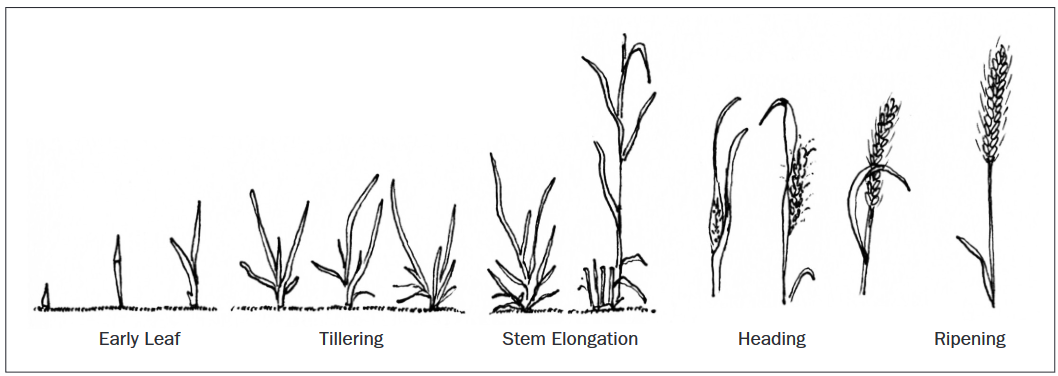
Figure 1. Approximate cereal grain growth stages. Flowering may occur before or after head emergence, depending on crop and variety. This figure was modified from its original (2).
Oilseed crop growth stages are divided into branching, bud formation, flowering and
ripening. Canola growth stages are illustrated and defined by the Canola Council of
Canada (3). Corn growth stages are defined by leaf, tassel, silk and kernel development. They
are illustrated and defined in a North Dakota State University publication (4).
Nutrient Functions
The three nutrients N, P, and K are classified as the ‘primary’ macronutrients because
deficiencies of N, P and K are most common. Small amounts of N are important early
in the growing season for seedling vigor. However, high rates of N fertilization may
damage seedlings and over-stimulate vegetative growth early in the season, depleting
soil moisture and depressing yields. Also, excess N may delay crop maturity. Phosphorus
is necessary for creating protein and energy storage and transfer and so is essential
for vigorous growth and seed development. It enhances crop maturity and quality, especially
in grain crops. Potassium maintains water balance and therefore stalk strength. In
addition, K promotes energy generation which is required for moving nutrients in the
plant, N uptake and protein synthesis. Crops that are K deficient can have low total
N uptake, yield, and protein.
For more information on plant nutrients, refer to MSU Extension’s Nutrient Management
Module 2 (4449-2). See “Extension Materials” at the back of this publication for information on how
to acquire referenced Extension publications.
Nutrient Uptake Curves
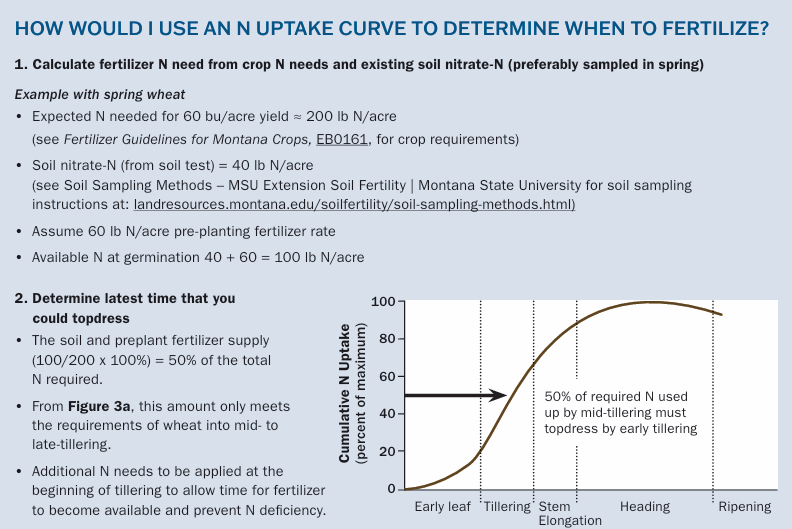
Understanding nutrient uptake patterns of crops can help producers and their advisers determine the optimal timing of fertilizer applications. Nutrient accumulation and uptake curves illustrate the uptake of nutrients from the soil, the translocation of nutrients into developing seeds, and the importance of early nutrient availability for crop growth. Our focus is on N because it is more commonly applied during the growing season than other nutrients.
Small Grains
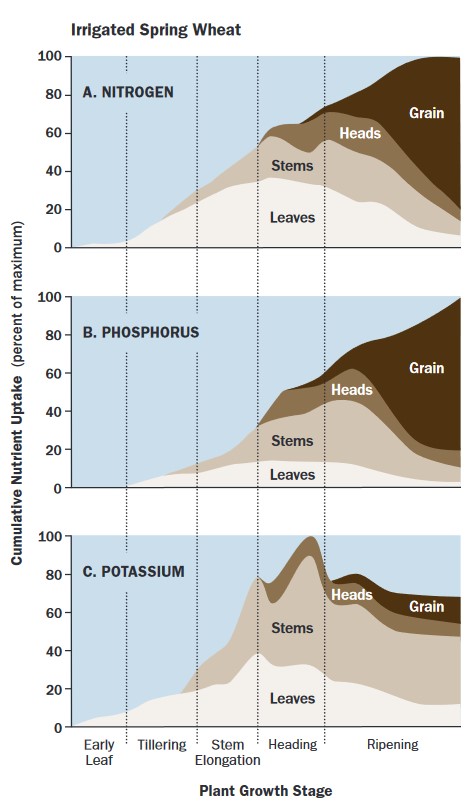 |
| Figure 2. Nutrient accumulation in leaves, stem, head and grain of irrigated hard red spring wheat as a percent of each nutrient’s maximum in Montana; A) nitrogen, B) phosphorus, and C) potassium. This figure was modified from its original (5 ). |
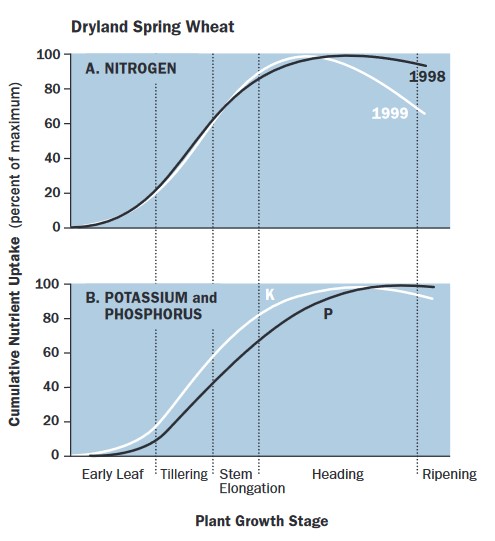 |
| Figure 3. Cumulative nutrient uptake as a percent of maximum accumulation by dryland spring wheat over time in Saskatchewan; A) N in 1998 and 1999, B) P and K in 1998. Uptake curves are adapted from the original (5 ). Plant growth stages are approximate and adapted from the originals (6 and 7 ). |
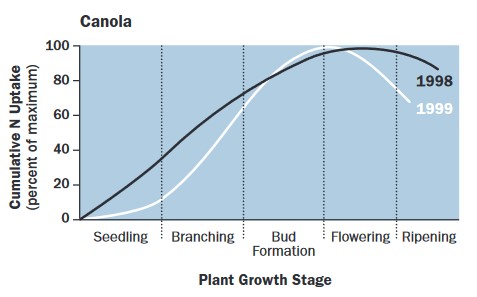 |
| Figure 4. Cumulative N uptake as a percent of maximum accumulation over the growing season by canola grown in Saskatchewan in 1998 and 1999. Plant growth stages are approximate and adapted from the original (9 ). |
 |
|
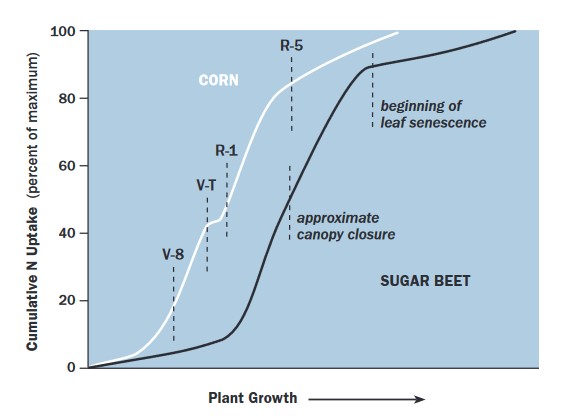
Figure 5. Cumulative N uptake as a percent of maximum |
Nutrient uptake patterns are similar among barley, oat and wheat. We use wheat as
the example. It has a high N uptake rate early in its development, with the maximum
measured at tillering (steepest slope in curves in Figures 2A and 3A).
The rate of P and K uptake peaked between stem elongation and the beginning of heading
in Montana (steepest slope in curves on Figures 2B and C). In Saskatchewan, the uptake rate of P and K was consistently high from tillering
to stem elongation (Figure 3B).
In the Montana study, more than 70 percent of the total above ground N and P had been
accumulated by the beginning of grain fill (Figures 2A and B). More than 55 percent of grain N and P came from redistribution of these nutrients
accumulated by the leaves, stems, and head, as shown by decreases in the percentages
of those nutrients at the heading stage in those plant parts; the rest came from the
soil. In the Saskatchewan study, wheat also accumulated most of its P before the peak
of heading and beginning of grain fill (Figure 3B). In contrast, maximum N accumulation was reached during early heading. This was
from full flowering to the end of flowering (Figure 3A) and was earlier than for the Montana wheat.
In a nutrient uptake study on dryland spring wheat in Mandan, North Dakota, the time
of maximum N accumulation depended on nutrient availability. The stands that received
both N and P peaked in N accumulation by heading; those stands fertilized with only
N reached peak accumulation during ripening; and those that were not fertilized were
still taking up N at maturity (8). Maximum P accumulation occurred by heading, independent of available N levels.
Regardless of when maximum accumulation is reached, sufficient N and P levels early
in the growing season are critical to meet the demands of grain fill.
Maximum K accumulation occurred just after flowering, or mid heading, in the Montana
study (Figure 2C). In the Saskatchewan study, maximum K accumulation was reached slightly earlier,
during flowering and early heading (Figure 3B). Unlike N and P, very little of the
accumulated K is used for grain fill (less than 20 percent, Figure 2C). Yet, K deficiency early in the growing season would limit N uptake and compromise
yield and protein.
Oilseeds
Maximum N uptake rates for oilseeds are during branching and early bud formation, as illustrated by canola (Figure 4). Although the time when nutrients are accumulated most rapidly will vary with yearly growing conditions (Figure 4), it always comes before maximum accumulation and early in the crop’s growth. Total N accumulation has been found to peak during the flowering stage. The uptake pattern for P and K are very similar to that of N, emphasizing the importance of early P and K availability for high seed production (9).
Corn and Sugar Beet
Since corn and sugar beet are usually irrigated and can be fertigated (adding nutrients
in irrigation water), N fertilization can be timed to match their N needs. In a Manitoba
study, maximum N uptake rates in corn occurred between the 8-leaf and tassel emergence
stages and again between the silking and dent stages (Figure 5). By the 10-leaf stage, 40 percent of the plant’s N had been accumulated. At maturity,
73 percent of the total plant N was located in the grain (10). Therefore, over half the N required for grain fill came from the leaves and stalk.
Insufficient N early in corn growth could greatly limit grain yield.
In sugar beet production, the N demand of seedlings is relatively small but critical
for the plants to attain canopy closure as quickly as possible (13). As these early leaves mature there is very high demand for N because they supply
much of the N needed for root growth (Figure 5; 11). However, applying N after canopy closure or the onset of bolting causes increased
top growth at the expense of sucrose quality and accumulation in the roots (12). After
mid to late summer there should be no additional N uptake and the leaves begin to
die as nutrients move into the growing roots.
Climate
Regional or yearly climatic differences will alter the rate and duration of nutrient
uptake. The longer period of N, P, and K uptake by wheat in the Montana study (versus
the Saskatchewan study) is likely because irrigation and rainfall (20 inches total
during the study) allowed for continued water and nutrient uptake into maturity. The
Saskatchewan study was on a dryland site (6 inches May to August rainfall in 1998
and 9 inches in 1999) where water and nutrient uptake would have been dramatically
limited as plants approached maturity.
The differences between the 1998 and 1999 uptake curves (Figures 3A, 4) were also likely caused by yearly climate variations which influenced the crops’
growth and development. Optimal moisture and temperatures in 1999 promoted rapid growth,
which required substantial nutrients early in the growing season. However, cold weather
during ripening in 1999 apparently decreased N movement to the grain and resulted
in N leaching below the rootzone or volatilization from the crop. Volatilization loss
from plant tissue can be substantial. For example, winter wheat in Nebraska lost 20
to 40 percent of the soil applied N through volatilization from the plant tissue after
anthesis (15). In the Saskatchewan wheat study, the actual N uptake was very different between
1998 and 1999, yet the N uptake pattern was very similar between the two years until
mid-heading (Figure 3A). In canola, both the actual N uptake and the pattern of uptake over time (Figure 4) differed between years.
Management
Overall nutrient use efficiency and yield should increase if the correct balance of
nutrients is available prior to maximum nutrient uptake. Maximum rate of uptake comes
before maximum nutrient accumulation, which precedes maximum biomass. Therefore it
is critical to apply fertilizer before maximum nutrient demands. This will ensure
balanced nutrition for the crop and reduce the risk of nutrient deficiencies and decreased
crop yield. It should also reduce fertilizer loss, increase nutrient use efficiency
and is an environmentally sensitive management strategy (see Crop and Fertilizer Management Practices to Minimize Nitrate Leaching, MT201103AG).
In-season fertilizer adjustments should be timed based on growth stage, when possible,
rather than time of year. Nitrogen top-dressed at tillering increased both yield and
protein of winter wheat grown in Montana, especially at low soil N levels (16). Waiting and applying N near the time of heading may help obtain optimum protein
levels though it is generally too late to have an effect on yield (17). Since N is very mobile and a portion can be absorbed through the leaf, strategic
timing would be particularly beneficial for producers that apply in-crop liquid N
solutions.
Ideally, P and K fertilizer would be applied continuously to the root zone during
early to mid-plant growth stages when P and K uptake are high. However, because P
is very immobile and K is relatively immobile in the soil, this is not practical.
In-season applications will likely not work their way into the root zone and foliar
applications are not very effective since little P or K is taken up directly through
the leaf. Therefore, P and K are best applied by subsurface banding at seeding, although
K can also be broadcast at or near the time of seeding.
Using soil tests combined with nutrient uptake curves, producers and their advisers
should be able to optimize both rate and timing of fertilizer application. For more
information on soil testing and developing yield goals and/or fertilizer calculations,
please see Interpretation of Soil Test Reports for Agriculture (MT200702AG) and Developing Fertilizer Recommendations for Agriculture (MT200703AG).
Enhanced Efficiency Fertilizers
Enhanced efficiency fertilizers (EEFs) have the potential to match nutrient availability
with crop demand to provide a relatively predictable nutrient supply. EEFs slow the
conversion of fertilizer to plant-available forms, reduce fertilizer losses to leaching
and volatilization, and reduce seedling damage when fertilizer is seed-placed. Controlled
and slow release N fertilizers are coated or otherwise treated to slow the release
of nutrients into the soil. An example is polymer coated urea. Stabilized fertilizers
such as urease and nitrification inhibitors have additives that alter or inhibit soil
enzymatic and microbial processes to reduce fertilizer losses.
Ideally, the release of nutrients from EEFs would match the desired crop’s nutrient
uptake curve. Because EEFs delay the availability of applied nutrients, they must
be applied sufficiently before peak crop demands. Currently, blends of EEFs with conventional
fertilizers and future improved EEF technology should enable a close match between
fertilizer nutrient availability and crop uptake.
Conclusions
Matching fertilizer applications with crop nutrient uptake can optimize nutrient use efficiency and crop yield. This will become increasingly important if fertilizer prices rise, and as air and water quality concerns continue to increase. Regardless of fertilizer costs, sufficient levels of nutrients should be provided so that plants have the nutrients they need throughout the growing season. Nitrogen should be applied no later than early tillering or branching, shortly before N uptake rate is the highest and likely most or much of the residual soil nitrate is used up. Optimal timing for in-season split applications of N can be determined using the provided crop nutrient uptake curves. Although maximum uptake rates of P and K come at a later growth stage than N, these nutrients need to be available to the young plants in the root zone. Therefore they are best supplied at or near seeding.
Extension Materials
Additional N, P, K, and S uptake curves for alfalfa, dry bean, canola, corn, grass, pulse crops, potato, sugarbeet, and sunflower are available at: landresources.montana.edu/soilfertility/nutuptake.html.
The following Extension publications can be found at https://landresources.montana.edu/soilfertility/publications.html
– Crop and Fertilizer Practices to Minimize Nitrate Leaching (MT201103AG)
– Developing Fertilizer Recommendations for Agriculture (MT200703AG)
– Fertilizer Guidelines for Montana Crops (EB0161)
– Growing Dry Pea in Montana (MT200502AG)
– Interpretation of Soil Test Reports (MT200702AG)
– Nutrient Management Modules (4449-1 to 4449-10)
Acknowledgements
We would like to extend our utmost appreciation to the following volunteer reviewers of this document:
– Bob Ullom, formerly with Wilbur-Ellis Co., Billings, Montana
– Jay Norton, former Professor and Extension Soil Scientist, University of Wyoming, Laramie, Wyoming
– Russ Miner, formerly with Wilbur-Ellis Co., Great Falls, Montana
– Shaun Casteel, Associate Professor and Extension Agronomist of Soybean and Small Grains, Purdue University, West Lafayette, Indiana
– Steve Lackman, former Yellowstone County Extension Agent, Billings, Montana
References
1. Chapin, F.S. III. and I.F. Wardlaw. 1988. Effects of phosphorus deficiency on source-sink interactions between the flag leaf and developing grain in barley. Journal of Experimental Botany. 39:165–177.
2. Weisz, R. 2005. Small grain production guide 2004-05. North Carolina State University Cooperative Extension. AG-580.
3. Canola Council of Canada. 2015. Canola Encyclopedia. https://www.canolacouncil.org/canola-encyclopedia/growth-stages/
4. McWilliams, D.A., D.R. Berglund and G.J. Endres. 1999. Corn growth and management quick guide. North Dakota State University, Agriculture and University Extension. A-1173. https://library.ndsu.edu/server/api/core/bitstreams/fa8d424d-fcb6-40bf-b05d-c3ecc4bcd7c7/content
5. Miller, R.O., J.S. Jacobsen and E.O. Skogley. 1994. Aerial accumulation and partitioning of nutrients by hard red spring wheat. Communications in Soil Science and Plant Analysis. 25:1891-1911.
6. Malhi, S.S., A.M. Johnston, J.J. Schoenau, Z.H. Wang and C.L. Vera. 2006. Seasonal biomass accumulation and nutrient uptake of wheat, barley and oat on a Black Chernozem soil in Saskatchewan. Canadian Journal of Plant Science. 86:1005–1014.
7. Gregoire, T., G. Enders and R. Zollinger. 2008. Leaf stages in small grain. North Dakota State University, Agriculture and University Extension. W-564.
8. Boatwright, G.O. and H.J. Haas. 1961. Development and composition of spring wheat as influenced by nitrogen and phosphorus fertilization. Agronomy Journal. 53:33-36.
9. Malhi, S.S., A.M. Johnston, J.J. Schoenau, Z.H. Wang and C.L. Vera. 2007. Seasonal biomass accumulation and nutrient uptake of canola, mustard, and flax on a Black Chernozem soil in Saskatchewan. Journal of Plant Nutrition. 30:641–658.
10. Heard, J. 2004. Nutrient accumulation and partitioning by grain corn in Manitoba. https://www.manitoba.ca/agriculture/crops/soil-fertility/pubs/soil-fert-poster-23.pdf
11. Armstrong, M.J., G.F.J. Milford, T.O. Pocock, P.J. Last and W. Day. 1986. The dynamics of nitrogen uptake and its re-mobilization during the growth of sugar beet. Journal of Agricultural Science. 107:145-154.
12. Carter, J.N. and D.J. Traveller. 1981. Effect of time and amount of nitrogen uptake on sugarbeet growth and yield. Agronomy Journal. 73:665-671.
13. Draycott, A.P. and D.R. Christianson. 2003. Nutrients for Sugar Beet Production: Soil-Plant Relationships. CABI Publishing. 272 pp.
14. Malhi, S.S., A.M. Johnston, J.J. Schoenau, Z.H. Wang and C.L. Vera. 2007. Seasonal biomass accumulation and nutrient uptake of pea and lentil on a Black Chernozem soil in Saskatchewan. Journal of Plant Nutrition. 30:721-737.
15. Daigger, L.A., D.H. Sander and G.A. Peterson. 1976. Nitrogen content of winter wheat during growth and maturation. Agronomy Journal. 68:815-818.
16. Lorbeer, S.L., J. Jacobsen, P. Bruckner, D. Wichman and J. Berg. 2000. Capturing the Genetic Protein Potential in Winter Wheat. Fertilizer Fact No. 23. Montana State University Extension, Bozeman, Montana. http://landresources.montana.edu/fertilizerfacts/
17. Westcott, M., J. Eckhoff, R. Engel, J. Jacobsen, G. Jackson and B. Stougaard.1997. Grain Yield and Protein Response to Late-Season Nitrogen in Irrigated Spring Wheat. Fertilizer Fact No. 11. Montana State University Extension, Bozeman, Montana. http://landresources.montana.edu/fertilizerfacts/