


Fall 2025 Capstone Paper
The Last Best Place: Problems and Solutions at the Wildland Urban Farmland Interface
Foreword By Beowulf Boswell and Patrick Lingle:
The Greater Yellowstone Ecosystem (GYE) contains over 22 million acres of land, providing crucial habitat for elk herds, grizzly bears, wolves, cutthroat trout, and numerous other species. For more than 11,000 years, humans have inhabited the GYE alongside these wildlife species (NPS 2025b). From early native tribes to modern day cities such as Bozeman, the GYE has seen a large increase in urbanization. In recent years, Bozeman’s population has increased from 37,000 in 2010 to nearly 60,000 in 2025 (World Population Review 2025). With this rapid growth, issues such as habitat loss and habitat fragmentation have become a threat to wildlife across the GYE. Rapid urbanization leads to decreased biodiversity and habitat degradation (Chen et al. 2025). Grassland birds are an excellent example of the impacts of urbanization.
Habitat fragmentation in the GYE is not limited to the construction of apartment buildings or single-family homes, as changes in land use and cover also impact habitat. As cities expand, the number of structures vulnerable to fire also increases. As a consequence of this increase, more effort and more chemicals are being used to suppress wildfires in the wildland urban interface (WUI). In addition to the physical destruction of buildings, excess nutrients and harmful PFAS chemicals are introduced to the soil. These additions can contaminate water supplies and alter plant growth.
Lastly, transportation corridors and human barriers can also impact habitat, migration routes, and mortality rates (Malcom 2018). Major highways like Interstate 90 and US Highway 191 also act as a physical barrier for migration. In addition to highways, other physical barriers such as fences can make accessibility more difficult for migratory wildlife. These barriers can block off crucial habitat or routes to habitat, especially for elk populations within the GYE. Physical barriers are not limited to road barriers, river structures like dams and reservoirs can also impact salmon and trout migration routes and habitat. Understanding how to mitigate these new issues is critical in preserving local wildlife populations and migration routes. If these issues are not addressed, habitat areas will continue to decrease.
Agricultural systems have a large impact on habitat. The physical alteration of the landscape as well as possible water contamination from fertilizers and pesticides impact both fish and wildlife habitats (Skoog et al. 2024). Cutthroat trout are one of many species impacted by the increased sediment load from tilling.
Agricultural lands are a recent part of the equation for managing the wildland-urban
interface. As water availability becomes less predictable, producers across the West
face growing pressure to adapt to a shifting climate. Many dryland grain farmers are
shifting from traditional fallow rotations to continuous or cover cropping systems
that increase soil organic 2 matter, enhance water infiltration, and stabilize yields
under dry conditions. However, rising
temperatures and increasingly erratic precipitation patterns have added an additional
layer of uncertainty, forcing producers to adjust planting schedules and adopt water-efficient
management strategies to maintain soil health and yield stability. These same climate
pressures make building soil resilience more important than ever.
Compost use has become one of the most effective ways to strengthen that resilience, restoring soil structure, boosting water-holding capacity, and supporting the microbial activity that sustains fertility over time. Composting is consistent with regenerative agricultural practices that prioritize soil health, animals, and people for treating the farm as an interconnected ecosystem and reducing the environmental harms of industrial agriculture. Together, these strategies illustrate how agricultural innovation can buffer farms against drought and degradation while reducing dependence on synthetic inputs.
Organic and regenerative agriculture emphasize the importance of minimizing the use of chemicals. Heavy use of glyphosate, the world’s most common herbicide, leaves residues that harm crops and native plants while diminishing soil microbial diversity. The same is true for overused insecticides, which can wash into streams. A more sustainable approach relies on parasitoid wasps and other biological controls that limit pests without damaging ecosystems.
In addition to agricultural chemicals, water in the state can be contaminated from natural sources. In Montana, groundwater can harbor arsenic, uranium, and bacteria including Mycobacteria and Legionella, creating significant health risks for private well users. While treatment systems are available, they are expensive and challenging to maintain. Meanwhile, PFAS, so-called “forever chemicals” originating from firefighting foam and industrial runoff, represent a new class of persistent pollutants. These compounds accumulate in sediment and food webs, persisting for decades. Recent studies indicate that biochar filtration may provide an affordable and sustainable method for eliminating such contaminants. Despite these efforts, engineered fixes have consequences: dams trap sediment, slow water flow, and create low-oxygen zones that turn chemicals into their most toxic forms. This illustrates that even carefully designed solutions can introduce new challenges, highlighting the need for cautious and informed approaches.
The Gallatin Valley, part of the Greater Yellowstone Ecosystem, shows how development, agriculture, and climate pressures converge around water. Once dominated by farmland and open range, it has become one of Montana’s fastest-growing regions, with Bozeman’s population nearly doubling in just over a decade. That population growth, layered over a long history of cropland and hayfield irrigation, has pushed both surface and groundwater systems to their limits. The same rivers that shaped the valley’s economy now reflect the cumulative effects of diversion, groundwater pumping, and warming temperatures.

Long-term U.S. Geological Survey records from Hyalite Creek and the Gallatin River
confirm a clear, basin-wide decline in streamflow since the 1970s (Table 1). However,
the magnitude and drivers of this decline vary across the valley. In the upper basin,
Hyalite Creek shows a relatively modest reduction in flow that aligns with climatic
trends—earlier snowmelt, reduced snowpack, and shifting runoff timing. Because Hyalite
receives minimal direct
withdrawals and has limited anthropogenic alteration, its decline reflects the broader
climatic pressures acting on headwater systems across the northern Rockies. However,
these small reductions matter, as they shorten the late-summer baseflow period.
In contrast, mid- and lower-basin sites show steeper declines linked to the valley’s growing water use. The Gallatin River near Gateway experiences the sharpest drop in discharge because it is at the center of agricultural diversions, groundwater pumping, and delayed irrigation return flows. Unlike headwater streams, this location receives almost no additional inflow from side tributaries, meaning every gallon removed for irrigation in the Gallatin Canyon directly reduces discharge. Downstream near Three Forks, the cumulative effect becomes clear: even with some return flow re-entering the system, the total amount of water leaving the valley is decreasing, indicating that withdrawals, and shifting hydrologic timing now exceed natural replenishment. The rest of the valley is declining faster than Hyalite, with human use, not climate alone, driving the majority of the observed reductions.
Regional research across the Interior West shows that declining streamflows are occurring
throughout snowmelt-fed river systems. More than 200 monitored watersheds across the
Colorado, Columbia, and Missouri River basins exhibit 10–20% reductions in late-season
discharge as irrigation intensifies and meltwater arrives earlier in the year (Ketchum,
2023). Statewide analyses show similar patterns, with long-term declines in peak flows
across Montana and northern Wyoming accompanied by shifts in runoff timing driven
by warming temperatures
and reduced snowpack (Sando, 2025). These regional trends mirror the underlying processes
shaping conditions in the Gallatin Valley, where altered flow timing and reduced discharge
interact with expanding surface-water pathways to drive warmer, slower late-summer
streams.
Yet declining discharge is only part of the hydrologic shift occurring in the Gallatin Valley. As more water is routed through an expanding network of irrigation ditches, subdivisions, and channels, the total surface area of flowing water across the landscape has increased dramatically. This redistribution exposes water to more solar radiation, warmer air temperatures, and longer residence times, allowing it to heat up before re-entering natural streams. This warmer return flow combines with reduced main-stem discharge to create shallower, slower, and hotter late-summer conditions. This transition directly sets the stage for ecological stress downstream.
These numbers point to more than just hydrological change; they reveal a system reaching
its physical and legal limits. The valley’s groundwater aquifer is over-allocated,
and each new domestic well further reduces stream baseflow. Under Montana’s “use it
or lose it” water rights framework, senior right holders must continue diverting their
full allotments each season or risk forfeiting them, leaving little incentive to conserve.
This combination of growth, policy, and natural decline creates a feedback loop where
even modest reductions in snowpack or
runoff cascade into larger ecological and economic impacts. Warmer streams hold less
oxygen, forcing species like westslope cutthroat trout into shrinking cold-water refuges,
while lower flows reduce dilution of nutrients and contaminants, worsening water quality.
Despite these challenges, local adaptation is underway. Some new developments and agricultural operations are experimenting with greywater reuse, low-energy filtration, and nanomaterial treatment systems to offset summer demand. Riparian restoration projects are also reconnecting floodplains and stabilizing banks, while compact urban planning seeks to reduce the hydrological footprint of growth. Yet, evidence indicates that surface-level interventions alone are insufficient: lasting sustainability depends on the integration of groundwater monitoring, return-flow accounting, and conservation incentives that reconcile human and ecological water demands.
Bozeman and the Gallatin Valley offer a clear picture of the modern West: a landscape where population growth, water scarcity, and innovation all intersect. The trends in streamflow are not just indicators of loss, but warnings of imbalance. Opportunities to rethink how water is shared, measured, and valued in a rapidly changing environment.
Natural cycles in the West are now operating within a new set of human and climatic
constraints. Snowmelt, fire, and flood events still happen, but their timing and strength
are increasingly shaped by warming temperatures, development, and the infrastructure
built across these landscapes. Dams, diversions, roads, and other human altered land
cover shift how water, nutrients, and wildlife move through an ecosystem. As these
pressures build, the effects become clear in wildlife, whose daily movements and seasonal
patterns reveal how much these
ecosystems are being reshaped.
Wildlife
Introduction
The GYE and surrounding Montana landscapes face mounting pressures from human development that threaten native wildlife across multiple ecosystems. As Montana's population has grown and urbanization has intensified, native species are forced to adapt to dramatically altered environments or face extirpation (National Park Service, 2024). Habitat destruction and fragmentation caused by highways, fencing, and urban expansion have disrupted essential ecological processes that wildlife depend upon for survival. For centuries, Rocky Mountain elk have traversed the wilderness expanse of the GYE, embarking on long-distance migrations from mountainous summer ranges to lower elevation winter ranges each year. However, human-dictated landscape fragmentation has reduced the connectivity of these migration corridors, forcing elk to navigate an increasingly obstacle-laden environment. Similarly, native birds face parallel challenges from climate change, competition with non-native species, and especially habitat destruction. Beyond terrestrial ecosystems, Montana's aquatic environments face distinct but equally pressing threats stemming from the diversion of substantial volumes from the Gallatin Valley's rivers and streams during critical growing months, proving particularly harmful to species like the westslope cutthroat trout, which relies on cold, navigable waters with ample dissolved oxygen levels throughout its life cycle (USGS, 2025). Together, these interconnected pressures from habitat destruction, landscape fragmentation, and water management practices illustrate the broad-scale and multifaceted impacts of human development on Montana's diverse ecosystems.
This section focuses on the effects of human development on three different animals in Montana’s ecosystems. The species of interest are elk, native birds, and westslope cutthroat trout.
Habitat Fragmentation Effects on Elk By Maxwell Opton
Every year, elk herds embark on long-distance migrations from mountainous summer ranges to lower elevation winter ranges. These migrations are essential for accessing seasonal forage and reproductive success within the herd. On a larger scale, elk transport nutrients across elevation gradients, help to shape plant communities, and influence predator dynamics (Sawyer et al., 2013). However, human development has been expanding and intensifying in this region, disrupting these migrations. Within the GYE, housing density has tripled in the last 50 years (National Park Service, 2024). Human-dictated habitat fragmentation caused by highways, fencing, and overall urban expansion has reduced the connectivity of this landscape.
Yellowstone elk historically spent their winters in the foothills and plains before
climbing into the mountains for summer (Skinner, 1925). Elk are grazing animals that
eat primarily grasses, which dictates the land they occupy and migrate to. Elk initiate
movement to lower-elevation winter ranges as soon as snowfall begins to accumulate,
and forage accessibility becomes limited (Smith et al., 2019). The problem is that
the lower elevations of winter forage
lands are now occupied by ranches and crisscrossing fences. Estimates suggest that
there are over 150,000 miles of fencing within the winter range habitat for elk in
the GYE (Kudelska, 2025). Elk can get tangled in fencing or injured trying to jump
over them, which increases mortality. These fences are a direct cause of habitat fragmentation,
representing a barrier that elk have to migrate around to reach their ranges. Habitat
fragmentation occurs when a once-continuous habitat is broken into smaller, disconnected
patches that are separated by areas
of varying habitat type (Wilcove et al. 1986). Anthropogenically, this can be caused
by development in forms of roads, trails, fences, and infrastructure. We’re changing
the habitat in a way that suits us, which can then have more widespread effects. The
larger impacts from this include reduced species diversity, increased forms of pollution,
as well as the spread of invasives (Millhouser, 2019).
Roads and highways are not only crossing hazards for elk, but they’re large-scale agents of fragmentation that reshape the ecology and management of migratory herds. Displacement effects of highways can extend up to 1.1 miles from the roadway, effectively creating a wide corridor of reduced habitat utility (Ruediger et al., 2005). When highways like 14 or 212 slice through migration routes, the loss of usable habitat includes broad swaths of adjacent winter and migration habitat. This displacement both fragments of seasonal ranges and compresses elk into fewer areas of refuge. Elk may also expend more energy to avoid roads, reducing foraging efficiency, and reproductive success.
The primary way of solving this is to create large, well-designed corridors through overpasses or tunnels accompanied by strategic fencing. These crossings need to be large, sited correctly, and paired with fencing that funnels the animals to the structure (Ruediger et al., 2005). While the crossings don’t restore the adjacent habitat lost from highways, they allow migratory species to navigate human-modified terrain.
Habitat fragmentation in the GYE has disrupted the natural migrations of elk by breaking
up continuous landscapes with roads, fencing, and development. These barriers force
herds to alter routes, avoid high-traffic areas, and rely more on private lands, leading
to increased mortality risks, disease transmission, and reduced access to forage.
These changes extend across the Western U.S., reflecting a broader regional pattern
of habitat connectivity loss and diminished ecosystem resilience. To protect migratory
elk and the ecological functions they
sustain, management must focus on maintaining and restoring landscape connectivity.
Conservation strategies such as wildlife crossings, zoning regulations, and partnerships
with private landowners are essential for ensuring elk can continue to move freely
between seasonal ranges. Protecting these migrations will not only sustain elk populations
but also help preserve the ecological balance of the GYE.
Native Birds Impacts By Brooks Taylor:
With so many people moving to Montana, native birds face obstacles including climate change, competition with non-native species, and especially habitat destruction. As Montana has become more urbanized, birds need to adapt to urban environments or face extirpation. Habitat destruction has severely affected native birds not only in Montana, but also throughout the entire US. Loss of habitat puts birds in situations where they are forced to deal with anthropogenic stressors. As a result, nearly 1 billion birds die each year from humans (Loss, 2015). Some of the birds that have been directly threatened by habitat destruction in the GYE include the western meadowlark and loggerhead shrike. This is especially true for grassland birds due to reliance on grasslands for their shelter and foraging.
Grassland’s conversion to urban areas remains one of the largest threats to biodiversity in North America, and this directly affects grassland birds. A major threat is a lack of grassland protection. Only 4% of the grasslands in the world are protected (Peterman, 2021). Grasslands are important due to the various ecosystem services and functions they provide. Functions and services of grasslands provide food through hunting, nourishment for the soul from being in nature, and important habitat for animals such as birds, squirrels and coyotes. As grasslands are turned into urban areas, the prairie ecosystem and its benefits are destroyed. Habitat destruction has negatively impacted grassland birds because of native grassland conversion to farmlands, severely affecting grassland bird species.
A species especially affected by loss of grasslands is the western meadowlark. Western meadowlarks rely on grasslands for nesting and cover from predators (Giovanni, 2015). They primarily prefer native grasslands and are less abundant in the grasslands of introduced species. The western meadowlark, a yellow, white, and brown passerine bird, lives in native, tall agricultural grasslands, roadsides, pastures, and orchards (MTNHP, 2025). Though their numbers are stable in Montana, they are declining at a rate of about 1% per year and have lost 47% of their population since 1970 (Mackin, 2024).
Unlike the western meadowlark whose population is stable, the Sprague’s pipit is under considerably more threat by habitat destruction. This small grassland bird occupies the grasslands of southern Canada and the northern great plains. Their range includes the states and provinces of Alberta, southwestern Manitoba, Saskatchewan, central and eastern Montana, central North Dakota, and northwestern South Dakota (Staufer, 2025). This white and dark brown bird, like western meadowlark, lives primarily on the ground and feeds insects. Currently, they’re in dire straits, losing roughly 4% of their habitat per year for a loss of 50% of their habitat since 1975 (Cornell, 2025). As a habitat specialist that only lives in native grasslands, the Sprague’s pipit is unable to live in conventional farm systems.
Though more abundant than Sprague’s pipit, loggerhead shrikes are also in rapid decline. Loggerheads are generalists who can live in a variety of habitats such as prairies, agricultural fields, low trees, golf courses, and pastures with fences (Cornell, 2025). In Montana, they are found throughout the entire state but are listed as a species of concern (Cornell, 2025). They possess many characteristics of raptors such as a sharpened beak and talons, but they are much smaller than most other birds of prey. The use of thorns and barbed wire to impale their prey. Despite their adaptability to different environments, they require open spaces to capture prey which can include rabbits and lizards. As of now, they’ve lost 75% of their population since 1966 and lose about 2.5% of their habitat per year.
Grasslands and the birds living in them are in peril, but what is being done to protect these areas? One effort currently is the North American Grasslands Conservation Act. This act gives 60 million dollars in grants to support conservation efforts in the US and in Montana (United States Congress, 2024). This bill is funding restoration to grasslands falling under the criteria that are threatened by crop conversion and woody encroachment (United States Congress, 2024). Additionally, the Perry Sodbuster Act of 1985 is meant to prevent farmers from cultivating land that has high erosion potential (Rollins, 2020). If land has one-third of its acreage affected by eroded soil, then the entirety of the land can’t be cultivated. This means land that isn’t prone to erosion and full of native vegetation can be converted to cropland. Grassland that is grazed to the bottom few inches of the soil destroy bird habitat and gives weeds a prime opportunity to invade the soil. There is no definitive evidence showing these bird species decline solely because of habitat fragmentation as very few studies have been conducted. The only way to study whether habitat fragmentation contributes to decline is doing a controlled experiment were a group of grassland birds live in a prairie, the prairie is converted into an urbanized area or farmland, and the response of the birds to the fragmentation is recorded.
Habitat destruction is the biggest driver in biodiversity loss, and it’s apparent that many of the birds we know and love in Montana are at risk of losing all their habitat, and this is especially true of grassland birds. All three of these birds; the loggerhead shrike, western meadowlark, and Sprague’s pipit are rapidly declining as their habitat is developed and farmed. Grasslands are declining at rapid rates as the need for urban development is valued more than sustainability of our ecosystems. Western meadowlarks have lost nearly 47% of their habitat since 1950 and are losing 1% of their habitat per year. Loggerhead shrikes and Sprague’s pipits are also losing their habitat at 1-5% per year as they slowly start to head towards possible extirpation. Habitat destruction is one of many obstacles grassland birds face that puts them in jeopardy of losing their effect on ecosystems such as vectors of seed dispersal and prey for other animals.
Westslope Cutthroat Trout Ecosystem Impacts By Samuel Gabrielson
A significant element of Montana water law is the application of the “use it or lose
it” principle. Since most water sources are over-appropriated in Montana, those who
hold water rights must put the water to beneficial use to be protected from challenges
of abandonment. Abandonment of a water right includes losing the right to the next
most senior right holder (DNRC, n.d.). This structure creates an incentive for rights
holders to use their full allocation every year, even during typically wetter periods
when conservation of the water could be beneficial, for fear of abandonment of their
right. This incentive is harmful to certain ecological communities, such as that of
the westslope cutthroat trout. The westslope cutthroat trout relies on cold, navigable
waters with ample dissolved oxygen levels for their life cycle, which will be addressed
in this study (USGS, 2025).
This framework of water allocation is visible throughout the Gallatin Valley in the
form of diversion structures, ditch systems, and holding ponds. These structures represent
centuries of investment in water capture and movement and can range in size from small
headgates on creeks to elaborate systems on larger rivers, such as dams and levees.
This infrastructure, built over the last couple hundred years, has created a highly
engineered and altered landscape in which the vast majority of surface water during
irrigation season is legally claimed (MSU Extension,
2025).
Irrigation intensification, land-use change, and groundwater development have collectively
altered hydrological conditions across the northern Rocky Mountains. Negative summer
flow responses have been documented across more than 200 basins in the Colorado River,
Columbia River, and Missouri River systems, with return flows lagging by several months
and proving insufficient to offset summer water losses (Ketchum, et al., 2023). A
typical natural
flow regime in Montana features high spring runoff driven by snowmelt, declining flows
through summer as the snowpack depletes, and stable baseflows during fall and winter
maintained by groundwater contributions (USGS, 2025). The decline observed at the
Gallatin River near Three Forks reflects this pattern, suggesting that irrigation
withdrawals and delayed return flows reduce available discharge in streams during
the critical July–September low-flow period. These regional findings align with patterns
observed in the Gallatin Valley and indicate that declining
streamflows are driven by both climatic variability and intensified land and water
use (Sando, et al., 2025).
The Gallatin Valley’s aquifer system is now considered over-allocated. Thousands of
domestic and subdivision wells draw from shallow groundwater sources that are hydraulically
connected to surface water. Due to the Gallatin Valley’s unique geology, the aquifer
is segmented, which prevents continuous flow throughout (Rose and Waren, 2022). This
reduced linkage means that each new well can incrementally reduce stream baseflow,
complicating the
enforcement of senior surface-water rights and creating a legal quagmire within Montana’s
prior-appropriation framework. Continued subdivision development, conversion of rangeland
to residential properties, and fragmentation of riparian corridors have likely reduced
aquifer recharge and further exacerbated summer low-flow conditions throughout the
basin.
The Gallatin Valley data are consistent with regional studies of hydrological change. The observed trends support a narrative of converging climatic and anthropogenic pressures driving reductions in late-summer streamflow. In the upper valley, Hyalite Creek exemplifies the sensitivity of headwater systems to minor changes in baseflow. Mid-basin reaches, such as the Gallatin River near Gateway, highlight the cumulative effects of irrigation and municipal growth in areas of concentrated demand. The Gallatin River near Three Forks provides an integrated downstream perspective, where cumulative withdrawals and climatic changes manifest as reduced discharge at the basin outlet. The coherence of these findings with broader regional analyses suggests that hydrological change in the Gallatin Valley is both locally significant and reflective of larger-scale processes across the northern Rocky Mountains (Bell, et al., 2021).
Although this water is allocated by right, the persistence of agriculture and urban
expansion in the Gallatin Valley has created unique pressure on these surface water
systems. This convergence of municipal and agricultural demands has made water management
in the Gallatin Valley a complex act of balancing established water rights, supporting
economic growth, and protecting the hydrological integrity of natural systems which
is increasingly unable to stand against the rising competition. Removal of water for
irrigation or municipal use, while natural
flows are receding, only exacerbates the stress on aquatic ecosystems (USGS, 2025).
Headwater sites, though characterized by smaller absolute declines, are not exempt from this ecological risk. Even modest flow reductions can produce disproportionate habitat losses in high-gradient, coarse-bed channels typical of mountain headwaters; Hyalite Creek falls within this category (Ma, et al., 2023). Although, as reported, the recorded decline is only about 2 cfs per decade, such reductions during warm, low-flow periods can decrease velocity and depth in critical habitats, constraining ecological integrity and inducing ecological stress (Johnson, et al., 2024).
Disruption of these components in natural ecosystems due to surface water diversion causes a cascading effect through the food web. The Gallatin Valley suffers from a disrupted natural flow regime, which during the summer months (low-flow periods) causes warmer temperatures to persist in the river. Higher temperatures cause westslope cutthroat trout populations to decline, as they rely on cool waters for the increased dissolved oxygen it holds. This is not the only issue westslope cutthroat trout face due to low flow; loss of critical habitat, reduced spawning and rearing areas, and increased vulnerability to predation and disease are all increasingly common challenges (Earthzine, 2016). This limits fish from accessing their traditional spawning tributaries or eliminating tributaries all together. These issues also increase the risk of invasive species. Native fish, like the westslope cutthroat trout, are currently losing their habitat to the invasive rainbow trout. The mountain streams that westslope cutthroat trout prefer were historically too cold for rainbow trout but rising water temperatures have allowed rainbow trout to expand into cutthroat territory. This has led to westslope cutthroat and rainbow trout mating, reducing the number of genetically pure westslope cutthroats (USGS, 2025).
To mitigate the effects of surface water usage on stream ecosystems, the conservation
programs for the Gallatin River have focused on a wide range of initiatives. Current
and ongoing projects include improving riparian integrity, floodplain connectivity,
and improving spawning habitat (Gallatin River Drainage Physical Description, 2020).
Many of these projects are symptom focused, however, instead of mitigation focused.
For example, the inclusion of
groundwater analysis would deepen the understanding of declining surface flows. Irrigation
and residential development increasingly draw from groundwater sources, so aquifer
depletion may be masking or accelerating streamflow reductions. Systematic monitoring
of well levels would help clarify this dynamic and provide a more complete understanding
of the valley’s water budget. Future management will require coordinated strategies
that address both surface and groundwater. Conservation incentives, instream flow
protections, and adaptive allocation policies remain central, but these should be
paired with monitoring programs that link aquifer conditions to streamflow trends.
Protecting headwater baseflows, reducing peak-season withdrawals in mid-basin reaches,
and safeguarding cumulative flows at the basin outlet are all essential for maintaining
hydrological stability. While being beneficial for restoring habitat and helping facilitate
healthy waterways, current initiatives do not address the fundamental drivers of stream
dewatering. Without addressing the usage patterns, the current long-term trends suggest
that this ecosystem will continue to degrade (Gallatin River Drainage Physical Description,
2020).
Streamflows in the Gallatin Valley have declined significantly over the past 30–50 years, with reductions evident at Hyalite Creek, Gallatin River near Gateway, and Gallatin River near Three Forks. These declines reflect the cumulative effects of Montana’s water rights framework, irrigation intensification, rapid urban growth, and regional climatic shifts. These trends demonstrate the challenge of balancing agricultural production, municipal expansion, and ecological health in a constrained hydrological system.
In conclusion, the effects of surface water reductions have been indicated by reduced flow in each of the three sampled sites. From this, ecosystem effects of surface water reduction on the prized westslope cutthroat trout species have been analyzed. Although current conservation efforts and restoration projects have implemented a goal of improving habitat for local species, efforts will be needed to analyze surface water usage with an emphasis on reducing ecological stress. An important next step is to integrate groundwater into the analysis. Well depths and aquifer monitoring could provide a clearer picture of whether declining surface flows are being compounded by reductions in groundwater contributions to baseflow. A dual focus on surface and subsurface systems will be critical to sustaining the Gallatin Valley’s ecological and economic resources under continued development and climate change. In a continually developing region of Montana, management actions will need to prepare for increased stress to surface water use.
Conclusion
The mounting pressure of human development across Montana’s Greater Yellowstone Ecosystem, including the Gallatin Valley reveals a complex system of interconnected ecological challenges. From Rocky Mountain elk navigating fragmented migration corridors to native bird species losing critical nesting habitat and westslope cutthroat trout struggling in continuously warming, depleted streams; it is clear there is a human-driven trend reshaping Montana’s ecosystems.
Each of the three focal species examined in this paper provide a distinct dimension of habitat disruption. Elk face physical barriers such as highways, fences, and urban expansion. Native birds receive pressure from the conversion of their habitat to agricultural and urban development. Westslope cutthroat trout endure the compounded effects of water diversion, reduced streamflow, and higher stream temperatures. Together, these three examples demonstrate the destruction and encroachment of three very different habitat compositions.
While current mitigation and restoration efforts are valuable, they are largely symptom focused. Wildlife crossings address the immediate mortality risks for elk, but ignore adjacent habitat lost due to highway driven displacement. Grassland conservation programs protect limited acreage, but cannot reverse decades of land conversion, or reduce urban sprawl. Stream restoration efforts improve local habitat conditions for trout, but do not address water right allocation framework driving the reduction of streamflow. Conservation in Montana as a whole will require a shift to integrated, large scale strategies that address the root causes of habitat degradation. This may include redesigning infrastructure to facilitate migration patterns, nesting areas, and ecosystem health.
The fate of not only elk, native birds, or westslope cutthroat trout, but all species in Montana is not predetermined, but requires action. With coordinated approaches that prioritize habitat connectivity, sustainable land use, and adaptive management, it is possible to maintain the ecological resources of the GYE and the economy of Montana’s growing communities.
Achieving this balance demands the immediate recognition that continued development without ecological considerations will lead to irreversible losses in ecosystem diversity and function.
Anthropogenic and Natural Impacts on Soil and Water Quality in Intermountain West
Ecosystems
Introduction
The Intermountain West is a vast region - ranging from the Sierra Nevadas in the West to the Western reaches of the Great Plains in the East. This region is diverse, containing ecosystems from alpine forests to salt deserts, and everything in between. This region is facing mounting pressures from both anthropogenic activities, and natural processes as climate change intensifies. Climate change has intensified drought conditions and wildfire frequency, and as human activity continues to expand into previously wild landscapes, these ecosystems are facing unprecedented stress. Understanding these impacts is critical for the ecosystems and the communities that depend on them.
Multiple pathways introduce and perpetuate contaminants in the Intermountain West ecosystems. Impacts at the focal point are long-term fire retardants, agricultural herbicides, waterway alterations via damming, and geogenic sources. While these sources all greatly differ in their origins, they all share a common thread: cascading effects through interconnected soil and water systems. The long-term effects of these landscape impacts are amplified by the Intermountain West’s uniquely water limited conditions and biogeochemical characteristics.
The consequences of these extend beyond chemical presence. Soil acidification, microbial disruption, heavy metal accumulation, and altered nutrient cycling greatly shift ecosystem structure and function. Long-term fire retardants introduce large-scale nutrient pulses with cascading effects, herbicides threaten soil biodiversity essential for productivity, dams allow for buildups of contaminants, and naturally occurring uranium and arsenic pose health threats to communities that depend on contained waterways.
Climate change intensifies the pressures of these stressors through increased annual temperatures, reduced snowpack, and prolonged drought. The following review synthesizes current research, identifies necessary further research, and proposes management strategies that contextualize the long-term ecological costs of these short term interventions.
Fire Suppression and Soil Chemistry: Long-Term Fire Retardants in the Intermountain
West By Brodi Maidesil & Noah Heck
Background and Context
Wildfire has been, and always will be, an impactful part of ecosystem processes. Fire has historically served as a cleansing agent. Removing overgrowth from the forest floor, cleaning litter on the prairies of the Great Plains, and serving as a benchmark for ecosystem succession. Fire is a critical component in nutrient cycling throughout ecosystems, and in historically adapted fire ecosystems, many plants have adapted to the impacts of wildfire.
With westward settlement, the practice of prescribed burning saw a decline and was
replaced by a policy of fire exclusion and extreme suppression, which has disrupted
natural fire regimes and interrupted natural ecosystem processes (Fig. 2). A large
factor in the disruption of these fire regimes was the “10 am” rule, instituted by
the U.S. Forest Service in 1935 (Forest History Society, n.d.). This rule was that
all fire starts, natural or human-caused, were to be extinguished by 10am the following
day. In recent decades, management strategies have shifted back towards prescription
burns as an effective management tool, but due to decades of rampant suppression and
fuel accumulations, these natural ecosystems are unable to return to their historic
state without large scale fire events. These disruptions to natural fire cycles provide
context to understanding how modern suppression methods, particularly chemical suppressants,
now influence dynamics at the soil level. This reliance on intensive intervention
has created the need for widespread use of chemical fire retardants. Long-term fire-retardant
applications present
a critical trade-off: while they provide short term and effective suppression that
protect human infrastructure, they also pose long term risks—including soil acidification,
heavy metal accumulations, and microbiome destabilization–that is likely to reduce
ecosystem resilience to future disturbance. With that, it begs the question of “How
do long-term fire retardants impact soil dynamics and biogeochemical processes in
the Intermountain West?”
 Wildfire Suppressants
Answering this question requires examination of these retardants and their role as
a wildfire management tool. To understand the tradeoffs associated with wildfire suppressants,
it is necessary to examine and understand their context in modern wildfire management.
In wildland firefighting, there are 3 classes of suppressants designated by the U.S.
Forest Service (USFS). The first being long-term retardants (LTFR), commonly referred
to by their brand name “Phos-Chek.” These are the primary suppressants used, as they
are formulated to alter the way fire burns by forming a combustion barrier with cellulose
tissue when those fuels are heated (Adams & Simmons, 1999). They are comprised of
a proprietary blend of fertilizer salts (ammonium polyphosphates), gum thickeners,
iron (for coloration), and water. These retardants are typically concentrated and
diluted with water to ensure uniform dispersal. Due to this, they do not rely on their
water content for effectiveness. They are typically delivered to a site aerially,
and their effectiveness is determined by the volume of retardant per unit of surface
area. In a study on toxicity of long-term retardants and their toxicity to Fathead
Minnows (Pimephales promelas), Phos-Chek D75-R’s toxicity and persistence depended
on the soil substrate it was applied to. It was found that D75-R remained at a toxic
level of 15%-100% after 45 days of weathering, dependent on soil substrate (Little
& Calfee, 2005). It should be noted that toxicity may have changed, as Phos-Chek D75-R
is an earlier formulation used. While formulation has
been slightly altered, current formulations like LC95A and LC95W still retain the
same composition of ammonium polyphosphates.
The next class is foam fire suppressants. These are also known as “short term retardants”, as they rely on their water content to be effective. These primarily contain foaming and wetting agents. The foaming agents impact aerial dispersal, how fast water is lost from the foam, and how effectively it can cling to fuels. The wetting agents determine the suppressant’s ability to penetrate fuels.
The third suppressant type is water enhancers. Enhancers alter the physical characteristics
of water. They change the effectiveness of aerial drops and their adhesion to fuels.
They allow water to cling to non-horizontal and smooth surfaces. Both short term suppressants
and water enhancers are typically delivered manually by ground crews, with applications
on a much smaller scale compared to aerially dropped retardants (U.S. Forest Service,
2019). Given this increasing dependence on retardant applications, it is essential
to thoroughly understand how
large-scale applications interact with soil chemistry and nutrient cycling. These
suppressants have become effective and necessary strategies in managing wildfires
to minimize impacts on human infrastructure and the environment. However, the growing
intensity and frequency of wildfire, in conjunction with human expansion into wildland
areas, has amplified the scale and frequency at which suppressants are used – particularly
in the wildland urban interface, where risks to human health and infrastructure are
highest.
Wildland Urban Interface
This increased reliance on suppressants is directly tied to changes in human interactions
and activities in fire-prone landscapes. Anthropogenic expansion into land that was
once considered wildland has introduced additional conflicts within this new WUI.
The WUI is commonly characterized as the space where urban development interfaces
with both private and public areas defined as wildlands (Davis, 1990). Human development
into these wildland settings has altered natural fire return intervals (FRI), changing
the intervals in which some ecosystems burn, drastically increasing the risk of a
high intensity fire event (Fig 3). Many ecosystems across the West that are accustomed
to short FRI’s, have suddenly seen these intervals become longer, leading to excess
fuel loading and delay of nutrient cycling as nutrients are locked in above ground
detritus (dead and decaying biomass). Literature surrounding detritus pools and their
relation to natural fire is scarce, with virtually no literature regarding the
Intermountain West. Limited research has shown that in an Australian eucalypt forest,
experimental plots that saw a “no burn” treatment exhibited statistically significant
higher Nitrogen and Phosphorus concentrations in litter compared to plots that saw
biennial (2y) and quadrennial (4y) burning. This indicates that nutrients were immobilized
in detritus and microbial biomass rather than cycling back into the soil (Butler et
al. 2020). This pattern of nutrient immobilization in detritus under fire-exclusion
strategies creates a baseline of nutrient limitations, making subsequent mass nutrient
inputs from retardants more ecologically disruptive. Increased fuel abundance due
to changes in FRI’s have compounded with anthropogenic induced climate change as the
West has seen increased average aridity and decreased average precipitation. Those
factors directly contribute to the ease at which fires can start, and the flammability
of fuels in the path of the fire (Fig. 3).
 Increases in Fire Occurrence and Severity
Altered fire regimes have driven not only a need for increased retardant use, but
changes in fire behavior itself. With such a drastic change in natural fire regimes
in combination with expansion into these wildland habitats, there has been an increased
need for structural protection when fighting wildland fires. In the past four decades,
areas burned by wildfires have nearly quadrupled. On average, 70 million hectares
are burned each year. Additionally, houses in the wildland-urban interface have increased
by 350,000 each year (Burke et al. 2021).
Wildfire-caused structure loss within the American West saw an increase of 246% of
loss per thousand hectares burned between 1999-2009 and 2010-2020. This increase in
structure loss was not correlated to an increase in burned area alone, but from human-caused
ignition, which accounted for 76% of the structure loss (Higuera et al., 2023). This
stark increase in loss was strongly driven by large-scale events affecting communities
that lie within the WUI. These increases in large-scale fire events in recent decades
have necessitated the increased use of aerially applied ammonium polyphosphate based
LTFRs to protect urban structures from wildfire. Between 1987 and 2017, severe wildfires
(characterized as a fire that destroys >95% of trees in burn areas) increased by 800%
(Parks & Abatzoglou, 2020). Correspondingly, from 2009 to 2021, the USFS and other
government agencies dropped 440 million gallons of fire retardant on federal, state,
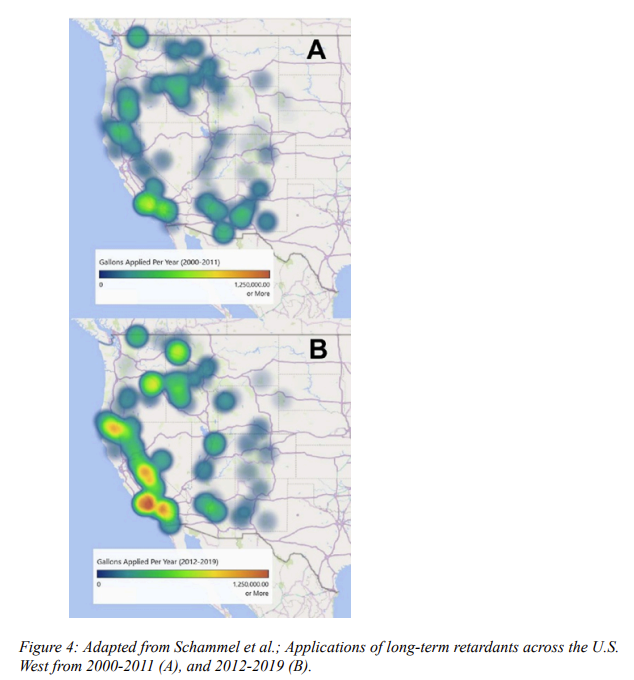
and private land (Tabuchi, 2025; Fig 4). Current fire trends indicate that the West
will continue to see greater fire occurrences and severity, prompting the question
about how
management strategies will follow suit. As long-term retardant use proliferates, it
becomes essential to understand how they interact with soil systems, both the positive
and negative effects, to effectively utilize this tool in a context of long-term ecological
sustainability.
Application Rates
To thoroughly understand the ecological impacts of increased retardant use, it must
be established how much Nitrogen (N) and Phosphorous (P) these applications are delivering
to the soil surface. The formula of the most common LTFR used, Phos-Chek LC95A, is
a proprietary blend and its exact composition is not publicly available. Application
rates per m2 can be roughly approximated using available compositions. The USFS typically
uses a dilution ratio of 5.5:1 of Phos-Chek to water (U.S. Forest Service, 2023).
Perimeter Solutions, the producer of Phos-Chek LC95A, state that undiluted Phos-Chek
has a composition of “80-100%” ammonium polyphosphates, making the final diluted solution
10-15% ammonium polyphosphates (Perimeter Solutions, 2020). The U.S. Air Force is
contracted by the USFS, in which C-130 aircraft may be used as wildfire attack resources.
The C-130 (and similarly sized “large” tankers) can discharge up to 3,000 gallons
of LTFR across an approximate area of 402.3 meters (1/4 mile) long, and 18.3 meters
(60 feet) wide (U.S. Air Force, 2009). Using these numbers and assuming the retardant
is discharged uniformly, it’s calculated that ammonium polyphosphates reach the ground
at a rate of .18 kg m-1
. As Phos-Chek LC95A is a proprietary blend, it’s assumed that the ammonium polyphosphate
fertilizers included is similar to typical agricultural blends, being comprised of
11% N and 37% P by weight. It’s calculated that N is applied at a rate of 176.65 lbs
acre-1, and P at a rate of 594.19 lbs acre-1 (conversion to lbs acre-1 follows standard
agricultural reporting for ease of comparison to agricultural guidelines). In comparison
to agricultural systems within Montana, the recommended P fertilizer (P2O5) addition
to a field of winter wheat.
with a baseline P concentration of 0 ppm is 55 lbs acre-1 (Dinkins & Jones, 2019). Wildland systems are comprised primarily of grassland, shrub, and forested ecosystems that require roughly 1/2 to 1/3 less available P compared to agricultural crops (Plank & Kissel, n.d.). The P application rates from LTFRs per m2 are 10x what would be used in systems that have no available P pool. This represents a nutrient pulse orders of magnitude beyond natural inputs, and even beyond intensive agricultural management. This creates conditions in which plant communities of the Intermountain West have no evolutionary context, creating a higher likelihood plants will experience P toxicity. LTFR dispersal’s high P application rates, in conjunction with its immobile nature, greatly impact microbial communities and the dynamics of these soil systems.
Soil Impacts
Fire retardants induce long-lasting effects on soil chemistry. Ammonium phosphate suppressants introduce large amounts of nitrogen and phosphorus to the soil. Per area, phosphorus inputs from fire retardants are 4 to 44 times greater than farming inputs. While nitrogen inputs are 0.3 to 16 times greater (Moorhead et al. 2025). Specifically, these inputs can cause three-fold increases in labile Nitrogen, 5-fold increases in labile Phosphorus, as well as threefold increases in labile sulphate (Hopmans & Bickford 2003).
These large-scale nutrient pulses rapidly influence the soil system, causing cascading biological and chemical changes. Due to LTFRs being mostly comprised of N and P fertilizer salts, they have the potential to alter soil pH, microbial communities, cation exchange capacity (CEC), immobilization of nutrients in microbial biomass, and shifting competition dynamics among plant species. Microbes are responsible for much of the biological dynamics that occur within soil. LTFR applications introduce large volumes N and P via these fertilizer salts into natural ecosystems. Nitrogen additions via fertilizer salts are linked to soil acidification.
When observing changes to soil pH, the effects of ammonium phosphate retardants vary. One study found an acidification of soil with pH decreasing from 6.5 to 6.0 (Gao & Deluca 2021). In soil with a pH of 5.5, average decreases of 0.3 and 0.2 units occurred. These pH changes were evident 12 months after retardant application. Additionally, ammonium phosphate application immediately increased salinization with a decrease to pre-treatment levels over 12 months (Hopmans & Bickford 2003).
Globally, research indicates that soil pH is responsive to N additions, with an average pH decrease of 0.49. Additionally, temperate forests displayed a greater correlation between pH response and N additions compared to tropical and boreal forests (Tian & Nu, 2015). These findings indicate that precipitation impacts the rate at which N deposition decreases soil pH. While these findings provide a global average, it can be interpreted that similar patterns would be seen within much of the Intermountain West, as the primary ecoregions contained are temperate forests and grassland/scrub landscapes. The Intermountain West in its lower and sub alpine elevations are characterized as “semi-arid,” with higher elevation regions seeing semi-arid characteristics, especially under the influence of climate change.These changes to soil chemistry cause significant alterations to plant and microbial communities.
A study within an Intermountain prairie system on Mt. Jumbo, approximately 1.5 miles
NW of Missoula, MT, was conducted 9 years after LTFR application. The study site was
determined visually through aerial imagery and field sampling, where pink coloration
was present on vegetation and was compared to adjacent control areas. Neither the
control nor the LTFR sites were burned, allowing for identification of LTFRs effects
without fire. LTFR sites
saw an average of 30.6 parts per million (ppm) of available P, compared to 13 ppm
in control sites. There was no significant difference in available N between the 2
sites, indicating that it had dissipated via plant uptake, leaching, and microbial
activity. This study also conducted the same analysis in sites in Bonner, MT, approximately
4.5 miles W of Missoula, MT. This analysis took place 1 year after LTFR application
and saw an available P increase of 6.8x, from 34.8 ppm to 236 ppm. Available N saw
similar trends, increasing 5.7x from 3.98 ppm to 22.7 ppm (Marshall,
et al., 2016). LTFRs present the risk of heightened nutrient persistence on a decadal
scale, having cascading effects. In water limited ecosystems, like the Intermountain
West, this long-term persistence is intertwined with soil pH, microbial composition,
and ecosystem recovery following a large-scale fire event.
Heavy Metal Deposition
Soil acidification and microbial disruptions caused by nutrient loading represents
only a piece of the compounding effects of retardants. Added corrosion-inhibitors,
in the form of heavy metals, introduce an additional layer of contamination that interacts
with pH changes. Soil pH impacts the mobility of heavy metals in soil solution. Typically,
soil acidification increases the mobility of heavy metals through dissolution of the
adsorption of Fe, Mn, and Al hydrous oxides sorbed to soil particles. Protonation
of soil surfaces leads to decreases in CEC and displacement of heavy metal cations
(Cadmium [Cd], Zinc [Zn], and Lead [Pb]) from sorption to clay particles. Limited
studies have shown Cd to become relatively mobile under acidic conditions, followed
by Zn, and Pb in descending order of mobility. Up to 70% of Cadmium’s total concentration
can be extracted (meaning it is free in solution) at neutral pHs from 6.5-7.2 due
to its tendency to be displaced from sorption by Ca2+ and Mg2+
(Kicinska et al., 2022). Due to long-term retardants being dispersed aerially, they
contain heavy metals that act as anti-corrosion agents to protect the flight equipment
that delivers it. One study, focused on Phos-Chek LC-95W,
the primary retardant used by the USFS, contains Chromium at 72,700 μg L -1, Cadmium
at 14,400 μg L-1, and Vanadium at 119,000 μg L-1 after dilution. These metals sit
at 727, 2,880, and 2,380, times the EPA’s limit for drinking water standards, respectively.
They were compared against EPA standards as there is a high likelihood that they will
return to waterways via leaching (Schammel et al., 2024).
Microbial Responses to Fire Retardants
Fire retardants have long lasting impacts on soil properties, leading to downstream
effects on microbial communities. Changes in pH fundamentally restructure microbial
community composition, and impact overall ecosystem function. Soil pH acts as a proxy
for bacterial and eukaryote β-diversity (species richness) in terrestrial systems.
Microbial communities tend to shift towards arbuscular mycorrhizal fungal dominance
as pH decreases (Marshall et al., 2016). Decreased pH lowered the β-diversity for
bacteria, while increasing the β-diversity for
eukaryotes. A large mechanism of ecosystem stabilization that is impacted by decoupling
of these bacteria-eukaryote dynamics, is that of disrupted nutrient cycling (Duan
et al., 2025). This disruption becomes more impactful when considering the changes
in competition between bacteria and fungi. The shift towards fungal dominance and
change in decomposition rates influence an ecosystem's recovery when these effects
are compounded with fire disturbance. The pH-driven effects on soil microbial systems
interact with additional components of fire retardants, particularly heavy metals
and corrosion inhibitors, which introduce further complexity to the dynamics in retardant-treated
areas. Concerning positive feedback loops (a self-reinforcing loop) are created by
increased mobility of heavy metals and the addition of metals contained within these
retardants, which can be amplified by soil acidification.
Beyond responses to soil pH changes and heavy metal introductions, biomass, metabolic activity, and functional diversity reveal the general effect of fire suppressants on microbes. In the short term, one year after application, ammonium phosphate retardants decrease microbial biomass and respiration (Yu et al. 2021, Barreiro et al. 2010). Additionally, enzymatic activity varies with ammonium phosphate fire retardants. In ammonium phosphate treated fires, β-glucosidase and urease activity can be inhibited while stimulated in others (Barreiro et al. 2010). After ten years, reductions in microbial biomass, respiration, and enzyme activity still persist for the same ammonium phosphate treated soils. When compared with untreated burnt soil, these reductions are most prominent in the top two cm of soil (Barreiro et al. 2016). In contrast, others found an increase in functional diversity and metabolic activity with retardant treatment (Velasco et al. 2009). This study monitored changes monthly over a year with seasonal variations occurring due to soil conditions and moisture. Overall, the diversity and metabolic increases were likely stimulated by nitrogen and phosphorus inputs acting as a fertilizer to these soils. The impacts of ammonium phosphate on microbial biomass, functional diversity, and metabolic capabilities can lead to altered nutrient cycling within treated soils.
In addition to measuring changes in microbial biomass, functional diversity and metabolic activity, we can look at specific changes within the community. Five years after a prescribed fire, the abundances of fungi and gram-negative bacteria in burnt soils increased when compared to unburnt soils. Notably, the effect of ammonium phosphate on these soil communities was not significant as bacterial and fungal abundances were similar to untreated burnt soil (Barreiro et al. 2010). Ten years after a prescribed fire, bacteria activity increased while fungal biomass decreased in ammonium phosphate treated soils when compared to burnt soils (Barreiro et al. 2016). This trend contrasts the fungal dominance that occurs with decreases in pH, but can be explained by nutrient spikes that stimulate bacteria, leading to carbon starvation of the fungi. In the short term, fires can have a positive effect on fungal communities, but the addition of ammonium phosphate can exclude fungi in the long term. Going forward, researchers should consider specific changes within fungal communities. Additionally, researchers should consider the impact soil type has on fungal responses. There are many fungi that act as plant symbionts with 90% of terrestrial plants relying on mycorrhiza (Aerts 2003). Looking at specific changes to certain groups like arbuscular mycorrhiza, ectomycorrhiza, and ericoid mycorrhiza can give insights to plant responses to fire retardants.
Beyond community shifts, soil enzyme activity gives insights to microbial metabolic functioning. When looking at specific enzymes, ammonium phosphate treated soils see a reduction in β-glucosidase activity. This reduction is observed both one and ten years after a prescribed fire, indicating a long-term response. This enzyme is responsible for carbohydrate breakdown into sugars. A decrease in this enzyme activity indicates lower rates of overall respiration, demonstrating less metabolic activity. Additionally, ammonium phosphate treated soils see large spikes in urease enzyme activity one year after a fire. This spike in urease activity could have been caused by the fire-retardant inputs. These suppressants usually contain ammonium salts which are similar in structure to urea. After ten years, urease activity slightly decreased, indicating diminished nitrogen inputs in the long term (Barreiro et al. 2010, Barreiro et al. 2016). These changes to enzyme activities can indicate long term changes in soil nutrient cycling.
Plant Responses to Fire Retardants
The effects of fire suppressants on plant communities are better documented. On an
unburned grassland in Montana, ammonium phosphate application resulted in exotic invasion,
as nonnative plants take advantage of nutrient spikes more than native plants. Specifically,
it resulted in cheatgrass (Bromus tectorum) and tumble mustard (Sisymbrium altissimum)
invasion. Cheatgrass is a facultative mycorrhizal plant and tumble mustard is non-mycorrhizal.
These plants pushed out obligate mycorrhizal species (Marshall et al. 2016). Linking
to microbial
responses, ammonium phosphate application results in increased bacterial activity
with decreased fungal biomass in the long term (Barreiro et al 2016, Marshall et al.
2016). Though the invasion was likely caused by nutrient spikes, the impacts on fungal
communities should be considered when observing plant responses to flame retardants.
Looking further into plant responses, the nutrient inputs from fire suppressants cause variable growth of different species. Ten years after a prescribed fire, forested plots treated with ammonium phosphate retardants resulted in larger pine heights and trunk diameters than untreated plots, but the root systems were smaller and more trunk deformities were found in treated plots. Additionally, phosphorus accumulations in ammonium phosphate treated trees were more than twice as high as other treatments. For shrubby vegetation, ammonium phosphate treatments favored resprouter species over obligate seeders. The disadvantage to seeder plants was due to the negative effect ammonium phosphate has on germination and seed viability (Fernandez et al. 2015). Moving to unburned wetland systems, retardant concentrations greater than 12% caused phosphorus values to rise above the maximum level instruments could detect. These nutrient inputs cause significant spikes in algal growth, providing evidence for a eutrophication effect from fire suppressants. Specifically, the algae blocked out sunlight and prevented seed germination of Cattail species, leading to decreased species richness (Rennert and Kneitel 2025). The impacts of these retardants on seed viability and plant community structure should raise concern with current application rates.
Glyphosate in Montana Farming Systems By Anja Bower
Introduction
Glyphosate is another anthropogenic contamination source that affects soil, water, and biodiversity of ecosystems. Glyphosate is a commonly used herbicide across the world and is especially widespread in Montana agricultural systems. This compound is applied to fields of crops to control weeds, reducing resource competition and preventing unwanted plants from being harvested. While farmers benefit from the removal of weeds, the environmental effects of herbicide application prove to be detrimental. The chemicals in glyphosate enter leaves and stems of plants and surrounding soil, impeding growth of crops that farmers are attempting to harvest. Chemicals also enter surrounding waterways, harming aquatic life and contaminating water. Pollinator exposure to herbicides often results in illness or death, and pollinators are essential to the growth of multiple plants and resulting crop yield. The adverse effects of herbicides threaten farms and can lead to reduced crop yields, harming farmers financially and consumers by reducing food availability (Aslam et al., 2023).
Background on Glyphosate
Glyphosate is the active ingredient in Roundup® , a popular brand name herbicide registered
for use in the United States in 1974 by the Environmental Protection Agency. Roundup®
was produced under Monsanto and acquired by Bayer in 2018 (Henderson et al., 2010).
Glyphosate is one of the most commonly used herbicides in agriculture across the world
due to efficiency in removing weeds (Diagboya et al., 2024). Glyphosate is advertised
as relatively harmless, as it biodegrades rapidly in the surrounding ecosystem. Despite
this, chemicals are still released into the environment during the degradation process.
A number of specific fates of this herbicide include absorption, precipitation, and
hydrolysis, all of which carry toxins into natural systems. The main product released
from glyphosate through degradation is aminomethylphosphonic acid (AMPA), which can
inhibit plant growth through
accumulation in the soil or application in high concentrations (Aslam et al., 2023).
Glyphosate targets the shikimic acid pathway in plants, which is an essential pathway
to plant survival. The enzyme 5-enolpyruvylshikimate-3-phosphate (EPSP) synthase is
inhibited, resulting in EPSP deficiency. This reduces amino acid production, which
plants depend on for protein synthesis and resulting growth. Along with suppressing
growth, glyphosate exposure removes green color in plants, causes leaf deformities,
and can kill tissue. Plants usually die completely between 4
and 20 days after tissue death. Mammals do not have the shikimic pathway, and glyphosate
is therefore not as directly harmful to animals as it is to plants (Henderson et al.,
2010).
Glyphosate Effects on Waterways
Glyphosate enters waterways mainly through soil leaching or runoff. Phosphorus is released into the environment when glyphosate degrades, resulting in eutrophication that is detrimental to waterways surrounding farmland. Eutrophication results in algal blooms, whichdeplete water of dissolved oxygen and ultimately kills fish and other aquatic life. This process alters ecosystem structures, with removal of aquatic organisms changing interactions between primary producer species and consumers (Lozana and Pizarro, 2024). Additionally, degradation of glyphosate in waterways releases chemicals, harming processes such as photosynthesis and respiration that aquatic plants rely on for growth. A literature analysis reviewing health effects of glyphosate on organisms in various study locations found that this compound has adverse effects on processes that microorganisms require for survival. Unicellular organisms such as Euglenia gracilis, a type of algae, experienced decreased chlorophyll, photosynthesis, and respiration when a 3x10⁻³ M concentration of glyphosate was applied. Euglenia gracilis are a primary producer essential to nutrient cycling and provide a food source for other aquatic organisms. When the population size of this algae declines, aquatic invertebrates that consume E. gracilis are faced with fewer food options and could experience malnutrition (Rivas-Garcia et al., 2022). Similar to the food chain disruptions resulting from eutrophication, deaths of primary producers such as E. gracilis alter trophic interactions which are key to ecosystem success.
Glyphosate Resistance in Plants
There are 48 grass and broadleaf weed species across the world that have developed glyphosate resistance, with 17 of these found in the United States (Baek et al., 2021). A study conducted in 2016 analyzed the resistance of Russian thistle to glyphosate on Montana farms. Russian thistle is an invasive plant species that competes with native plants for resources, reducing biodiversity and altering natural ecosystems (Kumar et al., 2017). This study provides an example of the negative effects of glyphosate focused specifically on Montana, and the effect this has at a local scale. Russian thistle significantly reduces the growth of wheat, reducing yields up to 50 percent. Russian thistle is a drought-tolerant plant with early seed production, producing a lot of seeds that can easily and quickly take over an area. The study location was in Choteau County, MT, where farmers follow a wheat summer fallow system. Glyphosate is applied three to four times per year and is heavily relied on by farmers. Thistle takes up a lot of soil moisture, and thereby reduces the benefits of a summer fallow system, which aims to conserve water. Russian thistle was collected from a fallow wheat field, and this specific patch had survived multiple glyphosate applications. Seed dispersal resulting from wind is another method of rapid establishment of Russian thistle in farms, with tumbleweeds frequently forming and dispersing (Kumar et al., 2017). Increasing resistance to herbicides magnifies issues regarding invasive plants taking over dry areas where cereal crop production is abundant.
Effects of Herbicides on Soil Structure
Soil community structure is one of the environmental features most affected by herbicides. Due to soil housing a diverse microbiome with countless ecosystem services, it is also a feature that most greatly affects crop growth and yield. An analysis published in 2023 analyzed the effects of herbicides, fungicides, and insecticides on the abundance and diversity of soil fauna (Beaumelle et al., 2023). This study analyzed 54 different studies focused on the response of soil microorganisms to various groups of pesticides. Diversity was affected even when substances were applied at the rate recommended by manufacturers. The major findings of this analysis determined that herbicides decrease both abundance and diversity of soil microorganism communities. This raises concern at both a local and global scale, with reduction in soil biodiversity creating significant issues for ecosystem health. Microorganisms, which include bacteria, archaea, protozoa, and fungi, break down organic matter and cycle nutrients. The cycled nutrients, including nitrogen and phosphorus, become available to plants and are taken up through root systems (Ortiz and Sansinenea, 2022). Soil organisms compose approximately 25% of biodiversity at a global scale, indicating that their health is critical to the entire environment. (Beaumelle et al., 2023). The depletion of biodiversity results in the need to implement stricter regulations regarding herbicide use and raises questions about potential bans of compositions that are especially toxic.
Pollinator Exposure to Herbicides
Pollinator species experience direct and indirect effects of glyphosate use in crops, often resulting in illness or death of bees. A major indirect effect results from lack of plant diversity, reducing the amount of pollen and nectar available to bees. This also has repercussions for farmers, who rely on bees to pollinate some of their crops and to increase yield. Compounds in glyphosate directly impair the cognitive abilities of bees, disorienting them and making it difficult to find their way back to their hives (Battisti et al., 2021). While many other herbicides contain chemicals significantly more toxic than those found in glyphosate, glyphosate is considered moderately toxic to bees. Direct effects combined with indirect effects of glyphosate exposure are substantial enough to reduce population sizes of bees and create visible effects on crop yield.
Conclusion
Through the analysis of various studies researching the effects of glyphosate in agriculture,
the importance of regulating herbicide application is made clear. Even though glyphosate
is among the less harmful herbicides, the environmental impacts are great enough toalter
ecosystem structure and function. When soil structure is disrupted by chemicals through
the decline of microorganism diversity, plants will experience decreased growth from
reduced nutrient cycling. The animals that rely on plants for food will need to seek
alternative sources.
Ecosystem function depends on healthy soil structure to support diverse plant communities
and the animals that depend on vegetation for nutrition (Ortiz and Sansinenea, 2022).
Other herbicides and pesticides as a whole pose even larger environmental risks, emphasizing
the importance of bringing awareness to the issue and introducing alternative, more
sustainable farming practices.
Dams and Contaminant Toxicity By Taylor Hardegger:
Humans manipulate water systems for their advantages. Dams and reservoirs give us power, recreation and a constant supply of water. We often construct large structures to stop water flow and hold it for the many uses we see fit, but through anthropogenic contamination, invisible risks can hide below the surface. The prevalence of dams and reservoirs in Montana, and across the United States, reflects a balance between the desire to restore degraded ecosystems and the need to maintain sustainable sources of energy and water. While these structures play a crucial role in human activities, they also disrupt natural sediment, nutrient, and contaminant cycles, creating complex biogeochemical environments that can heighten the risk of toxic chemical exposure. Over recent decades, dam construction has steadily declined while removal projects have increased, proving a shift in water management strategies to promote ecosystem restoration (Maavara et al. 2020). In the continuation of this process, we must ask, what invisible harms could present themselves in detrimental ways with the removal of dams in Montana?
Contaminants of concern in Montana originate from both natural and anthropogenic sources.
Potentially toxic elements (PTEs) in freshwater systems that are strongly influenced
by biogeochemical alterations include arsenic and heavy metals. The chemical form,
or speciation, of these elements determines their bioavailability by influencing their
physical state and molecular structure. Additionally, dams physically retain these
toxicants through sediment settling, leading to increased concentration over time.
In doing so, dams not only trap
contaminants but also transform them into more hazardous structures, elevating the
exposure risk for aquatic ecosystems and the communities that depend on these waters
(Maavara et al. 2020).
Dams create ecotoxicological risks by transforming upstream contaminants through altered chemical cycling. Water impoundments such as dams and reservoirs introduce unique biotic and abiotic conditions that change the physical state, and therefore the bioavailability, of PTEs. Elements that more readily enter biological systems, such as those capable of crossing cell membranes or the blood-brain barrier, pose greater health risks. This ability is strongly influenced by their chemical form and physical state. Microbial activity and altered redox dynamics in reservoirs may similarly modify the speciation and bioavailability of PTEs, thereby influencing their toxicity and persistence within aquatic ecosystems. As dams continue to be used for energy production and removed to restore ecosystem connectivity, it is crucial to monitor water quality for the changes invisible to the human eye, an area where current practices and data remain limited.
When it comes to common PTEs, aqueous, clear, and odorless forms are often more toxic
than their solid counterparts. Dissolved particles are more readily consumed and metabolized
than the corresponding solid (National Research Council, 1977). Dammed waterways also
accumulate toxic contaminants in the sediments of still or slow-moving water. While
the total concentration of PTEs remains an important concern, this factor is more
relevant to upstream sources of contamination as they are directly responsible for
the total amount present. Water
impoundment primarily influences the bioavailability and speciation of preexisting
contaminants, thereby modifying their potential risk to ecosystems and human health.
Milltown Dam Case Study
Montana’s long history of damming freshwater systems parallels the expansion of domestic,
agricultural, and industrial land and water use. Industrial practices, such as mining,
also use and release stream water, adding by-products in the process. Mining practices
have contributed to the accumulation of toxic by-products, like arsenic and heavy
metals, in downstream environments (Sigler & Bauder, n.d.). In 1981, residents of
Milltown, Montana,
located just east of Missoula along the Clark Fork River , began experiencing the
effects of elevated levels of contamination in the Milltown Reservoir (Figure 5).
Initially, the source of contaminants in the Milltown Reservoir was unknown. To investigate
the origin of arsenic in the community’s drinking water, researchers analyzed water
samples for heavy metals alongside arsenic. The co-occurrence of arsenic and various
metals supported the hypothesis that upstream mining and smelting activities in Butte
and Anaconda were the primary sources of contamination (EPA 2003). Over the following
century, roughly 6.6 million cubic yards of contaminated sediment accumulated in the
reservoir, derived from upstream mining and smelting activities in Butte and Anaconda
(EPA 2021). Subsequent hydrogeologic analyses identified dangerous concentrations
of arsenic, lead, and zinc in both the reservoir, aquifer, and nearby groundwater
wells (Moore and Woessner 2003).
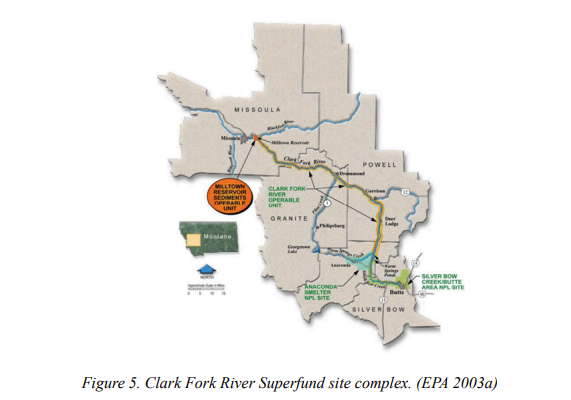 The area was designated as a part of the Milltown Reservoir Sediments/Clark Fork River
Superfund site location under the Comprehensive Environmental Response, Compensation,
and Liability Act (CERCLA) in 1983. This prompted investigations into the sources
of contamination and the causes of variable arsenic concentrations among wells (EPA
2021). Researchers found that the potentially toxic elements introduced by upstream
activities exhibited increased bioavailability depending on the presence or absence
of other reactive elements. Moreover, concentrations of PTEs were significantly higher
in the reservoir than in water discharged downstream through controlled flow paths
(Moore and Woessner 2003).
The area was designated as a part of the Milltown Reservoir Sediments/Clark Fork River
Superfund site location under the Comprehensive Environmental Response, Compensation,
and Liability Act (CERCLA) in 1983. This prompted investigations into the sources
of contamination and the causes of variable arsenic concentrations among wells (EPA
2021). Researchers found that the potentially toxic elements introduced by upstream
activities exhibited increased bioavailability depending on the presence or absence
of other reactive elements. Moreover, concentrations of PTEs were significantly higher
in the reservoir than in water discharged downstream through controlled flow paths
(Moore and Woessner 2003).
Dams and Contaminants
Impounded water susceptible to toxic element formation and accumulation are ones located
downstream of PTE producing sources. The construction of a dam in these areas has
the potential to either assist in the removal of contaminated sediment from downstream
water or increase bioavailability of contaminants through increasing biogeochemical
cycling conditions. In mining areas, the use of sediment and tailing ponds are designed
to collect and concentrate potentially toxic waste and sediment in a defined area,
allowing water free of these compounds
to flow down (Sankaran 2025). Hydroelectric dams and recreational and water supply
reservoirs are not intended for that purpose. These waters, if unintentionally collecting
and producing toxic elements of high bioavailability, present an unforeseen risk to
people and other organisms dependent on the water.
Damming alters both the absolute and relative concentrations of elements by changing
the residence time of water and sediment. Water impoundment significantly modifies
nutrient dynamics within aquatic systems by extending how long materials remain in
place. In this context, residence time refers to the duration an element is retained
in a body of water, serving as the key factor that balances the rate of transport
against the rate of biogeochemical reaction (Maavara et al. 2020). Research shows
that stagnant or slow-moving water limits the natural transport and dilution of nutrients
while facilitating their transformation between soluble and insoluble forms. Compared
to free-flowing streams, reservoirs exhibit much longer residence times, allowing
water and sediment to remain still and enabling more extensive chemical reactions
and microbial metabolism. These transformations are primarily governed by redox conditions,
with oxygen availability exerting a dominant influence on both biotic and abiotic
processes (Wu et al. 2024). Flowing water continually replenishes oxygen, whereas
stagnant, impounded water does not. As a result, oxygen in the water column is gradually
consumed to
depletion, creating anoxic conditions (Friedl and Wüest 2002).
Conclusion
Dammed streams and reservoirs accompanied by anthropogenic contaminants and microbial communities are breeding grounds for harmful elements at their most toxic forms. Retaining or removing these dams without investigating the biogeochemical cycling of elements in the water permits the potential release of toxic water and exposure to all downstream organisms and people. Potentially toxic element cycling in dammed water resulted in a significant Superfund site in Montana, and the consideration of this cycling led to a conclusively positive restoration. With continued generation of hydroelectricity, the risk of biogeochemical changes of elements to a more toxic form and accumulation in sediments can become significant. Additionally, as efforts to reestablish freshwater systems proceed with the removal of dams, risk of potentially toxic exposures could increase. When considering the construction or retention of a dam, anthropogenic influences of the water upstream must be taken into account, and the invisible toxicity impacts that could come along with them.
Natural Contamination Sources: Geogenic Contaminants in Montana Groundwater By Alexander
Von Barleowen
Natural Sources and Distribution: Groundwater Well Contamination
Groundwater is an important source of drinking water in Montana, as a large number of properties that have private wells. While many assume this water to be clean, it is possible for it to be contaminated with inorganic compounds and pathogenic bacteria. Inorganic elements and compounds such as arsenic, and uranium can be dangerous as they are odorless and colorless. A cumulative risk assessment was conducted using 84,000 water quality data points from 6,500 wells across the state of Montana and 19 inorganics were tested for. The inorganics that were tested for include arsenic, uranium, boron, fluorine, manganese, strontium, and zinc. 75% of the 51/81 Montana Watersheds that were tested had a cumulative risk greater than 1, which indicates potential concern. Arsenic and uranium were the two analytes that contributed the most to the cumulative risk assessment. (Eggers et al. 2025).
Well-water quality on reservations is also being looked at. On the Crow Reservation, a study was conducted looking for pathogenic and non-pathogenic bacteria in their well water. Mycobacterium species were detected in 35.1 % of the locations sampled, with 8 in the drinking water fraction. Of the 20 locations that tested positive for mycobacterium, 8 were treated municipal systems and 12 were groundwater well systems. Legionella species were detected in 21% locations sampled with 5 of those in the biofilm fraction, 8 in the drinking water fraction and only one occurrence of Legionella in both the biofilm and drinking water. Of the 12 samples with Legionella, 8 were treated at municipal sites and 4 were in groundwater. Helicobacter species were detected in 7% of locations sampled, with 2 of those in the biofilm and 2 in the drinking water. There were no occurrences of Helicobacter in the drinking water and biofilm concurrently. All of the positive samples were identified by PCR (Richards et al. 2018).
Arsenic and Fluoride Contamination in River Systems
River systems in close proximity to geothermal areas are prone to water contamination with arsenic and fluoride due to the high temperatures releasing these compounds and making them more soluble (Stauffer et al. 1980). Yellowstone National Park is a prime example of an area where this happens. In geysers around the park, arsenic levels range from 900 to 3560 µg/L . The geothermal areas in the park feed arsenic and fluoride into the Firehole and Gibbons Rivers, which in turn flow into the Madison River (Thompson et al. 1979). Average total recoverable arsenic levels from the Madison River starting at West Yellowstone to its convergence at Three Forks ranged from 270 µg/L to 69 µg/L. Average total recoverable arsenic levels from the Missouri River starting at Toston to Culbertson ranged from 30 µg/L to 4 µg/L (Nimick et al. 1998). These levels of arsenic are unsafe for human health as the EPA’s standard for safe drinking water is 10 µg/L of arsenic (EPA). These high levels of natural contaminants in the Madison and Missouri Rivers call into question the safety of the drinking water for the people living near these river systems.
Human Health Implications
Arsenic is a naturally occurring element that can have detrimental effects on human health. When unsafe levels of arsenic (<10 µg/L ) are ingested in drinking water, characteristic skin manifestation, vascular disease, renal disease, neurological effects, cardiovascular disease, chronic lung disease, cerebrovascular disease, reproductive effects, and cancer of skin, lungs liver, kidneys, and bladder can all occur (Singh et al. 2007). In children arsenic in drinking water can lead to decreased visual perception, reduced intellectual function, and lower heights (Wasserman et. Al 2004 Siripitayakunkit et al. 2000).
Uranium is also a naturally occurring element and as a radioactive element, there
are a variety of negative effects relating to human health. A major effect is kidney
toxicity that leads to renal failure and death (Chandrajith et al. 2011). Oral administration
of uranium (drinking it in water) can lead to nausea, vomiting, and diarrhea. Paralytic
ileus also can develop which causes paralysis of the muscles in the small intestine
(Domingo et al. 1987). In regions with high levels of Uranium in drinking water, a
correlation between thyroid cancer was found (van Gerwen et al.
2020).
Effects of Pathogenic Bacteria on Humans
Bacteria in drinking water can also have detrimental effects on human health. Mycobacteria
sp., Legionella sp., and Helicobacter sp. have all been found in well water around
Montana and each have negative effects on humans. Mycobacteria in drinking water is
believed to be connected to cervical lymphadenitis in children which causes the lymph
nodes in the neck to become inflamed (Primm et al. 2004). Mycobacteria tuberculosis
is a famous species of
mycobacteria that affects the lungs and leads to death. Non-tuberculosis mycobacteria
are increasingly being encountered and identified as human pathogens (van Ingen et
al. 2009). Legionella in drinking water also leads to multiple types of disease in
humans, Legionnaires disease and Pontiac fever. Legionnaires disease affects the lungs
and eventually leads to pneumonia. Heliobacter in drinking water can also lead to
disease in humans including
esophageal cancer, functional dyspepsia, gastroesophageal efflux disease, asthma,
and cardiovascular diseases (Mohebtash, Mahsa 2011).
For arsenic contamination in water, there are a variety of ways it could possibly
be removed including ion-exchange, coagulation/flocculation, phytoremediation, oxidation,
adsorption, bioremediation, and ultra-filtration. Ion-exchange works by replacing
arsenic anions in a liquid with harmless anions on a solid in highly insoluble solutions.
This technique works better when dealing with As(V) than with As(III). Coagulation/Flocculation
works by
coagulating, or sticking together the particles of arsenic in water, followed by filtrating
those particles out. This method is fairly simple and efficient and can be applied
at large and small scales. Phytoremediation method is when plants uptake arsenic from
the soil. This method could be used to remove arsenic concentrations from soil, which
in turn could help remove groundwater concentrations. The oxidation method works by
oxidizing As(III), which is very mobile, into As(V) a less mobile form of the element.
Oxidizing agents such as ozone, chlorine, bleaching powder and hydrogen peroxide are
used. The adsorption method works by using compounds such as ferric hydroxide and
activated alumina to attach arsenic to their surface. Bioremediation works by using
microorganisms to remove arsenic from environments. Ultrafiltration works by using
hydrogen peroxide to convert the mobile As(III) into As(V) and then using micellar-enhanced
ultrafiltration to remove the arsenic (Dilpazeer et al. 2023).
Uranium has less variety for possible remediation strategies. The most widely used strategy is that of ion-exchange. At pH levels higher than 6 uranium exists in aqueous solutions and the theoretical removal capacity is higher than other common elements found in drinking water such as arsenic and selenium. This strategy has greater than 95% effectiveness at removing uranium. Other strategies include reverse osmosis, permeable reactive barriers using zero valent iron, and adsorption media each with greater than 90% effectiveness at removing uranium (Katsoyiannis et al. 2013).
In relation to pathogenic bacteria, filter materials coated with silver nanoparticles have been tested to determine their effectiveness at removing these organisms from groundwater. These filters were tested on the removal of E.coli and at high concentrations, 0.1 mM, there was removal effectiveness ranging from 21% to 100%. At low concentrations, 0.01 mM, there was removal effectiveness ranging from 7% to 50% (Mpenyana-Monyatsi et al. 2012). Filter materials coated with silver nanoparticles are a fairly cost-effective way to remove pathogenic bacteria from water. Another method that was more successful was using biologically active filters. E.coli was reduced by 99%, E. faecalis was reduced by 99% and P. aeruginosa was reduced by 92% (Steven et al. 2022).
Remediation Issues
The issues with remediating arsenic from groundwater include costs associated with certain methods and dealing with different forms of arsenic. Many of these remediation techniques are too expensive for an average household to conduct such as the coagulation method. However, methods such as bioremediation (although somewhat tricky) and ultrafiltration are fairly low in cost. The other problem is converting As(III) into As(V) as the prior is more mobile and harder to remove from the environment (Dilpazeer et al. 2023). This step seems to be necessary in every form of arsenic remediation.
The issue with removing uranium from water is disposing of the waste as there are very specific regulations that need to be taken into account. The type of waste, concentration of uranium, co-occurring contaminates, and state/local regulations need to be considered. To dispose of material with unsafe levels of uranium, sanitary sewer systems or solid drying beds must be used (Katsoyiannis et al. 2013).
The issue with removing pathogenic bacteria from groundwater is that there are not many effective techniques available. Using filter materials coated with silver nanoparticles is a cost-effective technique, however the success rates are highly variable and not reliable (Mpenyana-Monyatsi et al. 2012).
Protecting and Restoring Water Quality
Parasitoids as an Integrated Pest Management Strategy By Isaac Olson
In modern agriculture, pesticides are widely used to protect crops from pests, but
this use also comes with significant environmental and health drawbacks. While pesticides
do a great job of removing pests from a community, they have other implications on
human health and the ecological systems that they are applied to. The effects of pesticide
use are becoming more apparent all over the Northern Great Plains in soil and water
health along with the biota that live within those ecosystems. With evidence linking
insecticides to neurological diseases, continuing their widespread use poses unacceptable
risks (EPA, 2025). Transitioning toward innovative and
sustainable pest management practices offers a safer alternative and a path toward
phasing out these hazardous chemicals. Although pesticides are known as one of the
most effective ways to manage pests and maximize yield, they may not be the healthiest
or safest in regards to our environment. Natural biological controls offer environmentally
safer alternatives to harsh insecticides, and using a general or specialized parasitoid
to reduce pest abundance may be a promising option. While not every pest has a parasitoid
capable of achieving economically significant parasitism, research shows that parasitoids,
when paired with other strategies, can
support safe and sustainable pest management.
Across the Northern Great Plains, where pesticide effects are becoming more visible,
sustainable pest management practices are beginning to take hold. Simple and effective
strategies are being implemented in smaller farms across the Great Plains in regard
to weed control, like the use of natural predators to reduce invasive species. These
strategies have reduced the need for herbicides in smaller agricultural settings and
are beginning to be implemented on larger scale farms all over the Northwest. These
examples demonstrate that natural biological
interactions—predators, pathogens, or parasitoids—can reduce dependence on chemical
pesticides when incorporated into integrated pest management.
Unlike parasites that coexist with their hosts, parasitoids complete their development by feeding on and eventually killing the host, making them an effective natural pest control agent. Although parasitoids vary in which host life stage they target, most attack eggs or larvae when the pest is most vulnerable. Many parasitoids are small wasps or flies specialized for particular hosts or host stages. Because they directly kill their hosts and tend to be host-specific, parasitoids can naturally reduce pest populations while maintaining crop health without chemical inputs.
One major cereal crop suffering heavy yield loss from pests in the Northern Great Plains is wheat. Much of this loss comes from pests that feed on the developing seeds or the pith inside the stem. The wheat-stem sawfly is especially damaging and largely unaffected by conventional pesticides because it spends most of its lifecycle inside the wheat stem. This protection makes sawflies uniquely difficult to control and highlights the limits of chemical management in certain pest systems. New innovative strategies include using specialized parasitoids and pest-resistant crop varieties to decrease the sawfly population. Research has also explored biological alternatives such as specialized fungi and nematodes. Two parasitoid wasps—Bracon cephi and Bracon lissogaster—show parasitism rates high enough to potentially reduce sawfly populations (Portman et al., 2018). Although rearing these parasitoids is challenging because they require sawfly-infested stems for development, research continues to identify feasible release methods.
In practical agricultural settings, these wasps could be reared by identifying small patches of heavily infested wheat, enclosing them in fine mesh, and releasing adult parasitoids inside. This targeted approach offers a realistic pathway for local rearing and field establishment. Research in Montana suggests that sucrose supplementation drastically increases parasitoid longevity and egg load. Bracon cephi lived an average of 10 days in the control and 30 days with sucrose, while Bracon lissogaster increased from 6 to 52 days (Reis et al., 2019). Sucrose also increased egg production; for example, B. cephi produced four mature eggs after six days compared to one in the control group. Although egg load was measured by dissection rather than lifetime parasitism, field-based tests could confirm how supplemental nutrition influences total reproductive output.
Successful biological control also relies on crop management decisions. The timing and height of harvest influence parasitoid survival because both Bracon species overwinter in the lower 10% of the stem (Beres et al., 2025). Cutting stems too low removes the overwintering habitat, reducing parasitoid populations the following year. Planting later-maturing wheat varieties can also increase parasitism because it shortens the time sawflies have to form their protective hibernacula, making them more vulnerable (Reis et al., 2019).
While these biological controls show promise for the wheat-stem sawfly, other pests
like the orange wheat blossom midge are still largely managed with insecticides. Chlorpyrifos
is commonly used, but its application can overlap with parasitoid emergence and unintentionally
harm Bracon populations (Beres et al., 2025). Chlorpyrifos also poses major risks
to human health by disrupting nerve function (Christensen et al., 2024). This creates
a dangerous tradeoff: controlling one pest with chemicals may inadvertently increase
another by killing its natural
enemies.
Fortunately, the wheat blossom midge has its own natural parasitoid—Macroglenes penetrans—which can reduce midge populations by 40–80% without human intervention (Thompson & Reddy, 2016). This demonstrates that suitable biological alternatives already exist for major cereal pests and could significantly reduce reliance on harmful organophosphate insecticides.
Pesticides remain a widely used tool in agriculture, but growing evidence demonstrates that alternatives can maintain yields while protecting ecosystem and human health. Parasitoid-based management will not replace chemical control for all pests, but it represents a critical step toward reducing insecticide dependence and developing more resilient, ecologically grounded pest management systems. As agriculture adapts to new environmental and economic pressures, integrating parasitoids alongside cultural and genetic strategies may help shift production away from hazardous chemicals and toward long-term sustainable solutions. This shift also intersects with broader environmental concerns, such as chemical contamination of soils and water, including PFAS-related issues. Developing safer biological pest management is one component of reducing chemical inputs across agroecosystems and aligning agriculture with more sustainable, low-toxicity practices.
Evaluating Biochar as a Remediation Strategy for PFAS By Brenna Matthews-Jackson
Per- and polyfluoroalkyl substances (PFAS) are quickly emerging as one of the most persistent and concerning environmental contaminants, resisting natural degradation and accumulating in water and soil across Montana. They are synthetic chemicals valued for their water repellent and grease repellent properties in products such as firefighting foams, nonstick coatings, and packaging. Their chemical stability allows them to accumulate in soils and water across Montana and persist over long periods of time. This includes areas near airports and military sites (Ehsan et al., 2025). PFAS are expensive to remove once released into the environment and pose significant ecological and human health risks. As Montana searches for sustainable and low-cost solutions for water treatment, biochar is rising as a promising solution. Biochar is a carbon-rich product of pyrolysis and could be the key for PFAS remediation in Montana that is both climate-conscious and practical.
PFAS persist due to their strong carbon-fluorine bonds, resisting breakdown by heat, sunlight, and microbes. These compounds have been detected at elevated levels across U.S. freshwater systems as they bioaccumulate in aquatic organisms. PFAS exposure is linked to thyroid disorders, cancer, immune dysfunction, and reproductive problems, even at trace concentrations. There are health advisories set by the U.S. Environmental Protection Agency (EPA) of 4 parts per trillion (ppt) for both PFOA and PFOS in drinking water. In amphibians and fish, PFAS have the ability to impair growth and disrupt entire food webs. For Montana’s rural communities that depend on local fisheries and shallow aquifers, PFAS persistence threatens both the safety of drinking water and ecosystem health.
Understanding the sources of PFAS is key for mitigation. In Montana, aqueous film-forming foam (AFFF) is the main contributor, which has historically been used at military bases and airports, such as the Malmstrom Air Force Base near Great Falls. Decades of training has led to PFAS leaching into nearby soils and groundwater, reaching concentrations exceeding hundreds of ppt. Landfills also release PFAS as consumer products like packaging or waterproof textiles degrade. Industrial processes can discharge PFAS-laden wastewater as well. Due to conventional treatment systems not effectively removing PFAS, contamination continues to spread through wastewater and surface water, specifically in regions that don’t have centralized infrastructure.
While conventional PFAS treatments like high-temperature incineration, activated-carbon adsorption, ion-exchange resins, and membrane filtration are able to remove or destroy PFAS, they are costly and energy intensive. Incineration requires extreme levels of heat, and filters and resins require frequent replacement and safe disposal afterwards as they produce concentrated streams of waste. For Montana’s small, decentralized systems, these technologies are impractical as the state often lacks the infrastructure and/or funding for such advanced treatment methods. Biochar, however, doesn’t create mobile streams of waste, but rather immobilizes PFAS within its porous carbon structure, making it a lower-risk and vastly more feasible, cost-effective, option for Montana’s rural water systems.
Biochar is produced through pyrolysis, by heating organic materials like crop residues or wood chips in limited oxygen environments. This forms a stable, porous carbon matrix. Its high surface area and reactive sites make for effective binding by PFAS through hydrophobic and electrostatic interactions. Biochar can also be tailored for specific contaminants by adjusting the feedstock and pyrolysis temperature. Studies have shown biochar pyrolysis at higher temperatures adsorbing long-chain PFAS more effectively, while biochar modified with iron or magnesium are able to capture both long- and short-chain forms. (Fabregat-Palau et al., 2022; Liang et al., 2024; Teng et al., 2024). This tunability is what makes biochar very adaptable to the chemical diversity of PFAS and the variable soil and water conditions seen across Montana.
Montana has various agricultural and forestry sectors that each produce an abundance
of residues. These residues could serve as feedstock for biochar production which
makes biochar serve the dual purpose of also supporting a circular-economy by turning
waste into a resource. Decisions regarding whether to divert residues for biochar
or to leave them in fields should remain site specific, however, as they hold many
soil-health and water-retention benefits. After filtration, biochar that has been
regenerated or safely disposed of could even be incorporated
back into soils to enhance fertility and water storage. The contaminated material
must be handled carefully to avoid any chemical re-release. Biochar’s long-term stability
also means that maintenance costs are significantly reduced compared to methods like
activated carbon or synthetic resins (Behnami et al., 2024).
Despite its promising qualities, biochar is far from the perfect solution. Not only does the adsorption efficiency vary among different PFAS types, but spent biochar also has the potential to re-release contaminants if not properly regenerated or disposed of. Thermal regeneration may also weaken its structure or release adsorbed PFAS, and inconsistent feedstocks can produce even more variability in results. It is essential to do field-scale testing and use standardized guidelines to ensure reliable outcomes before large-scale application will be feasible.
PFAS contamination from firefighting foams, landfills, and industrial waste has left lasting “forever chemical” legacies in Montana’s freshwater systems, and conventional treatments are costly for the state’s rural infrastructure. Biochar offers a locally sourced, low-costs alternative that aligns with community-based stewardship and environmental goals. Its carbon-rich structure is able to adsorb pollutants while also contributing to carbon sequestration and the state’s circular economy. Integrating biochar filtration into future greywater-reuse systems could even further extend Montana’s depleting freshwater supply and reduce overall PFAS exposure. Biochar may be the solution and the bridge between pollution cleanup and sustainable water management, especially as water quality and reuse becomes increasingly connected.
Anthropogenic Changes & Demands Down Stream on Water Resources in Response to Climate Change: Graywater By Benjamin Aupperle
While biochar can reduce PFAS contamination on a broad scale, local communities such
as Bozeman face immediate challenges from increasing water demand and household wastewater
containing persistent chemicals. Graywater reuse, which captures water from showers,
sinks, and laundry for non-drinking purposes, offers a practical solution that addresses
both local water scarcity and ongoing chemical pollution at the household and community
level. It reduces freshwater withdrawals, decreases the pollutant load entering treatment
systems, and
complements larger-scale remediation efforts. Implementing graywater reuse in Bozeman
provides a sustainable way to manage water resources as the city continues to grow.
Graywater comes from household uses like showers, sinks, and laundry, other than toilets or highly contaminated sources. Since it has fewer pathogens and solids than blackwater from sewage or drains unsafe due to microbial contamination, it can be treated and reused for things that don’t require drinking-quality water (Reclaim Water, 2025). Reusing graywater conserves freshwater and decreases the volume of wastewater that treatment plants must process. Learning to treat and reuse graywater safely is critical for communities like Bozeman, which face growing pressure on limited water resources. Understanding the characteristics and potential of graywater highlights its relevance for communities like Bozeman, where a growing population and semi-arid conditions are placing increasing pressure on limited freshwater resources.
Bozeman’s growing population and semi-arid climate have made water conservation a
concern. Rapid population growth is steadily increasing water demand. If current trends
continue, the city could eventually need more water than its legal water rights allow.
Graywater reuse can reduce reliance on freshwater while providing water for essential
non-potable uses such as irrigation, toilet flushing, and some industrial processes.
The treatment process typically begins with filtration to remove solids, followed
by biological or chemical methods to eliminate
organic matter and trace contaminants. Treated graywater can then be safely used for
non-potable purposes, helping advance toward a sustainable water cycle focused on
capture, treatment, and reuse rather than single-use disposal.
Constructed wetlands provide a low-energy and effective method for treating graywater in Montana’s cold, semi-arid climate. These systems mimic natural wetlands by using soil, plants, and microorganisms to remove suspended solids and nutrients. As graywater moves slowly through the wetland, sediments settle, and plants and microbes absorb and transform organic matter and nitrogen compounds (Kim et al., 2009). Even in colder months, microbial activity continues to reduce pollutants. Research indicates that constructed wetlands can remove over 90% of nitrogen and biochemical oxygen demand (Sanni et al., 2025). Small wetland systems could be implemented in community green spaces or residential areas, providing a natural complement to engineered treatment systems. While constructed wetlands offer a natural, low-cost solution, engineered systems provide greater control and consistency in water quality, particularly for urban applications.
Emerging engineered systems build on natural methods by enhancing contaminant removal. Activated carbon filters use highly porous carbon to capture PFAS, soaps, and trace pharmaceuticals (Asheghmoalla & Mehrvar, 2024). This approach differs from biochar, a natural, carbon-rich material derived from biomass that performs well in low-cost or distributed systems. Membrane bioreactors (MBRs) combine biological degradation with fine-pore filtration to efficiently remove suspended solids, pathogens, and nutrients. Electrocoagulation, another promising method, uses electrical currents to clump and separate contaminants without the need for added chemicals. Together, these systems create flexible options for graywater reuse depending on scale, cost, and contaminant type.
A practical example comes from the Shanghai Tower in China, where coagulation-flotation
pre-treatment combined with an MBR system treated high-nitrogen graywater from residential
and commercial use. The nitrogen levels were high mainly due to detergents and organic
matter in the water. The system produced clear, low-ammonia water suitable for irrigation
and toilet flushing (Liu et al., 2018). While biological activated carbon
filters can handle large water volumes, they require frequent maintenance due to clogging.
In Bozeman, decentralized MBR units could be applied on agricultural sites such as
livestock ranches or heavily fertilized farms to capture and treat graywater on-site.
This approach enables water reuse for irrigation or non-potable purposes, reduces
nutrient runoff, and eases pressure on municipal wastewater systems. This localized
approach reduces strain on the municipal system and supports a circular urban water
model.
By integrating natural and engineered graywater systems, Bozeman can demonstrate how local solutions address growing water demands and promote sustainability. Thoughtfully designed systems that incorporate wetlands and advanced filtration can reduce freshwater demand, limit wastewater volumes, and strengthen resilience to drought. When graywater is treated and reused rather than discarded after a single use, it creates a closed-loop system that conserves resources while supporting the health of the local watershed. With careful planning, supportive policies, and community education, Bozeman can serve as a model for sustainable, community-scale water reuse in Montana and other semi-arid regions, demonstrating how local solutions can address both environmental challenges and growing water demands.
Transitioning Away from Traditional Agricultural to Regenerative Practices Regenerative
Ag as a Solution
By Bode Kostick
Since the beginning of the 20th century, industrialization has been the hallmark of
modern agriculture. The transition towards industrialization has caused a rise in
mechanization, use of genetically uniform monocultures, and consolidation towards
fewer larger farms (Center for a Livable Future, 2025). These factors, and a host
of others, are what has landed us in our modern industrialized agricultural system.
It is how industrial agriculture (IA) farms have been able to produce common goods
at lower costs without price premiums (Durham & Mizik, 2021).
These practices, as mentioned, can acidify and erode soil and organic matter, leach
inorganic fertilizer and pesticides into our waterways, pollute the air through mining
of fertilizers and use of fossil fuels, and are detrimental to our soil, air, downstream
waterways, and human health (Horrigan et al., 2002).
Organic Agriculture (OA) was one of the first transitions away from IA that was developed
in the late 20th century. With the organic certification approved in 1972 (Leu, 2019),
it has been around for long enough to display advantages over IA, the biggest advantage
being that OA is less environmentally detrimental than IA. It has less severe impacts
on water quality, is better for soil health, and consumes less energy (Delate et al.,
2015). However, with OA you can still use naturally derived pesticides and “organic
fertilizers.” (Durham & Mizik, 2021). Regenerative agriculture (RA) is an improved
concept that builds off the foundations of OA. RA prohibits the use of outside fertilizers
unless crop nutrient demand dictates it. In dryland areas during seasons with low
rainfall, imported N and P are allowed. Only organically approved pesticides can be
used and are applied at the lowest efficacious rate; all effort is taken to find alternative
controls (Regenerative Organic Alliance, 2023). RA overall advocates for animal
welfare, social fairness, and takes a more critical look at soil health (Rodale Institute,
2023). With the threat of climate change increasingly impacting our agricultural systems,
it is imperative to transition away from IA. A transition to adopt RA practices into
IA and OA is essential to sustain healthy ecosystems and help combat climate change.
Industrial Agriculture
Industrial agriculture relies heavily on external inputs like chemical fertilizers,
pesticides, and fossil fuels. It prioritizes short-term yield over long-term ecological
structure and function (Aguilar & Paulino, 2025). Industrial agriculture contributes
to soil degradation, biodiversity loss in agricultural systems, and substantial greenhouse
gas emissions (Aguilar & Paulino, 2025). Due to the output of greenhouse gas emissions
into the atmosphere, IA is becoming a threat to the well-being of the globe. IA, while
doubling global grain production in the past 60 years,
increased the global warming potential (GWP) eightfold. The main contributors to GWP
are tillage, synthetic fertilizers, and increased need for irrigation (Abdo et al.,
2025). GWP, as defined by the EPA, is the measure of how much energy the emission
of 1 ton of gas will absorb over a given period, relative to the emission of 1 ton
of CO2. The higher the GWP, the greater the warming effect of that gas on the Earth
(EPA, 2016). Without any mitigation, the GWP of grain production is projected to increase
threefold by 2100 (Abdo et al., 2025). This is linked with crop
yield globally being projected to decrease in the future. With the most severe climate
change scenario and without any mitigation and adaptation, simulated crop yields in
the future are projected to decrease 7% to 23%. This is coupled with a projected increase
in global total food demand of 30% to 62% by 2050 (Rezaei et al., 2023). The issue
is that crop production cannot come from increased conversion of land to new farmland,
and farmland cannot be converted to housing developments. The immense threat to biodiversity
and the environment is not worth the cost. Increased production needs to come from
higher crop yields (Rezaei et al., 2023). Even then, lands with potential for future
agricultural expansion have lower productivity than compared with current lands (Abdo
et al., 2025). While these factors are all detrimental, the food production from IA
is unmatched. The necessary strategy is to increase yield by improving water conservation
and soil health, while decreasing fertilizer and pesticide usage. The way to improve
these factors is through transitioning to alternative agriculture methods like organic
and regenerative.
Organic Agriculture
The term “or ganic farming” was popularized by J.I. Rodale in the 1940s with the express goal of improving soil health and building up humus through practices that recycle organic matter. The organic movement began in the late 1800s as a response to industrialized agriculture. It arose over the concern of loss of crop quality from diseases and pest attacks, with the introduction of chemical fertilizers (Leu, 2019). This pioneering work by J.I. Rodale eventually led to the formation of the International Federation of Organic Movements (IFOAM).
IFOAM is the international organic governing body formed on November 5, 1972. It is an umbrella movement that seeks to unite and lead the organic sector around the world. They set international standards for policies and definitions on OA (Leu, 2019). The term “Organic Agriculture” as defined by the IFOAM, is a production system that sustains the health of soils, ecosystems, and people without the use of inputs that could have adverse effects. It relies on ecological processes, biodiversity, and biogeochemical cycles that are adapted to local ecosystems. The four principles of OA are the principles of health; ecology; fairness; and care (IFOAM, 2008). All four principles are thought of as equals; one cannot exist without the other.
Critically, OA can either underperform or outperform IA. A comprehensive meta-analysis
conducted on the yield potential of OA and IA farming systems shows a lower yield
compared to IA. OA globally has 5% to 34% lower yields than IA. With the best organic
practices being used there is an average of 13% decrease in yields compared to IA.
However, this depends heavily on each system and its unique characteristics. Under
conditions of good management, particular crop types, and growing conditions, OA can
almost match IA yields (Seufert et al., 2012).
Yields, as well, are not the sole factor to consider in farming practices. They are
important for sustainable food security, but OA takes into consideration the benefits
towards the social, ecological, and economic systems. The advantage of OA in the face
of climate change is worth considering as well. During periods of drought, IA’s resiliency
is greatly impacted. OA significantly outperforms IA during these periods and has
consistently higher yields by 70-90%. This is attributed to the soil’s higher water-holding
capacity (Lotter et al., 2003) and water-infiltration rate (Delate et al., 2015).
OA advocates for a more holistic, ecologically beneficial system of agriculture that
can sustain crop production during prolonged drought due to climate change.
Regenerative Agriculture
As defined simply by Regeneration International, “the opposite of regenerative is
degenerative” (Regeneration International, 2025). IA is degenerative while regenerative
agriculture (RA) is a holistic systems approach that encourages continual innovation
for environmental, social, economic, and spiritual well-being. It is characterized
by improving the land that is used, rather than degrading it. The primary aim of RA
is to increase soil organic matter (SOM) (Leu, 2019). SOM is the substrate and habitat
of soil microorganisms and fauna (Schnitzer & Monreal, 2011). By improving the SOM
content in the soil, it is regenerated and revitalized and in turn, so is the environment.
RA treats soil as a non-renewable resource. Its loss and degradation is finite and
is non-recoverable within a human lifespan (FAO, 2015). With improved soil health
and greater focus on conservation, RA can make farms more resistant. It can increase
resilience to extreme weather events, contribute to higher amounts of water retained
in soil, increase the abundance of beneficial soil biota, and increase nutrient bioavailability
(Leu, 2019). RA is an essential tool for combating the effects of climate change.
Carbon emissions alone have had a fourfold increase in the past 60 years (Abdo et
al., 2025). However, soils from RA can be considered healthier than IA, meaning there
is more SOM, greater levels of microbial activity, and greater potential to sequester
carbon in the soil. According to some sources, RA has the potential to mitigate climate
change (Rodale Institute, 2014, pg.2). RA could be a step back in time to return to
our natural agricultural roots. RA could be hugely beneficial to current agricultural
operations with its potential to sequester carbon and improve SOM.
Farming Systems Trial
The Farming Systems Trial (FST) by the Rodale Institute (RI), started in 1981 and
is the longest-running study in the U.S. comparing industrial, organic, and regenerative
organic agriculture. The RI is an organization founded in 1947 by J.I. Rodale. It
seeks to advance the regenerative organic agriculture movement through rigorous scientific
experimentation, farmer training, and education (Rodale Institute, 2025). The FST
is characterized by its longevity,
simplicity, and display of OA and RA response to drought conditions. The FST is arguably
one of the most effective studies that has analyzed these farming systems, and is
located in Kutztown, Pennsylvania. The soil type at the farm is a moderately well-drained
Comly silt loam (Delate et al., 2015).
In the FST the IA plots are a conventional synthetic system representing a typical U.S grain farm. OA plots are an organic legume cover crop system representing a traditional organic cash grain system. RA plots are an organic manure system that uses those same leguminous cover crops and periodic applications of composted manure from livestock (Rodale Institute, 2025). The crops chosen were based on typical crops grown in Pennsylvania. The conventional system grew corn and soybeans for 23 years, then wheat was added in 2003. Both organic systems grow corn, soybeans, wheat, red clover, alfalfa, and hay. In 2008, genetically modified crops and glyphosate no-till treatments were added to the conventional plots (Delate et al., 2015).
The FST analyses factors of soil health measured using the Cornell comprehensive assessment of soil health (CASH) (Rodale Institute, 2025). Unique CASH assessments are made to represent different regional areas and their different needs. Overall, it measures 30 physical indicators, and more than 10 biological, chemical, and crop observation-based indicators of soil health. The physical factors range from ‘soil feel,’ crusting, water infiltration, retention or drainage, and compaction. Soil biological properties encompass soil smell, color and molting, earthworm, or overall biological activity. Crop indicators include root proliferation and health, signs of compaction, legume nodulation, and signs of residue decomposition (Moebius-Clune et al., 2016).
The results over the course of the 44-year study show the promise of organic and organic regenerative agriculture. The FST has been able to analyze a period known as the “transition effect” and was one of the first long-term trials to report on this effect. The transition effect is the transition from conventional to organic agriculture, a period that lasts 36 months. After an initial yield decline during the transition years, organic grain yields eventually matched the conventional grain yields (Delate et al., 2015).
Since 2008 with the addition of genetically modified crops and glyphosate to the system, conventional yields have not improved over organic yields. Organic yields have also shown greater resiliency during drought periods. During a drought year in 2016, organic corn yielded 8,411 kg ha-1 and conventional corn yielded 6, 403 kg ha-1 (Delate et al., 2015).
The FST was one of the first studies to monitor underground water quality using a
lysimeter. It helps to assess the NO-3-N leachate out of the system. In conventional
systems, the leachate exceeds the drinking water standard of 10 ppm, while the organic
systems did not. In an analysis of the energy used in the manufacturing, transportation,
and application of fertilizers identified that the organic systems used 45% less energy
than the conventional system. The N fertilizer alone accounted for 41% of the total
energy consumption. Similarly, GHG emissions
associated with the conventional system were 40% greater per volume of production
than the organic systems (Delate et al., 2015).
Organic systems can be economically competitive with conventional agriculture. Only a 10% premium is needed to achieve the same economic viability as the conventional system. When actual organic price premiums were compared, the organic systems achieved 2.9 to 3.8 higher returns than the conventional system. The FST demonstrates that organic and regenerative organic can match conventional yields, resist drought conditions, leach less nitrate, produce less fertilizer related energy, and be economically viable.
Discussion
Without a doubt, IA food production is unmatched. IA has been able to double grain production in the past 60 years. Most farmers in the U.S. practice a form of this agriculture. It is usually consistent, predictable, and has worked for decades. However, climate change is challenging the viability of IA. No longer can the production be as consistent year after year. Once predictable patterns are becoming less certain, we will continue to see this unpredictability.
The most pertinent solution must be a transition away from these conventional practices. It is necessary to preserve our finite water and soil and protect our air. The way to do this is to incorporate organic and regenerative practices into our current industrial practices. We need to help farmers understand that our soil is not simply a growing medium, but a living breathing dynamic resource that must be conserved. Farms must be considered ecosystems that can nourish the soil, animals, and microbes, if you treat them right. The benefits of this resource cannot be mitigated by overuse of pesticides and fertilizers. In treating plants and animals more naturally, the benefits toward human life can be numerous.
There are two possible solutions to achieve this. One solution must involve a cooperative
government that provides subsidies to RA farms that can have competitive pricing equivalent
to OA, and IA. This can make it so people do not have to choose between their health
and the health of the environment; they can support regenerative practices without
weighing on their wallet. However, this relies on large-scale farms and requires small
incremental change to transition all of IA agriculture. The other solution is small.
Small farms that have no
mechanization and yield maximization. They create a better connection between the
consumer and the product. We must shrink our farms to small backyard plots with backyard
chickens. Gardens would provide healthy produce, that could subsidize purchasing those
at the store. The chickens could eat what you cannot. The cost could be governmentally
subsidized, and extension specialists could provide the necessary education. This
solution could take the strain off our global food supply chain and help mitigate
emissions. It could create a greater awareness of our food system and could help us
be more mindful of how our food ends up on our plate. Both
solutions I believe are viable; it is up to us to choose which will benefit us and
the planet the most.
Unpredictable Precipitation & Adoption of Sustainable Agriculture Practices in North
Dakota By Alyssa Harmel:
Challenges of Changes in Climate
Rises in global carbon dioxide levels are contributing to increases in temperature and precipitation variability in the Northern Great Plains (NGP) region. Precipitation variability includes unpredictability of both frequency and intensity of precipitation events. Locally, this will impact the agricultural integrity, or long-term sustainability of agriculture practices, of the NGP region. The NGP has seen an average temperature increase of 1.7 ℉ over the past few decades, greater than that of any other region in the U.S., as well as an increase in severe heat events. In addition, precipitation patterns in the NGP have shifted in favor of increasing precipitation amounts in spring and fall and decreasing amounts in the winter months. Extreme precipitation event frequency has also increased, resulting in higher amounts of precipitation in shorter periods of time, which does not always favor an increase in effective precipitation (Cross et al., 2021). These irregularities in precipitation timing in the region have a large influence on agricultural productivity, making agriculture in the region environmentally and economically vulnerable.
For this review, I will consider precipitation variability in North Dakota (ND). ND receives greater precipitation amounts than its western neighbor, Montana, but still experiences moisture differences across the state. Precipitation in North Dakota is expected to continue to increase during colder spring and fall months, aligning with predictions for the NGP region. This has potential to increase soil moisture but would delay the crop planting season and potentially impact harvest timing. This predicted precipitation increase during colder months is also thought to result in greater drought intensities for the state, because rising temperature rates could influence an increase in evaporation of colder-season precipitation (Frankson et al., 2022). In response, North Dakota crop producers have begun to utilize mitigative approaches to maintain yield and minimize potential soil health impacts in a time of irregular precipitation and greater drought risk.
Based on these considerations, the question driving this review is: How do unpredictable precipitation patterns affect the adoption of sustainable agriculture practices in North Dakota? The goal of this review is to assess North Dakota producer insight of strategies for maximizing water usage in a time of unpredictable precipitation variability.
North Dakota Agriculture
To better understand production pressures that are associated with increasing precipitation irregularity patterns in North Dakota, I consulted Kipp Harmel, a crop producer from Rugby, ND. Harmel gave producer insight for the 2025 growing and harvest season in north-central North Dakota, as well as for observations of water use efficiency strategies applied in the area. His observations of the 2025 season and the strategies that have come along with the season’s variability serve as recognition for each producer’s crop rather than an average, as well as the hard work put into each yield.
When asked, “What did this past growing/harvest season look like in central ND in relation to weather impacts?” Harmel had observational insight that aligned with current climate predictions of precipitation variability for the state. As previously mentioned, precipitation drives not only yield but also crop production timing. Over this past crop production season, April-September, central North Dakota producers experienced a later planting season and harvest season because of irregular precipitation event timing, as well as immense weed pressure. Many producers were not able to plant wheat until late spring for the 2025 crop season due to high precipitation frequency during the normal planting timeframe. Once the crop emerged, later than usual, many producers integrated pesticide application. Subsequent to application, rain fell yet again, resulting in pesticide removal and weed pressure. Heat and dryness increased throughout the summer, resulting in reduced crop productivity from drought impact and even greater weed pressure. Many producers applied pesticides again for the sake of their yield around the “normal” harvest window of August, but were then hit with additional, unexpected rainfall. This final rainfall not only washed off the applied pesticide a second time, but postponed the harvest season. At the time of the interview, September 28, 2025, many producers in central ND were still harvesting their wheat crop from the season (K. Harmel, personal communication). Crop production timing relies on precipitation patterns, and today’s increasing precipitation variability is making production economically and environmentally vulnerable.
Challenges Related to Soil Health
Precipitation irregularity not only impacts crop production timing but also has substantial effects on soil health. In agriculture, minimizing soil disturbance and maximizing surface cover is the most effective way to maintain, or even enhance, the health of a landowner's soil (USDA, n.d.). By minimizing disturbance and maximizing coverage, soil-water infiltration capacity is strengthened, and soil health is maintained. This is integral to crop production as precipitation patterns become more irregular and unpredictable, because soil health can be the determining factor of drought resilience.
Accounting for crop residues in agriculture is one of the most proficient ways to
minimize soil disturbance and maximize soil surface coverage. Crop residue, the remaining
biomass of a crop after harvest that includes stubble and chaff, is a large factor
in soil surface coverage when less disruptive agricultural practices are implemented.
Not only are crop residues an input of organic carbon and nutrients into the soil,
but the physical residue is essential to
water retention (Ghimire et al., 2017). Stubble biomass decreases soil compaction,
which increases surface infiltration ability and precipitation capture. Soil aggregation,
or structure, is a product of crop root systems, which can also be crucial to the
infiltration ability of a soil. Residues also help to protect the soil surface from
high wind speeds by creating a small-scale windbreak (Nielsen et al., 2005). Crop
residues are important for decreasing soil erosion from both wind and water, and maintaining
the overall health of a producer's soil in times of unpredictable precipitation.
Making Strategies Worthwhile
No-till, stripper header utilization, and cover cropping are current agricultural strategies that support soil health, and in turn may help to mitigate precipitation variability. No-till, the absence of tillage before planting, is already commonly adopted by many producers for allowing residues to keep soil intact and increase soil water storage (Nielsen et al., 2005). Even though no-till is commonly adopted, some ND producers prefer to do a rotational tillage method. This includes tillage once every 3-4 years, or longer, to break up possible compaction that still occurs with crop residue in times of drought, which ND is prone to. No-till has been an easily adopted strategy because asking producers to abandon a practice, and in turn “lighten their load,” has proven easier than implementing other mitigation strategies.
Stripper header utilization has also gained traction from producers as an efficient
water-use strategy in the face of unpredictable precipitation. A stripper header,
compared to a conventional header, leaves higher stubble that offers more soil stability
and water infiltration capacity while maintaining crop residue biomass. Harmel approached
stripper header technique advancements with optimism but relayed that crop rotation
must be considered prior to utilization. In the early growing season, Harmel’s neighbor’s
soybean crop that was planted in
high stubble left behind by a stripper header expressed growth deformities. The shade
from high stubble at the time of emergence reduced growth, as high amounts of sunlight
are essential to soybean growth. This resulted in a diminished yield for the producer
at harvest time, which can make or break profitability (K. Harmel, personal communication).
Even though tall residues may be effective for increasing water retention, maintained
or increased yield productivity may not be directly linked to the technique without
intentional crop rotation.
Cover crop implementation is not new in North Dakota agriculture, as existing federal
and state soil health programs help to incentivize ND producers to plant cover crops
with grant funds. Cover cropping is the practice of planting a crop to maintain soil
surface coverage. In North Dakota, this often includes planting the cover crop in
late fall after harvest of a producer’s cash crop, or early spring before the planting
of the cash crop. Common cover crops include rye, winter wheat, oats, clover, and
radishes. Each crop is chosen for specific benefits, and sometimes for grazing, but
all help to maximize soil surface cover and reduce erosion potential (USDA,n.d.).
Many producers still feel deterred from utilizing cover crops because of the cost,
time, and effort that goes into planting and harvesting another crop at a different
time of the year. At times, the program money is not always incentive enough for producers
to work overtime. It can even be “economically risky” in the short-term for producers
to adopt the practices of both planting and harvesting, as the payoff is linked to
future improvement in yield from soil health improvements of increased water retention,
rather than to an immediate profit (Kelly et al., 2021). Increases in cover crop implementation
in North Dakota will be more likely when implemented alongside grazing practices.
This would allow producers to cut the cost of harvesting the crop but still earn a
return in the form of soil aggregation and infiltration ability of their field. In
turn, future crop production may be more climate resistant because of increased soil
health. With grazing of cover crops, soil aggregation and water capture as a soil
health
parameter are maintained (Kelly et al., 2021). This suggests that the grazing practice
itself does not pose a risk to the water retention of the soil when concurrent with
cover cropping. Implementing grazing practices alongside cover cropping may not be
easy for producers without livestock, but a producer could lease the cover crop for
grazing rather than starting a livestock operation. This would allow them to not only
profit in the short-term from the lease income, but also in the long-term in regard
to the health of their soil. If a producer already has a livestock
operation, they will be able to cut the cost of buying feed if utilizing grazing with
cover cropping, while also reaping soil health and water retention benefits.
Conclusion
As precipitation becomes increasingly more irregular and unpredictable with rising
carbon dioxide levels, soil health and crop production timing are being impacted.
To minimize these potential pressures of precipitation variability on agriculture,
North Dakota producers have begun to utilize and develop water efficient strategies
for maintaining yield. Assessment of producer insight of no-till, stripper header
utilization, and cover cropping as mitigation strategies are integral to address the
impact that variable precipitation is having not only on production, but also on our
producers. This returns to the question, “How do unpredictable precipitation patterns
affect the adoption of sustainable agriculture practices in North Dakota?” Producer
insight concluded that eliminating a practice, in this case tillage, proves easier
than integrating practices as mitigation strategies because of the workload and costs
associated. The integration of water use efficiency strategies is intensive, especially
cover cropping, but the long-term benefits are increased soil health and production
resiliency leading to an overall greater agricultural integrity. Increases in precipitation
variability are leading to agricultural vulnerability, and producers need support
to make mitigation strategies environmentally and economically worthwhile. Reliable
precipitation is an essential component of agriculture and helping landowners navigate
the challenges of increasing precipitation irregularity should be our priority.
Cropping Systems and Cover Crops By Cole Edwards
Continuous Cropping
Adapting cropping systems to changing climate conditions is a way to improve efficiency
and maintain long-term sustainability. Fallow has historically been used to conserve
water in semi-arid and arid regions. However, nitrate leaching, decreased microbial
biomass, and degraded soil physical properties are all issues stemming from fallow
(Ruis et al., 2023). Continuous cropping with cash crops is one way to avoid some
of the negative effects associated
with fallow. Continuous cropping increases microbial biomass in the soil, compared
to fallow (Drijber et al., 2000). However, microbial communities are less diverse
in continuous monocropping systems compared to diverse cropping systems. Reduced microbial
diversity can lead to increased susceptibility to crop diseases (Pervaiz et al., 2020).
Continuous cropping does increase SOM, and reduce erosion, compared to fallow (Lenssen
et al., 2007). Along with those benefits, major drawbacks do exist when planting continuous
cash crops, especially continuous
wheat. Continuous cropping systems often use more water than diversified cover cropping
systems that have early-terminated cover crops. Farms in the northeast corner of Montana
are typically more successful in continuous cropping systems, as average annual precipitation
approaches 14 inches. Although the Lewistown area experiences relatively high precipitation,
shallow soils, which are common in the area, have less water holding capacity (USDA
NRCS, 2008; Figure 6)
 Cover Cropping Options
According to a 2015 survey conducted by Montana State, Montana producers who have grown cover crops in cereal rotation most commonly used pea, turnip, radish, and lentil (Jones et al., 2015). Leguminous cover crops, like peas and lentils, fix N with the help of rhizobia in root nodules. Because of the symbiotic N fixing relationship, legumes also tend to have higher N content in aboveground plant biomass compared to other plants such as wheat. Within N fixing plants, a majority of the N persists in the aboveground biomass (Liu et al., 2024). Leaving crop residues in the field can be helpful to both increase soil N and C, as well as retain soil moisture, especially during fallow periods or when living crops are in early stages of growth (Simon et al., 2022).
Field pea and lentils have relatively shallow rooting depths, possibly contributing to less water use. Wheat, sunflower, and safflower, on the other hand have extensive root systems which can access water across a wide range of soil depths (McVay, 2022). In addition to root depth, the timing of cover crop termination is also an important factor in water use and subsequent crop yield, which will be explored in a later section.
Other, less popular cover crops include canola, sunflower, safflower, camelina, sorghum,
and millet. These crops, although not N fixers, provide other benefits to soil health
such as increasing SOC, and assisting in water infiltration. In a study focusing on
sorghum and camelina in rotation with wheat, the two cover crops increase soil aggregate
stability as a result of increased SOC, and improve soil microbial activity (Obeng
et al., 2024). The deep root systems of safflower and sunflower can help to break
up compacted soil, and improve deep infiltration of
water after cover crop termination. Sunflower and safflower may also be effective
at accessing nitrate that has leached deeper into the soil profile. It is important
to note that because of their deep rooting nature, sunflower and safflower tend to
use more water than some other cover cropping options (Miller & Holmes, 2012).
Unlike the cool season cover crops already mentioned, sorghum and millet are C4 plants,
which makes them better adapted to warm growing conditions and tolerant to some drought
conditions (Chaturvedi et al., 2023). These two cover crops not only provide benefits
to soilhealth, but also serve as viable, late summer forage options for livestock,
when many other forage options are dried out. Although sorghum and millet can grow
in dry regions, they still use considerable amounts of water, which can affect subsequent
cash crops. This tradeoff must be
acknowledged by farmers to see if the benefits from growing a cover crop for forage
can outweigh possible losses in wheat yield.
Timing and Management of Cover Crops
The timing of cover crop termination is an important variable to consider, especially in semi-arid environments like much of Montana. Later termination of cover crops can contribute more organic carbon into the soil, however, subsequent wheat yields may suffer as water availability is decreased. Early cover crop termination can allow for some carbon addition to the soil, while still maintaining adequate soil moisture (Miller et al., 2023). Farmers should consider current and predicted precipitation when determining when to terminate cover crops. In dry years, or in dry areas such as north central Montana, farmers will want to consider terminating cover crops early to conserve soil moisture for the following cash crop, especially in soils with lower water holding capacity. In contrast, farmers in regions with higher moisture may be able to terminate cover crops later, achieving increased benefits of organic carbon additions or nitrogen additions from legumes; however, N release from decomposing plants is also affected by termination timing. Late termination can add plant matter with high C:N ratios, causing plant decomposition to take longer (Pesini et al., 2023). The decision of when to terminate cover crops is highly site and season-specific and should consider soil conditions, weather forecasting, and cropping goals.
Innovating Agricultural Sustainability with Compost By Eve Heeley-Ray
Sustainable farming recognizes the need to maintain nutritious, bioactive, and carbon-rich soils that can produce crops without eroding away. Farmers are faced with changing up their practices, in some cases reverting to practices that have been around since the dawn of agriculture. One such practice is called “composting”, and it has been a natural source of nutrients and soil health as far back as the Stone Age (Social Farms & Gardens, 2021).
“Compost” refers to a process of recycling organic waste into a material that can improve soil quality and provide nutrients for plants (U.S. Department of Agriculture, n.d.). Individual people and families may compost their yard-waste and food scraps to fertilize their gardens. Farms may use food scraps, unwanted crop parts, animal manure and other sources of organic material to create fertilizer for their crops. Keeping soil rich in organic matter keeps it healthy. The USDA Natural Resource Conservation Service (NRCS) defines soil health as “the continued capacity of soil to function as a vital living ecosystem that sustains plants, animals, and humans,” (NRCS, 2025). Compost is used as a soil amendment because it adds organic material back into the soil which improves its structure, loads it with plant nutrients, increases water-holding capacity, and nurtures micro- and macrofauna that live beneath the soil surface. Using compost to grow crops, with its high nutrient value and its water-holding capacity, can greatly decrease the amount of nutrient leaching caused by synthetic fertilizers. Making compost a component of farms big and small can aid in the cultivation of healthy soils by increasing carbon and water storage, cultivating a diverse and active macro and microbiome, and decreasing the need for mineral fertilizers which acidify the soil and pollute Earth’s waters.
Compost improves soil structure by increasing soil aggregation and biological activity, which both increase the pore space within the soil structure (U.S. Environmental Protection Agency, 2025). Pore space is important for soil because it creates a less dense soil, allowing for greater water infiltration, percolation, aeration, nutrient mobility, and flora and fauna growth (Nimmo, 2013). Increased organic matter also makes the soil more resistant to erosion from wind due to increased aggregability as well as water due to less vulnerability to runoff (Jarvis et al., 2024). On particularly sandy soils, adding organic matter can hold the sand particles together so they are able to hold onto water that would otherwise leach through (Old Farmer’s Almanac, n.d.). Organic matter added to hard clay soils attaches to the fine, densely packed clay particles and creates more space between them so they can hold and drain water that would otherwise not be able to penetrate. On perfectly loamy soils, the type well-suited for growing crops, keeping organic matter robust and alive with care, through things like compost additions, keeps the soil from losing water and nutrients and eroding away.
Compost improves soil chemistry and nutrient availability by stabilizing the pH (Zhao et al. 2022), improving cation exchange capacity (Medina et al., 2025), and adding nutrients back into the soil (Kwiatkowska-Malina & Maciejewska, 2021). These nutrients are also slowly released, which is preferable to synthetic fertilizers which give plants a boost of nutrients which quickly dwindle (Ellis, 2020). The essential macro-, secondary, and micronutrients plants take from the soil are returned to the soil when you compost them. Essential macronutrients plants need to grow are carbon, hydrogen, oxygen, nitrogen, phosphorous, and potassium. Secondary nutrients which plants need in smaller amounts are calcium, magnesium, and sulfur. Micronutrients (or “trace nutrients”) are only required in tiny amounts and include boron, chlorine, copper, iron, manganese, molybdenum, and zinc (Provin & McFarland, n.d.). Although needed in different quantities, all nutrients listed are vital to plant growth. Aside from carbon which is taken up by plants through the air during photosynthesis, most other nutrients are taken from the soil by roots (Provin & McFarland, n.d.). Oxygen and hydrogen are consumed by plants both from the air through stomata and by roots in the soil. Compost, because it contains organic matter which could only grow because it took up all essential nutrients needed for plant growth, contains the nutrients essential for new plants to grow. However, in the raw form nutrients are in when one first throws them into the compost pile, the nutrients are not yet available to plants. The organic matter must be broken down enough so that the nutrients exist in their elemental or ionic forms (Provin & McFarland, n.d.). Macro-organisms (like mites, slugs, or worms), microorganisms, and fungi do this for plants. Organic matter is consumed by smaller and increasingly smaller organisms until bacteria and fungi release it as elements and ions for plants to get their turn (Paul, 2015). Enzymes secreted into the soil by microorganisms are also important for breaking down organic matter (Daunoras, 2024). Some fungi, called mycorrhizae, have symbiotic relationships with plants where they create inter-connected networks with plant roots which allow them wider access to nutrients (Figueiredo et al., 2021). This entire community of organisms is essential to making nutrients available from organic matter: macro-organisms, fungi, and microorganisms like bacteria. Adding organic matter to the soil in the form of compost has a positive feedback loop effect where the biota of the soil is fed and can thrive, increasing plants nourishment, and increasing the organic matter produced by the thriving soil. A robust microbiome in a soil yields healthy soils and plants which are stronger and more impervious to pests and pathogens (De Corato, 2020).
Compost piles can be used to generate soil-amendment ready material on both the small
scale and the large scale. One could create a compost pile with household food scraps
in the backyard to feed their home veggie or herb garden. On a farm, a farmer could
create as many compost piles as possible with the amount of organic waste they generate.
They can also add farm-animal manure and animal parts in some cases, which are rich
in nutrients. Side note: it is important to be careful with animals and their products
(including dairy) when composting because animal material is particularly vulnerable
to dangerous bacteria and pathogens (Michigan State University Extension, 2015). Any
amount of compost can enrich the soil health and add plant nutrients. However, the
application of a farm’s compost onto their crops doesn’t just magically provide crops
with the perfect amount of nutrients, amend the soil to perfection, and solve all
the problems agriculture poses to the planet’s health. If only it were that simple. Though
any amount of compost can be beneficial to the soil, creating and maintaining a compost
can be energy intensive. Farmers already have a lot on their plates without adding
another step to the process. Once you start a compost pile, you must maintain it to
make sure the microbes have the right ratio of materials, enough oxygen, and enough
water. It also takes about a year for the material to be ready to be put into the
soil, so there is a buffer period before when you can start using your own compost.
Furthermore, one cannot rely solely on compost to fertilize their crops. Stoichiometrically
speaking, the organic material being recycled by the farm is not the same as the mass
of organic matter being grown in the farm’s soil. The bulk quantities of nutrient-rich
fruits, vegetables, nuts, and grains produced by farms are not replaced when only
the scraps are composted. Also, a single family living on and running a farm most
likely wouldn’t be producing enough food scraps to provide enough compost for their
crops. So, if a farm tried to return nutrients back to the soil with their compost
alone, their soil would get increasingly more depleted of nutrients.
Are we to throw away the entire idea of composting because a single farm can’t produce
enough organic matter to maintain a sufficient amount of compost, or could we somehow
utilize the vast quantities of food scraps produced by every farm’s nearby community
which are thrown away just to break down and fertilize landfills? Food is the largest
factor of waste produced in the US, making up 22% of municipal solid waste (RTS, 2025).
The US throws away more food than any other country in the world, around 60 million
tons every year, which is almost 40% of
our entire food supply. Per person, that is 325 pounds of waste every year. The sources
of this food waste range from food spoilage- either real or because of expiration
dates (which a lot of the time are way more conservative than they need to be or aren’t
even actual expiration dates at all and are actually sell-by dates), take-out culture,
overproduction, restaurant waste, and more (ReFED, n.d.). If every community collected
their food waste and composted it, there could be a dependable source of compost for
local farms!
Here at Montana State University in Bozeman, Montana, a team in the Office of Sustainability
is executing a student-led initiative to compost food-waste generated by the school.
Food waste from the two dining halls and the cafes on campus as well as the organic
matter waste generated by landscaping such as grass cuttings and leaves are saved
and picked up by a local composting company called Happy Trashcan. Happy Trashcan
gets paid to collect compost from individual homes, restaurants, establishments, and
now the university in Bozeman. At their operation, they process the compost so that
it is soil-ready and then sell it back to those with gardens, farms— whoever has a
use for it and can pay for the service. A system like this where a community’s organic
waste is recycled and put back to nurture the community is called ‘community composting’.
Community composting reduces greenhouse gasses from waste-transport and reduces the
methane emissions organic material can release when dumped in a landfill (U.S. Environmental
Protection Agency, 2025). Another effect of engaging the
community to support soil health and sustainable nutrient cycling is that it exposes
individuals to the systems that nurture them. It connects people to the production
of their food, grown in the scraps of their previous meal. Supporting your community
by sourcing locally and giving back with reciprocity with things like your compost
strengthens your community, addresses local food insecurity, creates local jobs, and
increases individual environmental awareness. By stewarding systems like community
composting, we can provide farms access to enough compost to nourish their soils and
maximize the benefits of compost applications.
Two main caveats of composting, especially at a large scale, are that it 1) produces greenhouse gases and 2) poses a threat of contamination. In aerobic decomposition of organic matter, carbon dioxide is produced as a byproduct. In anaerobic decomposition of organic matter, methane is produced as a byproduct (Live to Plant, 2025). Carbon dioxide and methane are major greenhouse gases which both contribute greatly to global warming. Some argue that composting more intensely on farms will increase greenhouse gas emissions, effectively cancelling out the positive effects composting may have on the planet. However, I posit that organic matter will be discarded and decompose whether we use it as an application on soil or not. When we just throw it away and it ends up in a landfill. The main form of decomposition there is anaerobic, so more organic matter may produce more methane when thrown away than when it is used in agriculture. Methane is a much more potent greenhouse gas than carbon dioxide is (International Energy Agency, 2021), and it would be advantageous to limit production in landfills. Furthermore, some argue that using compost is dangerous because it could be a source of toxic contamination— something we definitely do not want around our food. Compost is a conglomeration of discarded organic matter. Sources like lawns, farms, restaurants, and stores all contribute chemicals that end up in or on the organic matter. Pesticides and herbicides from food production can persist in compost, and some can outlive the decomposition process for years (US Composting Council, n.d.). Trash, PFAS (Per- and Polyfluoroalkyl substances), and microplastics can make their way through the sorting process, regardless of a composter’s best efforts to create clean compost (US Composting Council, n.d.). This issue stems from the place we are in as a society where we are learning that many of the chemicals we use in our products are persistent and toxic to both us and the environment. I would argue that contamination is an issue we should be tackling parallel to the issues of soil health and erosion. We should not cease to use compost as a soil amendment because it may contain contaminants. We should figure out how to eliminate contaminants from organic matter so that we are not poisoning ourselves and our planet in the first place.
How much can we really reduce the need for synthetic fertilizers with compost? For
a backyard garden, one may be able to grow their produce using nothing but compost.
However, growing produce in a large agricultural operation requires that the grower
pays close attention to the ratios of nutrients being supplied by their compost. One
may need to test the soil to ensure adequate quantities and ratios and adjust the
ingredients of their organic matter accordingly (GardenerBible, 2025). It is also
helpful in this setting to grow a diverse array of produce to ensure that one crop
is not competing for specific nutrients provided by a standard compost. On a farm,
this is harder to do as a producer usually aims to produce a large quantity of one
type of crop. In a study conducted on an ‘Anna’ apple orchard in Giza, Egypt, researchers
determined that apples grown in 75% NPK fertilizer with compost and microbial inoculant
increased shoot length, shoot diameter, leaf area, as well as leaf-specific weight
of the apple trees significantly compared to that of 100% NPK fertilizer alone (Okba
et al., 2025). A study conducted at the Experimental Garden of the Faculty of Agriculture
at the University of Muhammadiyah Jakarta found that soybeans grown in 50% inorganic
fertilizers and household-waste compost were not affected compared to soybeans grown
in 100% inorganic fertilizers (Elfarisna et al., 2023). In another study conducted
near Cairo, Egypt, researchers found that using 50% inorganic fertilizers with compost
instead of 100% inorganic fertilizers had superior production in “Superior Seedless”
grapes as well as the lowest contamination levels of nitrates and nitrites in
the grapes (Abdel-Mohsen et al., 2024). Nitrates and nitrites can be produced in excess
by inorganic fertilizers and are toxic at high enough concentrations (10 ppm for nitrates
and 1 ppm for nitrites) (Maine Center for Disease Control and Prevention, n.d.). However,
another study found that cowpeas grown in compost produced fewer pods per plant, seeds
per pod, and seeds per plant, than when plants were grown in inorganic fertilizers.
However, the plants with the greatest number of seeds per plant were those grown in
compost combined with inorganic
fertilizers (Diatta et al., 2024). The consensus of these and similar trials conducted
across crop types is that to produce the same, or better, yield than inorganic fertilizers,
compost must be applied in combination with fertilizers.
Even though it doesn’t seem possible to put an end to fertilizers entirely, compost can decrease the amount being applied to soils and leaching into water by at least 50% according to these studies. That’s huge! That’s 50% less fertilizer acidifying soil and leaching into water systems and creating eutrophication. Do we have to use inorganic and mined fertilizers for the other 50%? No, there are alternatives such as organic fertilizers!
What’s the difference between organic and inorganic fertilizers? Aside from raw, fresh
compost, another way to deliver nutrients to plants is through dry, concentrated,
granular organic matter that comes from the same sources as straight up compost (Fertilizer
Production Line, 2025). Organic fertilizer is commonly derived from animal manure,
compost, bone and blood meal, emulsified fish, seaweed, and green manure crops which
are high in nutrients (Fertilizer Production Line, 2025). One increasingly used source
of these fertilizers is treated sewage sludge due to the large availability of organic
material in this resource (U.S. Environmental Protection Agency, n.d.). However, some
cases of land-application of these fertilizers have led to contamination of PFAS (Via
& Singh, 2024). Organic fertilizers are like compost in that they add organic matter
back to the soil and therefore nourish the soil and microbial health, though in smaller,
more concentrated quantities than actual compost. Inorganic fertilizers, on the contrary,
are produced artificially or mined from the Earth and then refined to be highly concentrated
(Cherlinka, 2023; Spooner Agricultural Research Station, 2014). Common inorganic fertilizers
are ammonium nitrate, urea, triple superphosphate, potassium chloride, and ammonium
sulfate (Fertilizer Production Line, 2025. Inorganic fertilizers are synthetic, mineral
based nutrients that are concentrated and water-soluble, making them highly effective
at promoting rapid plant growth and high yields (University of Minnesota Extension,
n.d.). However, regular application of inorganic fertilizers can acidify and erode
soil, erode away organic matter, destroy water
retention capacity of the soil, and greatly harm the microbial communities of soils
(Xing et al., 2025). Inorganic fertilizers also leach through the soil into water
resources, causing eutrophication and nitrate toxicity in their path (Campos & Pereira,
2021). The consequences of using inorganic fertilizers are dire, and it is important
for the health of humans and the environment that we find solutions. Even merely minimizing
the use of inorganic fertilizers with the help of compost and organic fertilizers
could make a huge impact.
Despite their advantages, inorganic and mined fertilizers are much more affordable
than organic fertilizers on a per-nutrient basis (Nebraska Extension – Lancaster County,
2024). That means that farmers would have to pay more for the same quantity of organic
fertilizers as they buy in inorganic and/or mined fertilizers as well as purchase
more to make up for the difference in nutrient concentrations. It’s not surprising
that most farmers would probably go with the more efficient and cheaper option. This
is where I propose a paradigm shift in order for us as a species to figure out how
to produce food without compromising our environment. If there was a greater
demand for organic fertilizers over inorganic and mined fertilizers, the system would
evolve to make organic fertilizers easier to produce, cheaper, and more available.
Basic supply and demand dynamics here. Something that would greatly enhance a societal
shift like this would be government incentives. If policies recognized the benefits
of using compost and organic fertilizers instead of inorganic and mined fertilizers,
both for our soils and our produce, the government could offer farmers financial incentives
to adopt these practices. If more and more
farmers adopted these practices, the resources would become more efficiently produced,
cheaper, and more accessible. Future studies that evaluate the yield differences between
crops grown with 50% compost and 50% organic fertilizers in comparison to crops grown
with 50% compost and 50% inorganic fertilizers as well as contextual trade-offs would
be helpful in illuminating this idea.
Normalizing compost use on farms big and small through community composting, financial incentives, and paradigm shifts can steer modern agriculture in a more sustainable, soil-conscious direction. Reducing applications of inorganic fertilizers with compost and organic fertilizers can increase carbon storage, increase water retention, nurture essential soil microbiomes, provide slow-release nutrients for crops, and decrease methane production from landfills.
Final Conclusion
Human beings, in our rush to industrialize, modernize, and expand, have impacted the world and its many other species in innumerable ways. We, as environmental science students, were tasked with identifying and explaining examples of our impacts. Rapid expansion and urbanization are leading to constant habitat loss and fragmentation. Surface waters are declining, impacting the West Slope Cutthroat trout populations. Grasslands are becoming more developed, devastating the native grassland bird species. Forest fires are more frequent and the chemicals we use to fight them have many negative impacts, such as on soil microbial communities. Dams create environments that convert contaminants into their most toxic forms, posing threats to potential dam removal projects. Modern, industrial agriculture is in dire need of innovation to prevent further soil erosion, pollution, and other issues. We as a species need to find practical solutions to these and many other problems that will allow for us to live symbiotically with the planet and its many other species. In our careers as environmental scientists, whatever forms that may take, we want to be a part of these solutions. We can do this by striving for and supporting environmentally-minded change, uplifting our communities to do the same, and supporting policies and policy-makers that take responsibility for our impact on this planet and want to do better because of it.
Citations:
Abdo, Ahmed, Sun, D., Shi, Z., Abdel-Fattah, M., Zhang, J., and Kuzyakov, Yakov. 2024.
Conventional agriculture increases global warming while decreasing system sustainability.
Nature Climate Change. 15. 110-117. 10.1038/s41558-024-02170-4.
Aerts, R. 2003. The Role of Various Types of Mycorrhizal Fungi in Nutrient Cycling and Plant Competition. Pages 117–133 in M. G. A. van der Heijden and I. R. Sanders, editors. Mycorrhizal Ecology. Springer, Berlin, Heidelberg.
Agbeshie, A. A., S. Abugre, T. Atta-Darkwa, and R. Awuah. 2022. A review of the effects of forest fire on soil properties. Journal of Forestry Research 33:1419–1441.
Aguilar, G., & Paulino, S. (2025). Different approaches for transformation of agri-food systems in times of climate change: agroecology and regenerative agriculture. Agriculture and Sustainable Food Systems. 49: 1-28.
Altieri, M. A. (2002). Agroecology: the science of natural resource management for poor farmers in marginal environments. Agriculture Ecosystems & Environment, 93(1-3), 1–24.
Andrews, A. 1990. Fragmentation of Habitat by Roads and Utility Corridors: A Review. Australian Zoologist 26:130–141.
Aslam, S., Y. Jing, and K. M. Nowak. 2023. Fate of glyphosate and its degradation products AMPA, glycine and sarcosine in an agricultural soil: Implications for environmental risk assessment. Journal of Hazardous Materials 447:130847.
Baek Y., L. K. Bobadilla, D. A. Giacomini, J. S. Montgomery, B. P. Murphy, and P. J. Tranel. 2021. Evolution of Glyphosate-Resistant Weeds. Reviews of Environmental Contamination and Toxicology 255:93-128.
Barreiro, A., A. Martín, T. Carballas, and M. Díaz-Raviña. 2010. Response of soil microbial communities to fire and fire-fighting chemicals. Science of the Total Environment 408: 6172-6178.
Barreiro, A., A. Martín, T. Carballas, and M. Díaz-Raviña. 2016. Long-term response of soil microbial communities to fire and fire-fighting chemicals. Biology and Fertility of Soils 52:963–975.
Battisti, L., M. Potrich, A. R. Sampaio, N. de Castilhos Ghisi, F. M. Costa-Maia, R. Abati, C. B. Dos Reis Martinez, and S. H. Sofia. 2021. Is glyphosate toxic to bees? A meta-analytical review. The Science of the Total Environment 767:145397.
Beaumelle, L., L. Tison, N. Eisenhauer, J. Hines, S. Malladi, C. Pelosi, L. Thouvenot, and H. R. P. Phillips. 2023. Pesticide effects on soil fauna communities—A meta-analysis. Journal of Applied Ecology 60:1239–1253.
Bell, D. A., Kovach, R. P., Muhlfeld, C. C., Al-Chokhachy, R., Cline, T. J., Whited, D. C., Schmetterling, D. A., Lukacs, P. M., & Whiteley, A. R. (2021). Climate change and expanding invasive species drive widespread declines of native trout in the northern Rocky Mountains, USA. Science Advances, 7(52). Accessed 3 Oct. 2025.
Beres, B. L., Meers, S. M., Delaney, K. J., Cárcamo, H. A., Miller, P. R., Dosdall, L. M., Spaner, D. M., & Weaver, D. K. (2025). Stem height and harvest management influence conservation biological control of wheat stem sawfly by endemic parasitoids. Canadian Journal of Plant Science, 105, 1–12. https://doi.org/10.1139/cjps-2024-0227
Bijay-Singh, and E. Craswell. 2021. Fertilizers and nitrate pollution of surface and ground water: an increasingly pervasive global problem. SN Applied Sciences 3:518.
Bjørklund, G., Y. Semenova, L. Pivina, M. Dadar, M. M. Rahman, J. Aaseth, and S. Chirumbolo. 2020. Uranium in drinking water: a public health threat. Archives of Toxicology 94:1551-1560.
Boeckmann, C. 2025, September 17. How to Make Compost: A Guide to Composting at Home. https://www.almanac.com/how-to-make-compost.
Borch, T., R. Kretzschmar, A. Kappler, P. V. Cappellen, M. Ginder-Vogel, A. Voegelin, and K. Campbell. 2010. Biogeochemical Redox Processes and their Impact on Contaminant Dynamics. Environmental Science & Technology 44:15-23.
Browning, S. 2024. Natural vs. Synthetic Fertilizers | Nebraska Extension in Lancaster County | Nebraska. https://lancaster.unl.edu/natural-vs-synthetic-fertilizers/.
Butler, O. M., T. Lewis, M. R. Rashti, and C. Chen. 2020. Long-Term Fire Regime Modifies Carbon and Nutrient Dynamics in Decomposing Eucalyptus pilularis Leaf Litter. Frontiers in Forests and Global Change 3.
Center for a Livable Future. 2025. Industrialization of Agriculture | Food System Primer.
Chandrajith, Rohana, et al. 2011. Chronic kidney diseases of uncertain etiology (CKDue) in Sri Lanka: geographic distribution and environmental implications. Environmental Geochemistry and Health 33: 267-278.
Chaturvedi, P., M. Govindaraj, D. Sehgal, and W. Weckwerth. 2023. Editorial: Sorghum and pearl millet as climate resilient crops for food and nutrition security, volume II. Frontiers in Plant Science 14.
Chen, D., X. Ye, Y. Jiang, W. Xiao, Q. Zhang, S. Zhao, S. Shao, N. Gao, M. Huang, and J. Hu. 2022. Continuously applying compost for three years alleviated soil acidity and heavy metal bioavailability in a soil-asparagus lettuce system. Frontiers in Plant Science 13.
Chen, S., Ü. Halik, L. Shi, W. Fu, L. Gan, and M. Welp. 2025. Habitat Quality Dynamics in Urumqi over the Last Two Decades: Evidence of Land Use and Land Cover Changes. Land 14:84.
Cherlinka, V. 2023, November 28. Types Of Fertilizers: Different Compositions, Origins, And Forms. https://eos.com/blog/types-of-fertilizers/.
Christensen, K., Harper, B., Luukinen, B., Buhl, K., & Stone, D. (2024, May). Chlorpyrifos General fact sheet. Chlorpyrifos General Fact Sheet. https://npic.orst.edu/factsheets/chlorpgen.html
Compo. 2021, March 7. The Science of Composting: How Compost Happens.
Cooke, S. J., M. L. Piczak, N. J. Singh, S. Åkesson, A. T. Ford, S. Chowdhury, G. W. Mitchell, D. R. Norris, M. Hardesty‐Moore, D. McCauley, N. Hammerschlag, M. A. Tucker, J. J. Horns, R. R. Reisinger, V. Kubelka, and R. J. Lennox. 2024. Animal migration in the Anthropocene: threats and mitigation options. Biological Reviews 99:1242–1260.
Culp, J. M., R. B. Brua, G. A. Benoy, and P. A. Chambers. 2013. Development of reference conditions for suspended solids in streams. Canadian Water Resources Journal / Revue canadienne des ressources hydriques 38:85–98.
Daunoras, J., A. Kačergius, and R. Gudiukaitė. 2024. Role of Soil Microbiota Enzymes in Soil Health and Activity Changes Depending on Climate Change and the Type of Soil Ecosystem. Biology 13:85.
Dauwalter, D. C., M. A. Baker, S. M. Baker, R. Lee, and J. D. Walrath. 2022. Physical habitat complexity partially offsets the negative effect of Brook Trout on Yellowstone Cutthroat Trout in the peripheral Goose Creek subbasin. Western North American Naturalist 82:660–676.
Davis, J. B. (1990). The Wildland-Urban Interface: Paradise or Battleground? Journal of Forestry, 88(1), 26–31.
De Corato, U. 2020. Soil microbiota manipulation and its role in suppressing soil-borne plant pathogens in organic farming systems under the light of microbiome-assisted strategies. Chemical and Biological Technologies in Agriculture 7:17.
de Paiva Magalhães, D., M. R. da Costa Marques, D. F. Baptista, and D. F. Buss. 2015. Metal bioavailability and toxicity in freshwaters. Environmental Chemistry Letters 13:69-87.
Delate, K., et al. “A Review of Long-Term Organic Comparison Trials in the U.S.” Sustainable Agriculture Research, vol. 4, no. 3, 18 June 2015, p. 5, .
Diagboya, P. N., B. I. Olu-Owolabi, and R.-A. Düring. 2024. Exploring the interactions of glyphosate in soil: the sorption scenario upon soil depletion and effect on waterleaf (Talinum triangulare) growth. Environmental Science. Processes & Impacts 26:2051–2061.
Diatta, A. A., G. Kanfany, B. Camara, C. Bassène, A. G. B. Manga, M. Seleiman, C. Mbow, and C. Schillaci. 2024. Compost as an Alternative to Inorganic Fertilizers in Cowpea [Vigna unguiculata (L.) Walp.] Production. Legume Science 6:e247.
Dilpazeer, F., M. Munir, M. Y. J. Baloch, I. Shafiq, J. Iqbal, M. Saeed, M. M. Abbas, S. Shafique, K. H. H. Aziz, and A. Mustafa. 2023. A comprehensive review of the latest advancements in controlling arsenic contaminants in groundwater. Water 15:478.
Dinkins, C. P., & Jones, C. (2019, July). Developing fertilizer recommendations for agriculture (MontGuide MT200703AG). Montana State University Extension, Department of Land Resources and Environmental Services.
Domingo, J. L., J. M. Llobet, J. M. Tomás, and J. Corbella. 1987. Acute toxicity of uranium in rats and mice. Bull. Environ. Contam. Toxicol.;(United States) 39.
Dowdle, P. R., A. M. Laverman, and R. S. Oremland. 1996. Bacterial Dissimilatory Reduction of Arsenic(V) to Arsenic(III) in Anoxic Sediments. Applied and Environmental Microbiology. 62: 1664-1669.
Duan, Y., J. Zhang, E. Petropoulos, J. Zhao, R. Jia, F. Wu, Y. Chen, L. Wang, X. Wang, Y. Li, and Y. Li. 2025. Soil Acidification Destabilizes Terrestrial Ecosystems via Decoupling Soil Microbiome. Global Change Biology 31:e71704.
Durham, T. C., & Mizik, T. (2021). Comparative Economics of Conventional, Organic, and Alternative Agricultural Production Systems. Economies, 9(2), 64.
Eggers, M. J., W. A. Sigler, N. Kiekover, P. M. Bradley, K. L. Smalling, A. Parker, R. K. D. Peterson, and J. I. Lafave. 2025. Statewide cumulative human health risk assessment of inorganics-contaminated groundwater wells, Montana, USA. Environmental Pollution 369.
Ellis, N. 2020, December 19. How To Compost On A Farm {A Simple Guide}.
Engineers, U. S. A. C. 2020. National Inventory of Dams. U.S. Department of Defense.
Environmental Protection Agency. 2025. Chlorpyrifos | US EPA. EPA. https://www.epa.gov/ingredients-used-pesticide-products/chlorpyrifos
EPA. 2016. Understanding Global Warming Potentials | US EPA. US EPA.
EPA. 2003a. Milltown Reservoir/Clark Fork River Superfund in M. R. S. Proposed Plan, Clark Fork River Superfund editor. Superfund Program Clean-up Proposal.
EPA. 2003b. Superfund Program Clean-up Proposal.in EPA, editor.
EPA. 2021. Milltown Reservoir Sediments. Superfund Sites. U.S. EPA.
Extension, MSU. 2015, October 29. Food safety and composting. https://www.canr.msu.edu/news/food_safety_and_composting.
FAO. 2015. Soil is a non-renewable resource. Food and Agriculture Organization of the United Nations.
Feng, X., X. Sun, W. Zhou, W. Zhang, F. Che, and S. Li. 2021. The effects of green waste compost on soil N, P, K, and organic matter fractions in forestry soils: elemental analysis evaluation. RSC Advances 11:31983–31991.
Fernández-Fernández, María, María Xesús Gómez-Rey, and Serafín Jesús González-Prieto. 2015. Effects of fire and three fire-fighting chemicals on main soil properties, plant nutrient content and vegetation growth and cover after 10 years. Science of the Total Environment 515 :92-100.
Fertilizer Product Line. 2025, August 11. 7 Key Differences Between Organic Fertilizer and Inorganic Fertilizer - Fertilizer Production Line.
Figueiredo, A. F., J. Boy, and G. Guggenberger. 2021. Common Mycorrhizae Network: A Review of the Theories and Mechanisms Behind Underground Interactions. Frontiers in Fungal Biology 2:735299.
Forest History Society. 2025. U.S. Forest Service – Fire suppression. Retrieved October 20, 2025, from https://foresthistory.org/research-explore/us-forest-service-history/policy-and-law/fire-u-s-forest-service/u-s-forest-service-fire-suppression/
Friedl, G. and A. Wüest. 2002. Disrupting biogeochemical cycles – Consequences of damming. Aquatic Sciences 64:55-65.
Gallatin River Drainage Physical Description. 18 Feb. 2020. Accessed 2 Oct. 2025
Gammons, C. H., D. A. Nimmick, S. R. Parker, T. E. Cleasby, and R. B. McCleskey. 2005. Diel behavior of iron and other heavy metals in a mountain stream with acidic to neutral pH: Fisher Creek, Montana, USA. Geochimica et Cosmochimica Acta 69:2505-2516.
Garcia-Villaraco Velasco, A., A. Probanza, F. J. Gutierrez Mañero, A. Cruz Treviño, J. M. Moreno, and J. A. Lucas Garcia. 2009. Effect of fire and retardant on soil microbial activity and functional diversity in a Mediterranean pasture. Geoderma 153:186–193.
Ghernaout, Djamel, Noureddine Elboughdiri, and Ramzi Lajimi. 2022. Legionella: health impacts, exposure evaluation, and hazard reduction." Algerian Journal of Engineering and Technology 6: 43-61.
Gigliotti, L. C., Xu, W., Zuckerman, G. R., Atwood, M. P., Cole, E. K., Courtemanch, A., ... & Middleton, A. D. 2022. Wildlife migrations highlight importance of both private lands and protected areas in the Greater Yellowstone Ecosystem. Biological Conservation, 275: 109752.
Giovanni, Matthew D., Larkin A. Powell & Walter H. Schacht. 2015 Habitat preference and survival for western meadowlark (Sturnella neglecta) fledglings in a contiguous prairie system, The Wilson Journal of Ornithology, 127:200-211, DOI: 10.1676/wils-127-02-200-211.1
Gurrutxaga, M., and S. Saura. 2014. Prioritizing highway defragmentation locations for restoring landscape connectivity. Environmental Conservation 41:157–164.
Henderson, A. M., J. A. Gervais, B. Luukinen, K. Buhl, D. Stone, A. Strid, A. Cross, and J.
Jenkins. 2010. Glyphosate Technical Fact Sheet; National Pesticide Information Center, Oregon State University Extension Services.
Higuera, P. E., M. C. Cook, J. K. Balch, E. N. Stavros, A. L. Mahood, and L. A. St. Denis. 2023. Shifting social-ecological fire regimes explain increasing structure loss from Western wildfires. PNAS Nexus 2:pgad005
Hopmans, P., and R. Bickford. 2003. Effects of fire retardant on soils of heathland in Victoria. Fire Management, Dept. of Sustainability and Environment, Research Report No. 70, East Melbourne, Vic.
Horrigan, L., Lawrence, R. S., & Walker, P. 2002. How sustainable agriculture can address the environmental and human health harms of industrial agriculture. Environmental Health Perspectives. 110: 445-456.
IEA. 2021. Methane and climate change – Methane Tracker 2021 – Analysis. https://www.iea.org/reports/methane-tracker-2021/methane-and-climate-change.
IFOAM. 2008. Definition of Organic Agriculture. IFOAM.
IFOAM. 2024. The Four Principles of Organic Agriculture. IFOAM.
Jarvis, N., E. Coucheney, E. Lewan, T. Klöffel, K. H. E. Meurer, T. Keller, and M. Larsbo. 2024. Interactions between soil structure dynamics, hydrological processes, and organic matter cycling: A new soil-crop model. European Journal of Soil Science 75:e13455.
John, A. A., C. A. Jones, S. A. Ewing, W. A. Sigler, A. Bekkerman, and P. R. Miller. 2017. Fallow replacement and alternative nitrogen management for reducing nitrate leaching in a semiarid region. Nutrient Cycling in Agroecosystems 108:279–296.
Johnson, M. F., Albertson, L. K., Algar, A. C., Dugdale, S. J., Edwards, P., England, J., Gibbins, C., Kazama, S., Komori, D., Andrew, Scholl, E. A., Wilby, R. L., Fabio, & Wood, P. J. 2024. Rising water temperature in rivers: Ecological impacts and future resilience. WIREs. Water, 11(4). Accessed 6 Oct. 2025.
Jones, C., K. Olson-Rutz, P. Miller, and C. Zabinski. 2020. Cover Crop Management in Semi-Arid Regions: Effect on Soil and Cash Crop. Crops & Soils 53:42–51.
Kamath, P. L., Foster, J. T., Drees, K. P., Luikart, G., Quance, C., Anderson, T. D., & Cross, P. C. 2016. Genomics reveals historic and contemporary transmission dynamics of a bacterial disease among wildlife and livestock. Nature Communications. 7:11448.
Katsoyiannis, I. A., and A. I. Zouboulis. 2013. Removal of uranium from contaminated drinking water: a mini review of available treatment methods. Desalination and Water Treatment 51: 2915-2925.
Kelly, C., M.E. Schipanski, A. Moore, W. Trujillo, J.D. Holman, A. Obour, S.K. Johnson, J.E. Brummer, L. Haag, and S.J. Fonte. 2021. Dryland cover crop soil health benefits are maintained with grazing in the U.S. High and Central Plains. Agriculture, Ecosystems and Environment. 313: 107358.
Ketchum, D., Hoylman, Z. H., Huntington, J., Brinkerhoff, D., & Jencso, K. G. 2023. Irrigation intensification impacts sustainability of streamflow in the Western United States. Communications Earth & Environment, 4: 479.
Kicińska, A., Pomykała, R., & Izquierdo-Diaz, M. 2022. Changes in soil pH and mobility of heavy metals in contaminated soils. European Journal of Soil Science, 73:13203.
Kim, H., Seagren, E. A., & Davis, A. P. 2009. Engineered wetlands for sustainable graywater management. Ecological Engineering, 35:12–20.
Klátyik, S., G. Simon, M. Oláh, E. Takács, R. Mesnage, M. N. Antoniou, J. G. Zaller, and A.Székács. 2024. Aquatic ecotoxicity of glyphosate, its formulations, and co-formulants: evidence from 2010 to 2023. Environmental Sciences Europe 36:22.
Kumar, V., J. F. Spring, P. Jha, D. J. Lyon, and I. C. Burke. 2017. Glyphosate-Resistant Russian-thistle (Salsola tragus) Identified in Montana and Washington. Weed Technology 31:238–251.
Lanning, S. P., K. Kephart, G. R. Carlson, J. E. Eckhoff, R. N. Stougaard, D. M. Wichman, J. M. Martin, and L. E. Talbert. 2010. Climatic Change and Agronomic Performance of Hard Red Spring Wheat from 1950 to 2007. Crop Science 50:835–841.
Legislature, M. 2023. Dam Safety Act.in M. Legislature, editor. 85, Montana Code Annotated.
Lenssen, A. W., G. D. Johnson, and G. R. Carlson. 2007. Cropping sequence and tillage system influences annual crop production and water use in semiarid Montana, USA. Field Crops Research 100:32–43.
Leu, A. 2019. An overview of global organic and regenerative agriculture movements. Organic Food Systems: Meeting the Needs of Southern Africa. CABI Digital Library.
Little, E. E. and R. D. Calfee. 2005. Environmental persistence and toxicity of fire-retardant chemicals: Fire-Trol® GTS-R and Phos-Chek® D75-R to fathead minnows (CERC Ecology Branch Fire Chemical Report: ECO-05). U.S. Geological Survey, Columbia Environmental Research Center.
Liu, H. Y., Z. S. Lin, and T. Wen. 2006. Responses of Metapopulation Dynamics to Two Different Kinds of Habitat Destruction Caused by Human Activities. Plant Ecology 188:53–65.
Liu, H., Yao, Y., Chen, Z., Leng, F., & Zhou, X. 2018. Grey water reuse of a multi-functional super-high building: Evaluation of model treatment processes. Desalination and Water Treatment, 116, 96–102.
Liu, J., Chen, Y., & Zhang, L. 2018. Graywater recycling and reuse in high-rise buildings: The Shanghai Tower case study. Water Research, 143, 56–65.
Liu, L., J. D. Knight, R. L. Lemke, and R. E. Farrell. 2024. Quantifying the contribution of above- and below-ground residues of chickpea, faba bean, lentil, field pea and wheat to the nitrogen nutrition of a subsequent wheat crop. Field Crops Research 313:109412.
Loss, S., T. Will, T., and P. Marra. 2015. Direct Mortality of Birds from Anthropogenic Causes. | Annual Review of Ecology and Systematics. 46: 99-120.
Lotter, D. W., Seidel, R., & Liebhardt, W. 2003. The performance of organic and conventional cropping systems in an extreme climate year. American Journal of Alternative Agriculture. 18: 146-154.
Lozano, V. L., and H. N. Pizarro. 2024. Glyphosate lessons: is biodegradation of pesticides a harmless process for biodiversity? Environmental Sciences Europe 36:55.
Lozano, V.L. and H. N. Pizarro. 2024. Glyphosate lessons: is biodegradation of pesticides a harmless process for biodiversity? Environ Sci Eur 36:55.
Ma, C., Morrison, R. R., White, D. C., Roberts, J., & Kanno, Y. 2023. Climate change impacts on native cutthroat trout habitat in Colorado streams. River Research and Applications, 39: 970-986.
Maavara, T., Q. Chen, K. Van Meter, L. E. Brown, J. Zhang, J. Ni, and C. Zarfl. 2020. River dam impacts on biogeochemical cycling. Nature Reviews Earth & Environment 1:103-116.
MacCarthy, D. S. 2023. Climate change impacts on crop yields. Nature Reviews Earth and Environment. 4: 831-846.
Mackin, Libby. 2024. Birds in the North American Agricultural Landscape: A Collapse of Beauty. M.S. Thesis. Oregon University, Oregon University, 2024, pp. 1–44.
Maine DHHS. 2025. Nitrate & Nitrite | Maine Center for Disease Control & Prevention. https://www.maine.gov/dhhs/mecdc/healthy-living/health-and-safety/drinking-water-safety/public-water-systems/information-for-consumers/drinking-water-contaminants/nitrate-nitrite.
Marshall, A., L. Waller, and Y. Lekberg. 2016. Cascading effects of fire retardant on plant–microbe interactions, community composition, and invasion. Ecological Applications 26: 996-1002.
MBMG. 2025. Montana Bureau of Mines and Geology (MBMG) - National Ground Water
Monitoring Network. https://www.usgs.gov/apps/ngwmn/provider/MBMG/.
Miles, L. S., L. R. Rivkin, M. T. J. Johnson, J. Munshi-South, and B. C. Verrelli. 2019. Gene flow and genetic drift in urban environments. Molecular Ecology 28:4138–4151.
Miller, P. R., A. Bekkerman, C. A. Jones, M. H. Burgess, J. A. Holmes, and R. E. Engel. 2015. Pea in Rotation with Wheat Reduced Uncertainty of Economic Returns in Southwest Montana. Agronomy Journal 107:541–550.
Miller, P. R., and J. A. Holmes. 2012. Short Communication: Comparative soil water use by annual crops at a semiarid site in Montana. Canadian Journal of Plant Science 92:803–807.
Miller, P. R., C. A. Jones, C. A. Zabinski, S. M. Tallman, M. L. Housman, K. M. D’Agati, and J. A. Holmes. 2023. Long-term cover crop effects on biomass, soil nitrate, soil water, and wheat. Agronomy Journal 115:1705–1722.
Moebius-Clune, B.N., D.J. Moebius-Clune, B.K. Gugino, O.J. Idowu, R.R. Schindelbeck, A.J. Ristow, H.M. van Es, J.E. Thies, H.A. Shayler, M.B. McBride, K.S.M Kurtz, D.W. Wolfe, and G.S. Abawi. 2016. Comprehensive Assessment of Soil Health – The Cornell Framework, Edition 3.2, Cornell University, Geneva, NY.
Mohebtash, Mahsa. 2011. Helicobacter pylori and its effects on human health and disease. Archives of Iranian Medicine 14: 192.
Montana Department of Environmental Quality. (n.d.). Circular DEQ-4: Montana Standards for Subsurface Wastewater Treatment Systems. Helena, MT. Retrieved September 9, 2025, from Montana DEQ. 2003. MilltownProposedPlan. https://www.epa.gov/sites/default/files/documents/MilltownProposedPlan.pdf.
Moore, J. N., and W. W. Woessner. 2003. Arsenic Contamination in the Water Supply of Milltown, Montana. Pages 329–350 in A. H. Welch and K. G. Stollenwerk, editors. Arsenic in Ground Water: Geochemistry and Occurrence. Springer US, Boston, MA.
Moorhead, L. C., M. J. Pennino, R. D. Sabo, and S. D. LeDuc. 2025. Fire Retardants Are an Overlooked Source of Phosphorus to Western US Ecosystems. ACS ES&T Water 5:1620–1627.
Moya, D., González-De Vega, S., Lozano, E., García-Orenes, F., Mataix-Solera, J., Lucas-Borja, M. E., & de las Heras, J. 2019. The burn severity and plant recovery relationship affect the biological and chemical soil properties of Pinus halepensis Mill. Stands in the short and mid-terms after wildfire. Journal of Environmental Management, 235: 250–256.
Mpenyana-Monyatsi, L., N. Mthombeni, M. Onyango, and M. N. B. Momba. 2012. Cost-effective filter materials coated with silver nanoparticles for the removal of pathogenic bacteria in groundwater. International Journal of Environmental Research and Public Health 9: 244-271.
National Research Council. 1977. Medical and Biological Effects of Environmental Pollutants.in N. A. P. (US), editor. Arsenic: Medical and Biologic Effects of Environmental Pollutants. National Library of Medicine, Washington (DC).
Nimick, D. A., J. N. Moore, C. E. Dalby, and M.W. Savka.1998. The fate of geothermal arsenic in the Madison and Missouri Rivers, Montana and Wyoming. Water Resources Research 34:3051-3067.
Nimmo, J. R. 2013. Porosity and Pore Size Distribution. Reference Module in Earth Systems and Environmental Sciences. Elsevier.http://dx.doi.org/10.1016/B978-0-12-409548-9.05265-9
NPIC. 2019. Glyphosate Technical Fact Sheet. https://npic.orst.edu/factsheets/archive/glyphotech.html.
NPS. 2025a, April 18. Greater Yellowstone Ecosystem - Yellowstone National Park (U.S. National Park Service). Government. https://www.nps.gov/yell/learn/nature/greater-yellowstone-ecosystem.htm.
NPS. 2025b, April 18. Land Use - Yellowstone National Park (U.S. National Park Service). Government. https://www.nps.gov/yell/learn/nature/land-use.htm.
NPS. 2025c, April 18. Timeline of Human History in Yellowstone - Yellowstone National Park (U.S. National Park Service). Government. https://www.nps.gov/yell/learn/historyculture/timeline.htm.
Obeng, E., A. K. Obour, N. O. Nelson, I. A. Ciampitti, and D. Wang. 2024. Cropping sequence influenced crop yield, soil water, and soil properties in wheat-camelina cropping system. Farming System 2:100066.
Okba, S. K., H. M. Abo Ogiela, A. Mehesen, G. B. Mikhael, S. M. Alam-Eldein, and A. M. S. Tubeileh. 2025. Influence of Compost and Biological Fertilization with Reducing the Rates of Mineral Fertilizers on Vegetative Growth, Nutritional Status, Yield and Fruit Quality of ‘Anna’ Apples. Agronomy 15:662.
Olfert, O., Elliott, R. H., & Hartley, S. 2008. Non-native insects in agriculture:
Strategies to manage the economic and environmental impact of wheat midge, Sitodiplosis
Mosellana, in Saskatchewan - biological invasions. SpringerLink.
https://link.springer.com/article/10.1007/s10530-008-9324-0
Ortiz, A. and E. Sansinenea. 2022. The Role of Beneficial Microorganisms in Soil Quality and Plant Health. Sustainability 14:5358.
Oueld Lhaj, M., R. Moussadek, L. Mouhir, H. Sanad, K. Manhou, O. Iben Halima, H. Yachou, A. Zouahri, and M. Mdarhri Alaoui. 2025. Application of Compost as an Organic Amendment for Enhancing Soil Quality and Sweet Basil (Ocimum basilicum L.) Growth: Agronomic and Ecotoxicological Evaluation. Agronomy 15:1045.
Pappa, A. A., Tzamtzis, N. E., & Koufopoulou, S. E. 2008. Nitrogen leaching from a forest soil exposed to fire retardant with and without fire: A laboratory study. Annals of Forest Science, 65:210–210.
Parks, S. A. and J. T. Abatzoglou. 2020. Warmer and Drier Fire Seasons Contribute to Increases in Area Burned at High Severity in Western US Forests From 1985 to 2017. Geophysical Research Letters 47: e2020GL089858.
Paul, E. 2015. Soil Microbiology, Ecology and Biochemistry. http://www.sciencedirect.com:5070/book/monograph/9780124159556/soil-microbiology-ecology-and-biochemistry?utm_source=chatgpt.com.
Peterman, Jana, and Oksana Buzdygan. 2021. Grassland Biodiversity: Current Biology, 31: 1195-1201.
Portman, S. L., Jaronski, S. T., Weaver, D. K., & Reddy, G. V. P. 2018.. Advancing biological control of the wheat stem sawfly: New Strategies in a 100-yr struggle to manage a costly pest in the Northern Great Plains. Annals of the Entomological Society of America. 111: 85-91.
Primm, T. P., C. A. Lucero, and J. O. Falkinham III. 2004. Health impacts of environmental mycobacteria. Clinical Microbiology Reviews 17:98-106.
Provin, T. L., and M. L. McFarland. (n.d.). Essential Nutrients for Plants. Texas A&M Agrilife Extension Service.
Reclaim Water Initiative. (2025). Graywater reuse guidelines. Bozeman, MT.
Recycle Track Systems. 2025. Food Waste in America in 2025: Statistics & Facts | RTS.
ReFeed. (n.d.). Food Waste Data—Causes & Impacts. https://refed.org/food-waste/the-problem/.
Regenerative Organic Alliance. 2023. Framework for Regenerative Organic Certified®, Version 4.1. In The Regeneration International Standard with Guidance.
Reis, D. A., Hofland, M. L., Peterson, R. K., & Weaver, D. K. 2019. Effects of sucrose supplementation and generation on life‐history traits of Bracon cephi and Bracon lissogaster, parasitoids of the wheat stem sawfly. Physiological Entomology, 44(3–4), 266–274. https://doi.org/10.1111/phen.12303
Rennert, M. E. and J. M. 2025. Variable effects of a fire-retardant gradient on seasonal wetland communities. Ecotoxicology 34: 554-564.
Rezaei, E. E., Webber, H., Asseng, S., Boote, K., Durand, J. L., Ewert, F., Martre, P., & McCarthy, D. 2023. Climate change impacts on agriculture. Nature Reviews Earth and Environment. 4: 831-846.
Richards, C. L., S. C. Broadaway, M. J. Eggers, J. Doyle, B. H. Pyle, A. K. Camper, and T. E. Ford. 2018. Detection of pathogenic and non-pathogenic bacteria in drinking water and associated biofilms on the crow reservation, Montana, USA. Microbial Ecology 76:52-63.
Rigolot, C., & Roquebert, C. I. 2024. A century of biodynamic farming development: implications for sustainability transformations. Agriculture and Human Values. 42: 765-772.
Rivas-Garcia, T., A. Espinosa-Calderón, B. Hernández-Vázquez, and R. Schwentesius-Rindermann. 2022. Overview of environmental and health effects related to glyphosate usage. Sustainability 14:6868.
Rodale Institute. 2014. Regenerative Organic Agriculture and Climate Change A Down-to-Earth Solution to Global Warming.
Rodale Institute. 2023. Regenerative Organic Certified® - Rodale Institute.
Rodale Institute. 2025. Rodale Institute - Global Leaders in Organic Agriculture
Rodale Institute. 2025. Farming Systems Trial - Rodale Institute. Rodale
Rodriguez, E. 2025, May 28. Can You Grow In Just Compost? The Ultimate Guide - GardenerBible.
Rollins, Brigit. 2020. In the Dirt: Introduction to Sodbuster. National Agricultural Law Center, nationalaglawcenter.org/in-the-dirt-introduction-to-sodbuster/.
Ruediger, W. C., Wall, K., & Wall, R. 2005. Effects of highways on elk (Cervus elaphus) habitat in the Western United States and proposed mitigation approaches. UC Davis: Road Ecology Center. https://escholarship.org/uc/item/2c78x1f0
Ruis, S. J., S. Stepanovic, and H. Blanco-Canqui. 2023. Intensifying a crop–fallow system: impacts on soil properties, crop yields, and economics. Renewable Agriculture and Food Systems 38:e42.
Saliu, T. D., and S. Sauvé. 2024. A review of per- and polyfluoroalkyl substances in biosolids: geographical distribution and regulations. Frontiers in Environmental Chemistry 5.1383185
Sando, S. K. and A. V. Vecchia. 2016. Water-quality trends and constituent-transport analysis for selected sampling sites in the Milltown Reservoir/Clark Fork River Superfund Site in the upper Clark Fork Basin, Montana, water years 1996–2015.
Sando, S. K., Barth, N. A., Sando, R., & Chase, K. J. 2025. Peak streamflow trends in Montana and northern Wyoming and their relation to changes in climate, water years 1921–2020. Scientific Investigations Report. Accessed 4 Oct. 2025.
Sankaran, M. 2025. Understanding Tailings Ponds: Mining Waste Containment and Environmental Management. KETOS.
Sanni, S. O., Pholosi, A., Pakade, V. E., Brink, H. 2025. Adsorptive and photocatalytic remediation of greywater in wastewater: A review. Adsorption, 31: 58. https://doi.org/10.1007/s10450-025-00607-6
Sawyer, H., Kauffman, M. J., Middleton, A. D., Morrison, T. A., Nielson, R. M., & Wyckoff, T. B. 2013. A framework for understanding semi-permeable barrier effects on migratory ungulates. Ecology Letters, 16(4), 470–480.
Schammel, M. H., Gold, S. J., McCurry, D. L., 2024. Metals in Wildfire Suppressants | Environmental Science & Technology Letters. 11:1247-1253.
Schnitzer, M., & Monreal, C. M. 2011. Quo Vadis Soil Organic Matter Research? A Biological Link to the Chemistry of Humification. Advances in Agronomy, 113:143–217.
Schoessow, K., and W. Counties. (n.d.). Manufactured vs. Natural Fertilizers.
Shaw, E. A., and J. S. Richardson. 2001. Direct and indirect effects of sediment pulse duration on stream invertebrate assemblages and rainbow trout (Oncorhynchus mykiss) growth and survival. Canadian Journal of Fisheries and Aquatic Sciences 58:2213–2221.
Sigler, A. W., and J. Bauder. 2025. Arsenic. https://waterquality.montana.edu/well-ed/interpreting_results/images-files/Arsenic.pdf.
Sigler, W.A. and Bauder, J. Well Educated: Arsenic. Northern Plains & Mountains Regional Water Program.
Simon, L. M., A. K. Obour, J. D. Holman, and K. L. Roozeboom. 2022. Long-term cover crop management effects on soil properties in dryland cropping systems. Agriculture, Ecosystems & Environment 328:107852.
Singh, Nrashant, Deepak Kumar, and Anand P. Sahu. 2007. Arsenic in the environment: effects on human health and possible prevention." Journal of Environmental Biology 28: 359.
Siripitayakunkit, U. 2000. Growth of children with different arsenic accumulation, Thailand. 4th International conference on Arsenic exposure and Health effects, San Diego, CA, June, 2000.
Social Farms and Gardens. 2021. Composting and Community. https://www.farmgarden.org.uk/sites/default/files/cinc_history_0.pdf.
Staufer, A. C., Maggs, E. K., Beever, E. A., & Mitchelll, A. E. 2025. Sprague's pipits (Anthus spragueii) occupying high-elevation intermontane valley habitat throughout the breeding season in southwest Montana. Western North American Naturalist, 85: 80-86.
Stauffer, Robert E. 1980. Molybdenum blue applied to arsenic and phosphorus determinations in fluoride-and silica-rich geothermal waters. Environmental Science & Technology 14: 1475-1481.
Steven, J. A. C., R. M. S. Thorn, G. M. Robinson, D. Turner, J. E. Lee, and D. M. Reynolds. 2022. The control of waterborne pathogenic bacteria in fresh water using a biologically active filter. npj Clean Water 5:30.
Stewart, K. P., T. E. McMahon, T. M. Koel, and R. Humston. 2024. Current and historical patterns of recruitment of Yellowstone cutthroat trout in Yellowstone Lake, Wyoming, as revealed by otolith microchemistry. Hydrobiologia 851:7–24.
Tabuchi, H. (2025, January 10). Pink Fire Retardant, A Dramatic Wildfire Weapon, Poses Its Own Dangers. The New York Times.
Theobald, D. M., & Romme, W. H. 2007. Expansion of the US wildland–urban interface. Landscape and Urban Planning, 83: 340–354.
Thompson, B. M., & Reddy, G. V. P. 2016. Status of Sitodiplosis mosellana (Diptera: Cecidomyiidae) and its parasitoid, Macroglenes penetrans (hymenoptera: Pteromalidae), in Montana. Crop Protection, 84, 125–131. https://doi.org/10.1016/j.cropro.2016.03.009
Thompson, James Michael. 1979. Arsenic and fluoride in the upper Madison River system: Firehole and Gibbon Rivers and their tributaries, Yellowstone National Park, Wyoming, and southeast Montana." Environmental Geology 3: 13-21.
Thompson, L., J. 2024, September 1. Nitrate and Nitrite Poisoning in Animals - Toxicology. https://www.merckvetmanual.com/toxicology/nitrate-and-nitrite-poisoning/nitrate-and-nitrite-poisoning-in-animals.
Tian, D., & Niu, S. 2015. A global analysis of soil acidification caused by nitrogen addition. Environmental Research Letters, 10: 024019.
Trottier, G., A. Tremblay, F. Bilodeau, and K. Turgeon. 2024. Peaks and transient dynamics of ecological and biogeochemical variables following impoundment in boreal reservoirs. Science of The Total Environment 924:171256.
Turner, M. G. 2022, February 10. How serious are we, really, about protecting the Yellowstone ecosystem? Property and Environment Research Center (PERC).
U.S. Air Force. (2009). Modular airborne fire fighting system. Air Force Reserve Command.
Umphlett, N.A. and C.J. Stiles. 2022. North Dakota State Climate Summary 2022. NOAA
US Department of Agriculture, Forest Service. 2023. Nationwide aerial application of fire retardant on National Forest System lands: Final supplemental environmental impact statement. Fire and Aviation Management.
University of Minnesota Extension. 2024. Quick guide to fertilizing plants. https://extension.umn.edu/manage-soil-nutrients/quick-guide-fertilizing-plants.
US Composting Council. 2025. Contamination. https://www.compostingcouncil.org/page/CompostContamination.
US EPA, O. (n.d.). MILLTOWN RESERVOIR SEDIMENTS Site Profile. Overviews and Factsheets.
https://cumulis.epa.gov/supercpad/SiteProfiles/index.cfm?fuseaction=second.Cleanup&id=0800
445#bkground.
US EPA, O. 2023, September 6. Community Composting. Overviews and Factsheets. https://www.epa.gov/sustainable-management-food/community-composting.
US EPA, O. 2025, January 3. Benefits of Using Compost. Guidance (OMB).
https://www.epa.gov/sustainable-management-food/benefits-using-compost.
USDA. 2025, November 13. Composting | USDA. https://www.usda.gov/about-usda/general-information/initiatives-and-highlighted-programs/peoples-garden/food-access-food-waste/composting.
Van Gerwen, Maaike, et al. 2020. Association between uranium exposure and thyroid health: a National Health and Nutrition Examination Survey analysis and ecological study. International Journal of Environmental Research and Public Health 17: 712.
Van Ingen, J., M. J. Boeree, P. N. R. Dekhuijzen, and D. van Soolingen. 2009. Environmental sources of rapid growing nontuberculous mycobacteria causing disease in humans. Clinical Microbiology and Infection 15:888-893.
Velasco, A. G. V., A. Probanza, F. G. Mañero, A. C. Treviño, J. M. Moreno, and J. L. Garcia. 2009. Effect of fire and retardant on soil microbial activity and functional diversity in a Mediterranean pasture. Geoderma 153: 186-193.
Wasserman, G. A., X. Liu, F. Parvez, H. Ahsan, P. Factor-Litvak, A. van Geen, V. Slavkovich, N.J. Lolacono, Z. Cheng, I. Hussain, H. Momotaj, and J. H. Graziano. 2004. Water arsenic exposure and children’s intellectual function in Araihazar, Bangladesh. Environmental Health Perspectives 112:1329-1333.
Weaver, D. K., Nansen, C., Runyon, J. B., Sing, S. E., & Morrill, W. L. 2005. Spatial distributions of Cephus cinctus Norton (hymenoptera: Cephidae) and its braconid parasitoids in Montana Wheat Fields. Biological Control, 34(1), 1–11.
Welch, Alan H., et al. 2000. Arsenic in ground water of the United States: occurrence and geochemistry. Groundwater 38: 589-604.
Wildland Fire Chemicals. 2019. US Forest Service.
World Population Review. 2025. Bozeman, Montana Population 2025. https://worldpopulationreview.com/us-cities/montana/bozeman.
Wu, Y., Y. Li, E. Du, Y. Sun, J. Zhang, Z. Liu, and C. Song. 2024. The dominant mechanisms of nutrient cycling in high-dam reservoirs: retention, transport or transformation? Environmental Research Letters 19:124024.
Xing, Y., Y. Xie, and X. Wang. 2025. Correction: Enhancing soil health through balanced fertilization: a pathway to sustainable agriculture and food security. Frontiers in Microbiology16.
Yu, A. C., M. Reinhart, R. Hunter, K. Lu, C. L. Maikawa, N. Rajakaruna, and E. A. Appel. 2021. Seasonal impact of phosphate-based fire retardants on soil chemistry following the proph